Kim Tae-Hun, Ku Boncho, Bae Jang-Han, Shin Jae-Young, Jun Min-Ho, Kang Jung Won, Kim Junghwan, Lee Jun-Hwan, Kim Jaeuk U
Korean Medicine Clinical Trial Center, Kyung Hee University Korean Medicine Hospital, #23 Kyungheedae-ro, Dongdaemun-gu, Seoul, 02447, South Korea.
KM Fundamental Research Division, Korea Institute of Oriental Medicine, Daejeon, 34054, South Korea.
BMC Complement Altern Med. 2017 May 22;17(1):274. doi: 10.1186/s12906-017-1787-z.
Radial pressure pulse wave (RPPW) examination has been a key diagnostic component of traditional Chinese medicine. The objective of this study was to investigate the changes in RPPW along with various hemodynamic variables after acupuncture stimulation and to examine the validity of pulse diagnosis as a modern diagnostic tool.
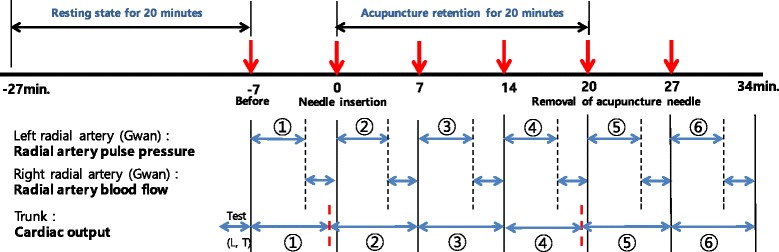
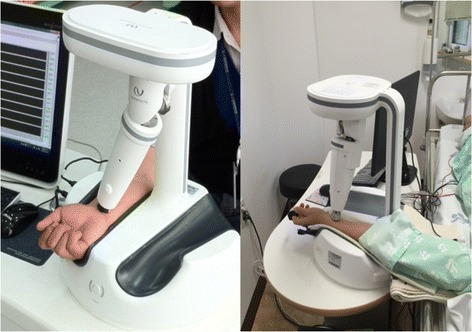
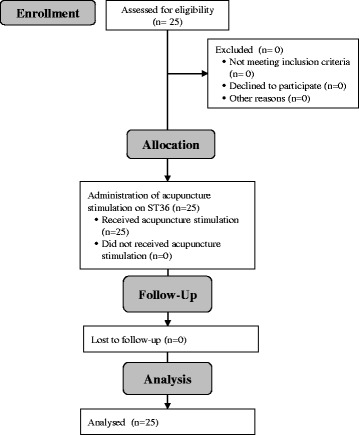
We conducted acupuncture stimulation at both ST36 acupuncture points in 25 healthy volunteers. We simultaneously assessed the RPPW by pulse tonometry; heart rate variability (HRV) by electrocardiogram; photoplethysmogram (PPG) signals, respiration rate, peripheral blood flow velocity and arterial depth by ultrasonography; and cardiac output by impedance cardiography, before, during and after a session of acupuncture stimulation.
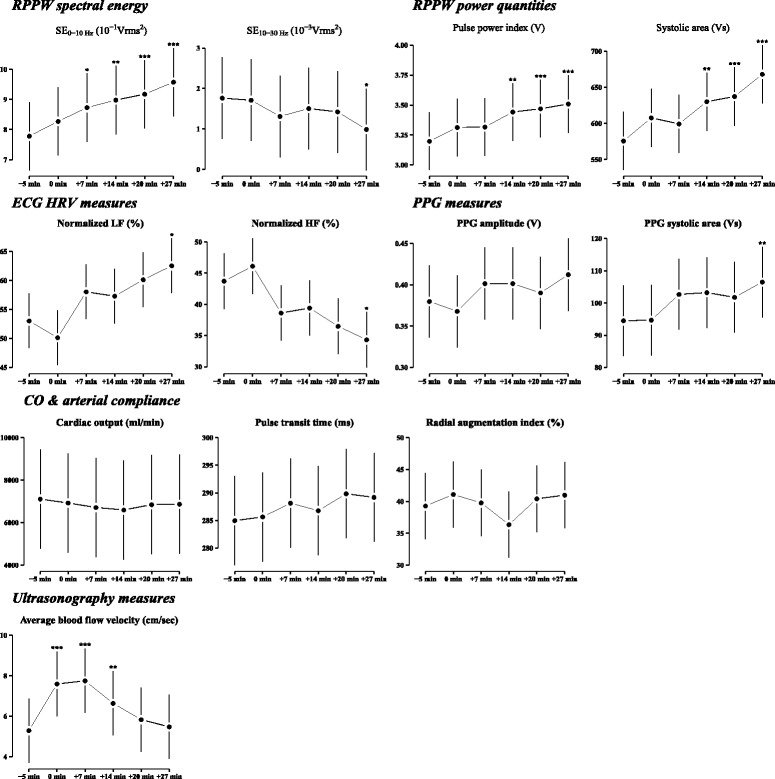
We observed consistent patterns of increased spectral energy at low frequency (<10 Hz) and pulse power using RPPW examination and in the amplitude and systolic area of the PPG signal during the entire acupuncture session. The low- and high-frequency domains of HRV increased and decreased, respectively, during the acupuncture session. The peripheral blood velocity rose shortly after needle insertion, reached a maximum in the middle of the session and decreased afterwards. The augmentation index (AIX) and pulse transit time (PTT) obtained from RPPW did not change significantly.
Acupuncture stimulation at ST36 in healthy subjects increased the peripheral pulse amplitudes (pressure pulse wave (PPW) and PPG), blood flow velocity (ultrasonography) and sympathetic nerve activity (HRV). The lack of changes in the AIX and PTT suggests that the increased pulse amplitudes and blood flow velocity may result from increased cardiac output.
Clinical Research Information Service ( KCT0001663 ).
桡动脉压力脉搏波(RPPW)检查一直是中医诊断的关键组成部分。本研究的目的是调查针刺刺激后RPPW与各种血流动力学变量的变化,并检验脉诊作为现代诊断工具的有效性。
我们对25名健康志愿者的双侧足三里穴位进行针刺刺激。在针刺刺激前、期间和之后,我们同时通过脉搏张力测量法评估RPPW;通过心电图评估心率变异性(HRV);通过超声检查评估光电容积脉搏波(PPG)信号、呼吸频率、外周血流速度和动脉深度;并通过阻抗心动图评估心输出量。
在整个针刺过程中,我们观察到使用RPPW检查以及PPG信号的幅度和收缩面积时,低频(<10Hz)频谱能量和脉搏功率一致增加。针刺过程中,HRV的低频和高频域分别增加和减少。针刺入后不久外周血流速度上升,在针刺过程中间达到最大值,随后下降。从RPPW获得的增强指数(AIX)和脉搏传输时间(PTT)没有显著变化。
对健康受试者足三里穴位进行针刺刺激可增加外周脉搏幅度(压力脉搏波(PPW)和PPG)、血流速度(超声检查)和交感神经活动(HRV)。AIX和PTT缺乏变化表明脉搏幅度和血流速度增加可能是心输出量增加所致。
临床研究信息服务(KCT0001663)。