School of Life and Environmental Sciences, Faculty of Science, University of Sydney, 2006, Australia
Sydney School of Veterinary Science, Faculty of Science, University of Sydney, 2006, Australia.
G3 (Bethesda). 2017 Jul 5;7(7):2327-2335. doi: 10.1534/g3.117.043109.
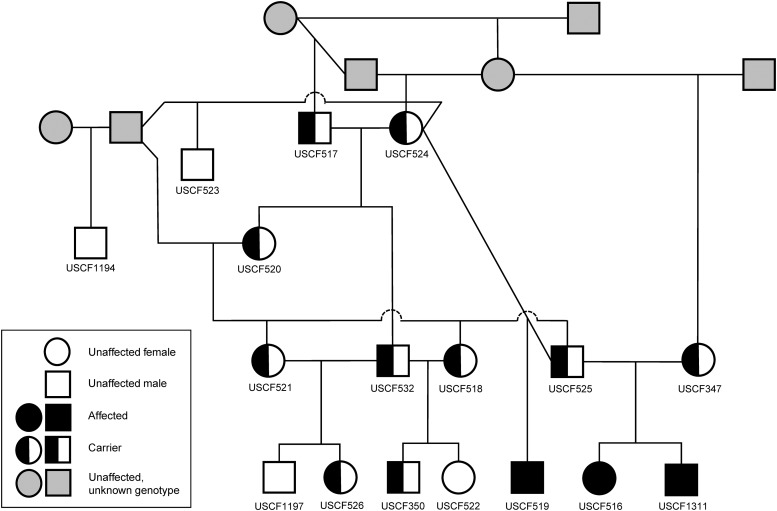
Progressive retinal atrophy is a common cause of blindness in the dog and affects >100 breeds. It is characterized by gradual vision loss that occurs due to the degeneration of photoreceptor cells in the retina. Similar to the human counterpart retinitis pigmentosa, the canine disorder is clinically and genetically heterogeneous and the underlying cause remains unknown for many cases. We use a positional candidate gene approach to identify putative variants in the Hungarian Puli breed using genotyping data of 14 family-based samples (CanineHD BeadChip array, Illumina) and whole-genome sequencing data of two proband and two parental samples (Illumina HiSeq 2000). A single nonsense SNP in exon 2 of (c.58A > T, p.Lys20*) was identified following filtering of high quality variants. This allele is highly associated ( = 3.425, = 103) and segregates perfectly with progressive retinal atrophy in the Hungarian Puli. In humans, is known to cause Bardet-Biedl syndrome which includes a retinitis pigmentosa phenotype. From the observed coding change we expect that no functional BBS4 can be produced in the affected dogs. We identified canine phenotypes comparable with -null mice including obesity and spermatozoa flagella defects. Knockout mice fail to form spermatozoa flagella. In the affected Hungarian Puli spermatozoa flagella are present, however a large proportion of sperm are morphologically abnormal and <5% are motile. This suggests that BBS4 contributes to flagella motility but not formation in the dog. Our results suggest a promising opportunity for studying Bardet-Biedl syndrome in a large animal model.
进行性视网膜萎缩是犬类致盲的常见原因,影响超过 100 个品种。它的特征是由于视网膜感光细胞的退化而导致的视力逐渐丧失。与人类的色素性视网膜炎相似,犬类疾病在临床上和遗传上具有异质性,许多病例的根本原因仍然未知。我们使用定位候选基因方法,使用 14 个基于家族的样本(CanineHD BeadChip 阵列,Illumina)的基因分型数据和两个先证者和两个亲本样本的全基因组测序数据(Illumina HiSeq 2000),在匈牙利牧羊犬品种中鉴定出潜在的变异。在经过高质量变异过滤后,在 2 号外显子中发现了一个单一的无义 SNP (c.58A > T, p.Lys20*)。该等位基因与匈牙利牧羊犬的进行性视网膜萎缩高度相关 (= 3.425, = 103),并完美分离。在人类中, 已知会导致 Bardet-Biedl 综合征,其中包括色素性视网膜炎表型。从观察到的编码变化来看,我们预计受影响的犬体内不能产生功能性 BBS4。我们鉴定出与 -null 小鼠具有可比性的犬类表型,包括肥胖和精子鞭毛缺陷。BBS4 敲除小鼠无法形成精子鞭毛。在受影响的匈牙利牧羊犬中,精子鞭毛存在,但很大比例的精子形态异常,<5%的精子具有运动能力。这表明 BBS4 有助于鞭毛的运动,但对犬类鞭毛的形成没有作用。我们的研究结果表明,在大型动物模型中研究 Bardet-Biedl 综合征具有很大的潜力。