Manning Benjamin J, Yusufzai Timur
Department of Radiation Oncology, Dana-Farber Cancer Institute and Department of Biological Chemistry and Molecular Pharmacology, Harvard Medical School, Boston, Massachusetts 02215.
Department of Radiation Oncology, Dana-Farber Cancer Institute and Department of Biological Chemistry and Molecular Pharmacology, Harvard Medical School, Boston, Massachusetts 02215.
J Biol Chem. 2017 Jul 14;292(28):11927-11936. doi: 10.1074/jbc.M117.779470. Epub 2017 May 21.
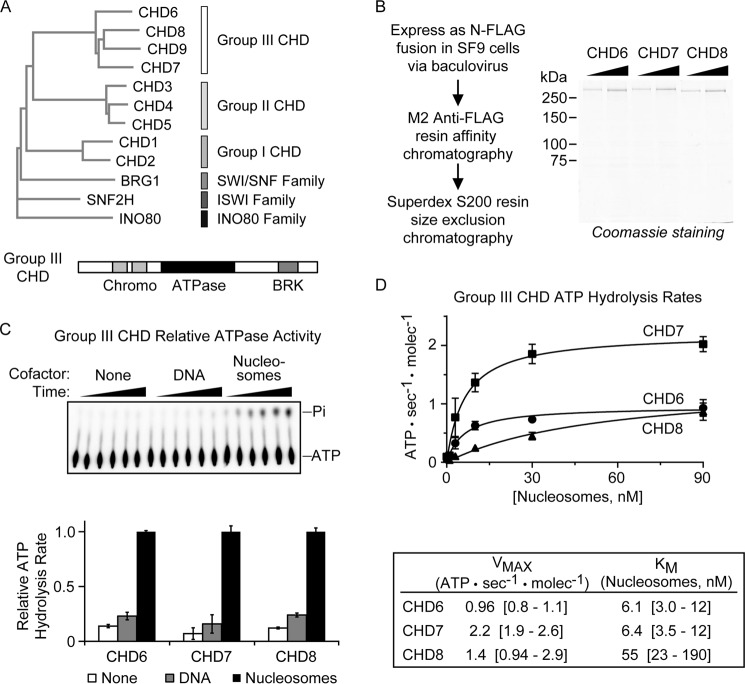
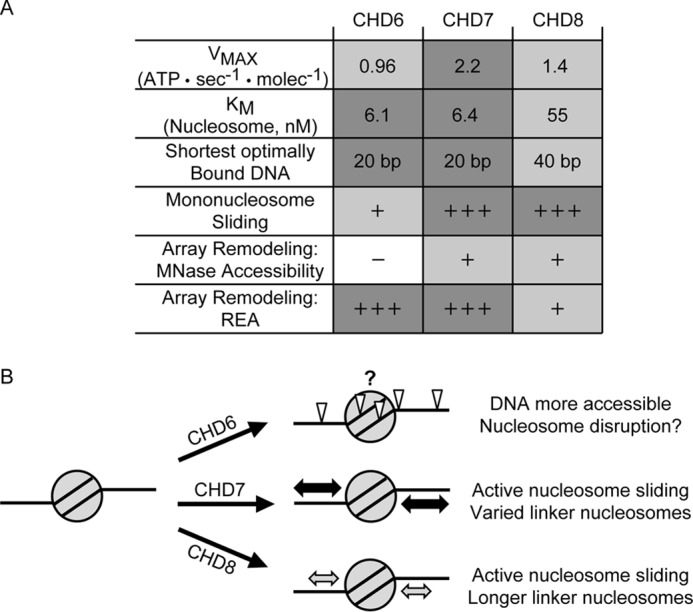
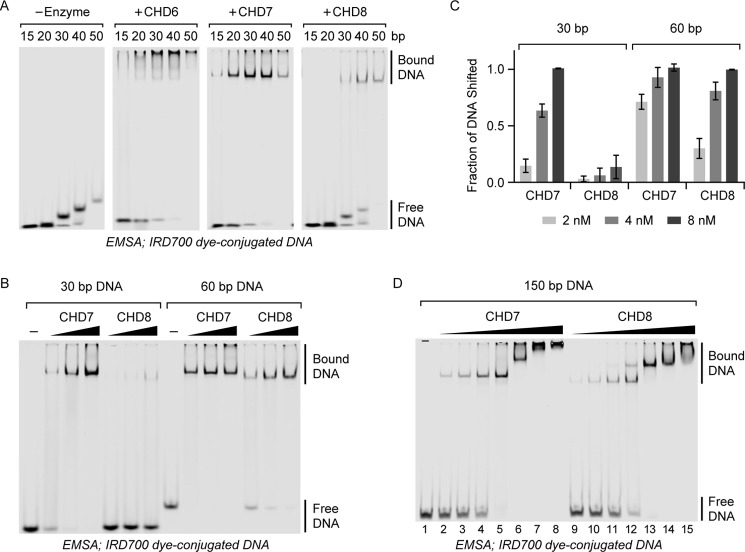
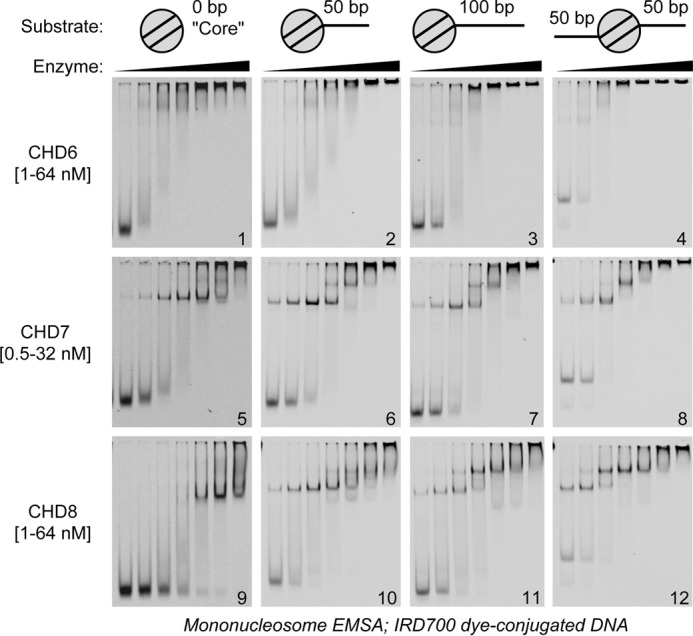
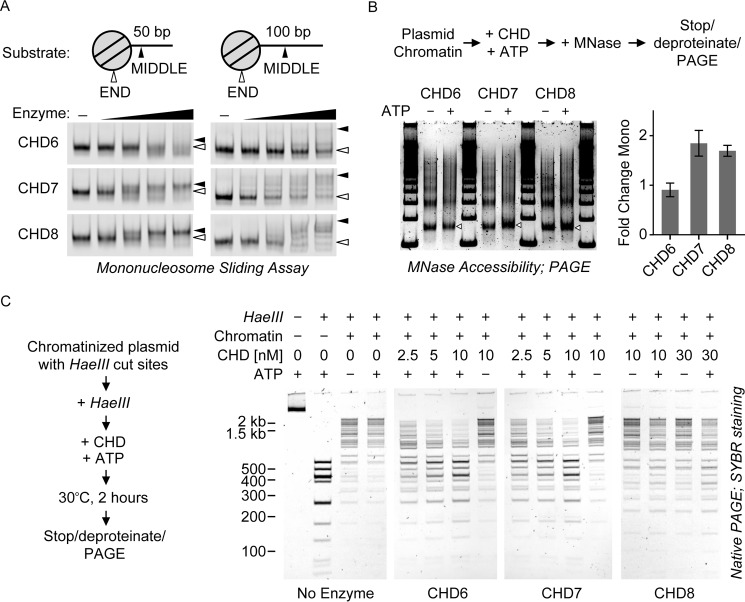
Proper chromatin regulation is central to genome function and maintenance. The group III chromodomain-helicase-DNA-binding (CHD) family of ATP-dependent chromatin remodeling enzymes, comprising CHD6, CHD7, CHD8, and CHD9, has well-documented roles in transcription regulation, impacting both organism development and disease etiology. These four enzymes are similar in their constituent domains, but they fill surprisingly non-redundant roles in the cell, with deficiencies in individual enzymes leading to dissimilar disease states such as CHARGE syndrome or autism spectrum disorders. The mechanisms explaining their divergent, non-overlapping functions are unclear. In this study, we performed an in-depth biochemical analysis of purified CHD6, CHD7, and CHD8 and discovered distinct differences in chromatin remodeling specificities and activities among them. We report that CHD6 and CHD7 both bind with high affinity to short linker DNA, whereas CHD8 requires longer DNA for binding. As a result, CHD8 slides nucleosomes into positions with more flanking linker DNA than CHD7. Moreover, we found that, although CHD7 and CHD8 slide nucleosomes, CHD6 disrupts nucleosomes in a distinct non-sliding manner. The different activities of these enzymes likely lead to differences in chromatin structure and, thereby, transcriptional control, at the enhancer and promoter loci where these enzymes bind. Overall, our work provides a mechanistic basis for both the non-redundant roles and the diverse mutant disease states of these enzymes .
适当的染色质调控对于基因组功能和维持至关重要。III类染色质结构域-解旋酶-DNA结合(CHD)家族的ATP依赖性染色质重塑酶,包括CHD6、CHD7、CHD8和CHD9,在转录调控中具有充分记录的作用,影响生物体发育和疾病病因。这四种酶在其组成结构域上相似,但它们在细胞中发挥着惊人的非冗余作用,单个酶的缺陷会导致不同的疾病状态,如CHARGE综合征或自闭症谱系障碍。解释它们不同的、不重叠功能的机制尚不清楚。在这项研究中,我们对纯化的CHD6、CHD7和CHD8进行了深入的生化分析,发现它们在染色质重塑特异性和活性方面存在明显差异。我们报告说,CHD6和CHD7都以高亲和力结合短连接子DNA,而CHD8需要更长的DNA进行结合。因此,与CHD7相比,CHD8将核小体滑动到侧翼连接子DNA更多的位置。此外,我们发现,虽然CHD7和CHD8滑动核小体,但CHD6以一种独特的非滑动方式破坏核小体。这些酶的不同活性可能导致染色质结构的差异,从而在这些酶结合的增强子和启动子位点进行转录控制。总体而言,我们的工作为这些酶的非冗余作用和多样的突变疾病状态提供了一个机制基础。