Qin Chao-Chao, Liu Yan-Ning, Hu Ying, Yang Ying, Chen Zhi
Chao-Chao Qin, Yan-Ning Liu, Ying Hu, Ying Yang, Zhi Chen, State Key Laboratory for Diagnosis and Treatment of Infectious Diseases, The First Affiliated Hospital, Zhejiang University School of Medicine, Hangzhou 310003, Zhejiang Province, China.
World J Gastroenterol. 2017 May 7;23(17):3043-3052. doi: 10.3748/wjg.v23.i17.3043.
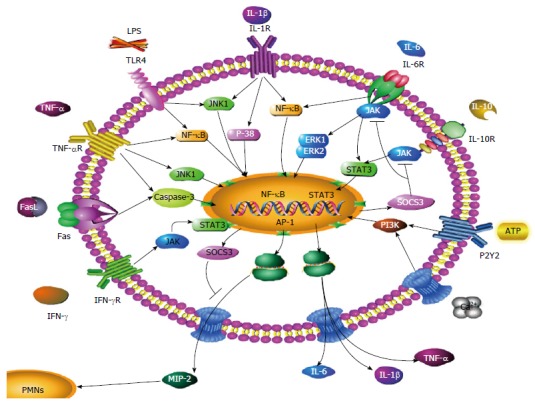
Macrophage inflammatory protein (MIP)-2 is one of the CXC chemokines and is also known as chemokine CXC ligand (CXCL2). MIP-2 affects neutrophil recruitment and activation through the p38 mitogen-activated-protein-kinase-dependent signaling pathway, by binding to its specific receptors, CXCR1 and CXCR2. MIP-2 is produced by a variety of cell types, such as macrophages, monocytes, epithelial cells, and hepatocytes, in response to infection or injury. In liver injury, activated Kupffer cells are known as the major source of MIP-2. MIP-2-recruited and activated neutrophils can accelerate liver inflammation by releasing various inflammatory mediators. Here, we give a brief introduction to the basic molecular and cellular sources of MIP-2, and focus on its physiological and pathological functions in acute liver injury induced by concanavalin A, lipopolysaccharides, irradiation, ischemia/reperfusion, alcohol, and hypoxia, and hepatectomy-induced liver regeneration and tumor colorectal metastasis. Further understanding of the regulatory mechanisms of MIP-2 secretion and activation may be helpful to develop MIP-2-targeted therapeutic strategies to prevent liver inflammation.
巨噬细胞炎性蛋白(MIP)-2是CXC趋化因子之一,也被称为趋化因子CXC配体(CXCL2)。MIP-2通过与其特异性受体CXCR1和CXCR2结合,经由p38丝裂原活化蛋白激酶依赖性信号通路影响中性粒细胞的募集和活化。MIP-2由多种细胞类型产生,如巨噬细胞、单核细胞、上皮细胞和肝细胞,以响应感染或损伤。在肝损伤中,活化的库普弗细胞是MIP-2的主要来源。MIP-2募集并活化的中性粒细胞可通过释放各种炎性介质加速肝脏炎症。在此,我们简要介绍MIP-2的基本分子和细胞来源,并重点阐述其在刀豆蛋白A、脂多糖、辐射、缺血/再灌注、酒精和缺氧诱导的急性肝损伤以及肝切除诱导的肝再生和肿瘤结直肠癌转移中的生理和病理功能。进一步了解MIP-2分泌和活化的调控机制可能有助于开发以MIP-2为靶点的治疗策略来预防肝脏炎症。