Nasir Aejaz, Holzer Timothy R, Chen Mia, Man Michael Z, Schade Andrew E
Diagnostic and Experimental Pathology, Eli Lilly and Company, Indianapolis, IN USA.
Eli Lilly and Company, Lilly Corporate Center, DC0424, Indianapolis, IN 46285 USA.
Cancer Cell Int. 2017 May 19;17:56. doi: 10.1186/s12935-017-0427-5. eCollection 2017.
Clinically relevant predictive biomarkers to tailor anti-angiogenic therapies to breast cancer (BRC) patient subpopulations are an unmet need.
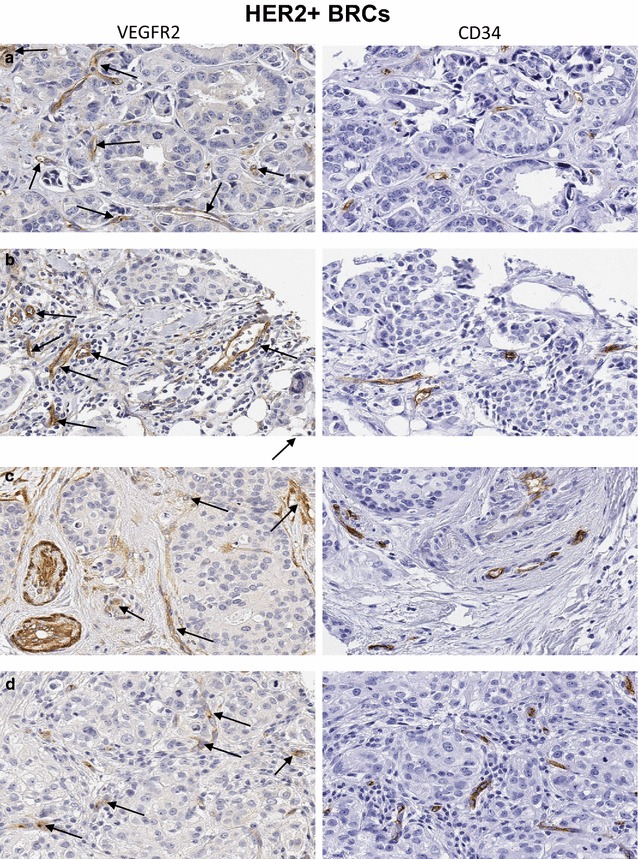
We analyzed tumor vascular density and VEGFR2 protein expression in various subsets of primary human BRCs (186 females; Mean age: 59 years; range 33-88 years), using a tissue microarray. Discrete VEGFR2+ and CD34+ tumor vessels were manually scored in invasive ductal, lobular, mixed ductal-lobular and colloid (N = 139, 22, 18, 7) BRC cores.
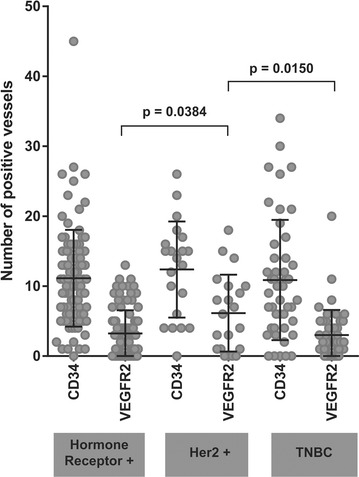
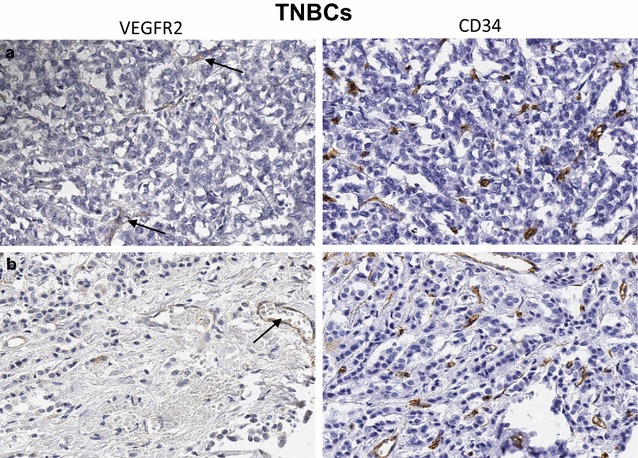
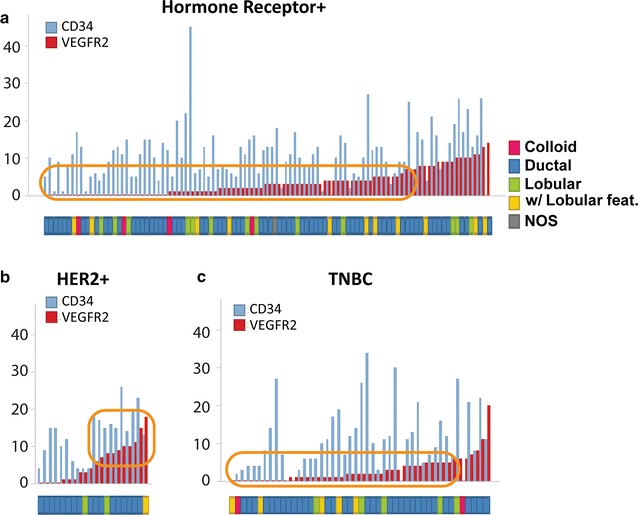
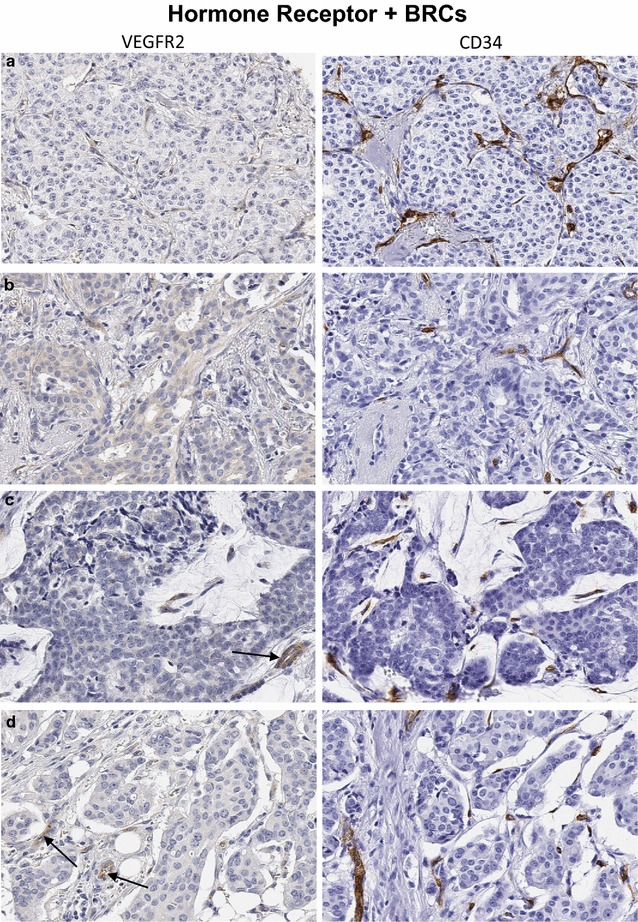
The observed CD34+ and VEGFR2+ tumor vascular counts in individual cases were heterogeneous. Mean CD34+ and VEGFR2+ tumor vessel counts were 11 and 3.4 per tumor TMA core respectively. Eighty-nine of 186 (48%) cases had >10 CD34+ tumor vessels, while 97/186 (52%) had fewer CD34+ vessels in each TMA core. Of 169 analyzable cores in the VEGFR2 stained TMA, 90 (53%) showed 1-5 VEGFR2+ tumor vessels/TMA core, while 42/169 (25%) cores had no detectable VEGFR2+ tumor vessels. Thirteen of 169 (8%) cases also showed tumor cell (cytoplasmic/membrane) expression of VEGFR2. Triple-negative breast cancers (TNBCs) appeared to be less vascular (Mean VD = 9.8, range 0-34) than other breast cancer subtypes. Overall, VEGFR2+ tumor vessel counts were significantly higher in HER2+ as compared to HR+ (p = 0.04) and TNBC (p = 0.02) tissues. Compared to HER2- cases, HER2+ breast cancers had higher VEGFR2+ tumor vessel counts (p = 0.007).
Characterization of pathologic angiogenesis in HER2+ breast cancer provides scientific rationale for future investigation of clinical activity of agents targeting the VEGF/VEGFR2 axis in this clinically aggressive breast cancer subtype.
尚未找到可用于为乳腺癌(BRC)患者亚群量身定制抗血管生成疗法的具有临床相关性的预测生物标志物。
我们使用组织微阵列分析了原发性人类BRC不同亚组(186名女性;平均年龄:59岁;范围33 - 88岁)中的肿瘤血管密度和VEGFR2蛋白表达。在浸润性导管癌、小叶癌、导管 - 小叶混合癌和黏液癌(分别为N = 139、22、18、7)的BRC样本芯中,对离散的VEGFR2 +和CD34 +肿瘤血管进行手动计数。
在个别病例中观察到的CD34 +和VEGFR2 +肿瘤血管计数存在异质性。每个肿瘤组织微阵列样本芯中CD34 +和VEGFR2 +肿瘤血管的平均计数分别为11和3.4。186例中有89例(48%)每个样本芯的CD34 +肿瘤血管>10条,而186例中有97例(52%)每个样本芯的CD34 +血管较少。在VEGFR2染色的组织微阵列中,169个可分析样本芯中,90个(53%)每个样本芯显示1 - 5条VEGFR2 +肿瘤血管,而169个样本芯中有42个(25%)未检测到VEGFR2 +肿瘤血管。169例中有13例(8%)还显示肿瘤细胞(细胞质/细胞膜)表达VEGFR2。三阴性乳腺癌(TNBC)的血管似乎比其他乳腺癌亚型少(平均血管密度 = 9.8,范围0 - 34)。总体而言,与HR +(p = 0.04)和TNBC(p = 0.02)组织相比,HER2 +组织中的VEGFR2 +肿瘤血管计数显著更高。与HER2 -病例相比,HER2 +乳腺癌的VEGFR2 +肿瘤血管计数更高(p = 0.007)。
HER2 +乳腺癌中病理性血管生成的特征为未来研究针对VEGF/VEGFR2轴的药物在这种临床侵袭性乳腺癌亚型中的临床活性提供了科学依据。