Martins Eduardo F, Lemos Thiago, Saunier Ghislain, Pozzo Thierry, Fraiman Daniel, Vargas Claudia D
Laboratório de Neurobiologia II, Instituto de Biofísica Carlos Chagas Filho, Universidade Federal do Rio de JaneiroRio de Janeiro, Brasil.
Programa de Pós-Graduação em Ciências da Reabilitação, Centro Universitário Augusto Motta-Centro Universitário Augusto Motta (UNISUAM)Rio de Janeiro, Brasil.
Front Hum Neurosci. 2017 May 8;11:217. doi: 10.3389/fnhum.2017.00217. eCollection 2017.
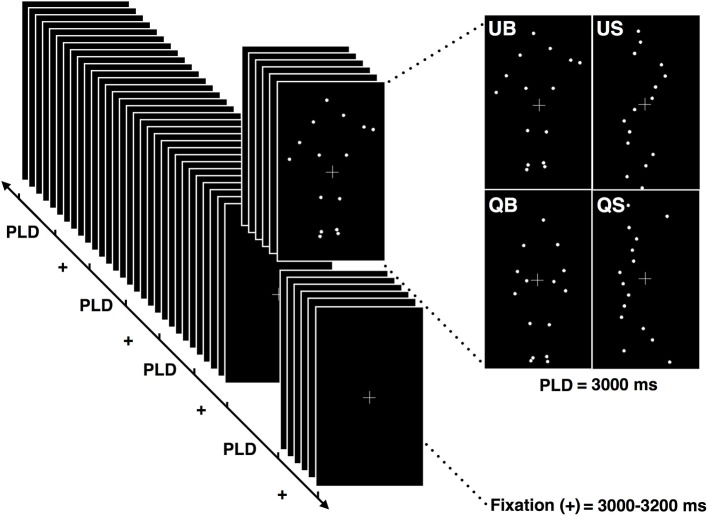
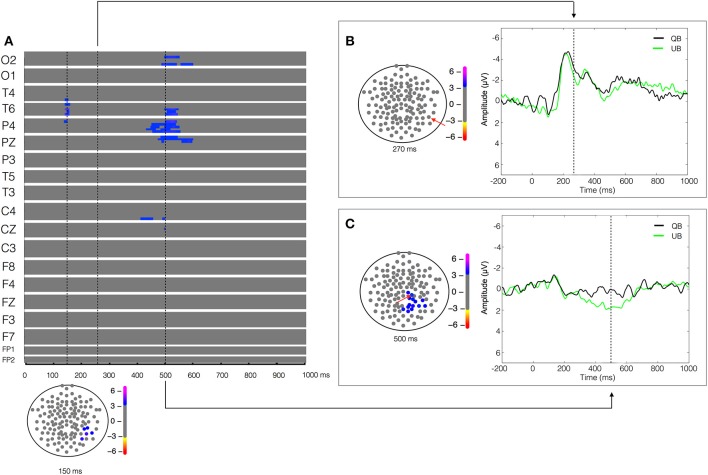
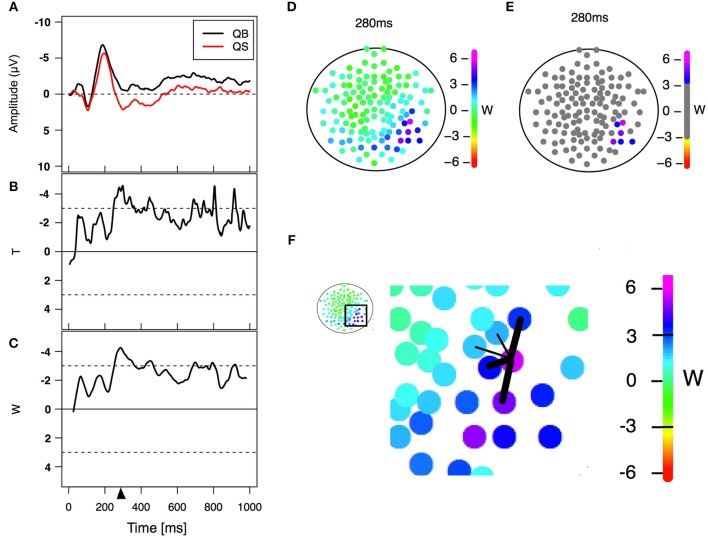
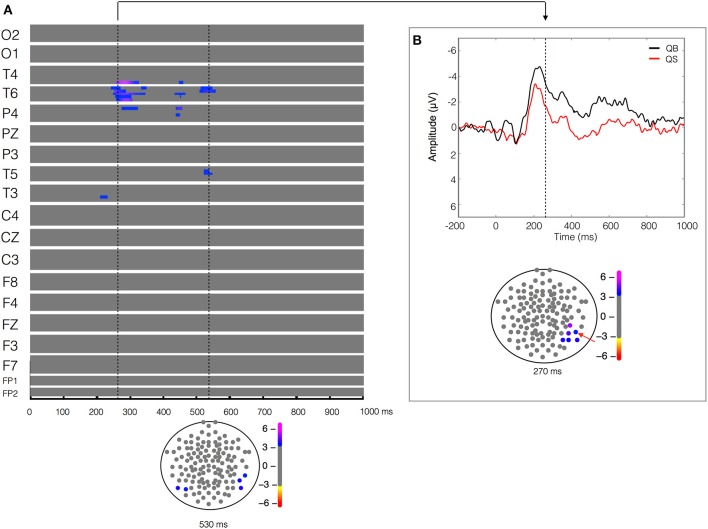
As highly social creatures, human beings rely part of their skills of identifying, interpreting, and predicting the actions of others on the ability of perceiving biological motion. In the present study, we aim to investigate the electroencephalographic (EEG) cerebral dynamics involved in the coding of postural control and examine whether upright stance would be codified through the activation of the temporal-parietal cortical network classically enrolled in the coding of biological motion. We registered the EEG activity of 12 volunteers while they passively watched point light displays (PLD) depicting quiet stable (QB) and an unstable (UB) postural situations and their respective scrambled controls (QS and US). In a pretest, 13 volunteers evaluated the level of stability of our two biological stimuli through a stability scale. Contrasting QB vs. QS revealed a typical ERP difference in the right temporal-parietal region at an early 200-300 ms time window. Furthermore, when contrasting the two biological postural conditions, UB vs. QB, we found a higher positivity in the 400-600 ms time window for the UB condition in central-parietal electrodes, lateralized to the right hemisphere. These results suggest that PLDs depicting postural adjustments are coded in the brain as biological motion, and that their viewing recruit similar networks with those engaged in postural stability control. Additionally, higher order cognitive processes appear to be engaged in the identification of the postural instability level. Disentangling the EEG dynamics during the observation of postural adjustments could be very useful for further understanding the neural mechanisms underlying postural control.
作为高度社会化的生物,人类部分依赖于感知生物运动的能力来识别、解读和预测他人的行为。在本研究中,我们旨在探究参与姿势控制编码的脑电图(EEG)脑动力学,并检验直立姿势是否会通过经典地参与生物运动编码的颞顶叶皮质网络的激活来进行编码。我们记录了12名志愿者在被动观看描绘安静稳定(QB)和不稳定(UB)姿势情况及其各自的加扰对照(QS和US)的点光显示(PLD)时的EEG活动。在一项预测试中,13名志愿者通过稳定性量表评估了我们两种生物刺激的稳定性水平。对比QB和QS发现在200 - 300毫秒早期时间窗口右侧颞顶叶区域存在典型的ERP差异。此外,当对比两种生物姿势条件,即UB与QB时,我们发现在400 - 600毫秒时间窗口中,UB条件在中央顶叶电极处有更高的正性,且偏向右侧半球。这些结果表明,描绘姿势调整的PLD在大脑中被编码为生物运动,并且观看它们会募集与参与姿势稳定性控制的网络相似的网络。此外,高阶认知过程似乎参与了姿势不稳定水平的识别。解析观察姿势调整过程中的EEG动力学对于进一步理解姿势控制的神经机制可能非常有用。