Damiani Mario Francesco, Falcone Vito Antonio, Carratù Pierluigi, Scoditti Cristina, Bega Elioda, Dragonieri Silvano, Scoditti Alfredo, Resta Onofrio
Department of Respiratory Diseases, San Camillo Clinic, Taranto, Italy.
Department of Respiratory Diseases, San Paolo Hospital, Bari, Italy.
Multidiscip Respir Med. 2017 May 18;12:14. doi: 10.1186/s40248-017-0093-4. eCollection 2017.
To date, an important aspect that has still not been clarified is the assessment of OHS severity. The purpose of this retrospective study was to evaluate whether grading OHS severity according to PaCO values may be useful in order to provide a more definite characterization and targeted management of patients. In this regard, baseline anthropometric and sleep polygraphic characteristics, treatment options, and follow up outcomes, were compared between OHS patients with different degree of severity (as assessed according to PaCO values).
Patients were classified into three groups, according to PaCO values: 1) mild (46 mmHg ≤ PaCO ≤ 50 mmHg), moderate (51 mmHg ≤ PaCO ≤ 55 mmHg), severe (PaCO ≥ 56 mmHg). Therefore, differences among the groups in terms of baseline anthropometric, and sleep polygraphic characteristics, treatment modalities and follow up outcomes were retrospectively evaluated.
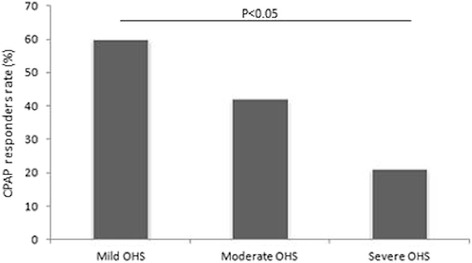
Patients with more severe degree of hypercapnia were assessed to have increased BMI and bicarbonate levels, worse diurnal and nocturnal hypoxemia, and a more severe impairment in pulmonary mechanics compared to milder OHS. CPAP responders rate significantly decreased from mild to severe OHS. After follow up, daytime sleepiness (as measure by the ESS), PaO, and PaCO significantly improved with PAP therapy in all three groups.
Classification of OHS severity according to PaCO levels may be useful to provide a more defined characterization and, consequently, a more targeted management of OHS patients. Further studies are needed to confirm our findings.
迄今为止,仍未阐明的一个重要方面是阻塞性睡眠呼吸暂停(OHS)严重程度的评估。这项回顾性研究的目的是评估根据动脉血二氧化碳分压(PaCO)值对OHS严重程度进行分级是否有助于更明确地描述患者特征并进行针对性管理。在这方面,对不同严重程度(根据PaCO值评估)的OHS患者的基线人体测量学和睡眠多导监测特征、治疗选择及随访结果进行了比较。
根据PaCO值将患者分为三组:1)轻度(46mmHg≤PaCO≤50mmHg)、中度(51mmHg≤PaCO≤55mmHg)、重度(PaCO≥56mmHg)。因此,对三组患者在基线人体测量学、睡眠多导监测特征、治疗方式及随访结果方面的差异进行了回顾性评估。
与轻度OHS相比,高碳酸血症程度更严重的患者被评估为体重指数(BMI)和碳酸氢盐水平升高、日间和夜间低氧血症更严重、肺力学损害更严重。持续气道正压通气(CPAP)反应率从轻度OHS到重度OHS显著降低。随访后,所有三组患者经气道正压通气(PAP)治疗后,日间嗜睡(用Epworth嗜睡量表(ESS)测量)、动脉血氧分压(PaO)和PaCO均有显著改善。
根据PaCO水平对OHS严重程度进行分类可能有助于更明确地描述患者特征,从而对OHS患者进行更有针对性的管理。需要进一步研究来证实我们的发现。