Liu Chaoling, Chen Mao-Sheng, Yu Hui
Respiratory Department, Guangdong Provincial Hospital of Chinese Medicine & the 2nd Clinical College of Guangzhou University of Chinese Medicine, Guangzhou, 510120, China.
Division of Chest Pain Center, Guangdong Provincial Hospital of Chinese Medicine & the 2nd Clinical College of Guangzhou University of Chinese Medicine, Guangzhou, 510120, China.
Oncotarget. 2017 Oct 3;8(54):93168-93178. doi: 10.18632/oncotarget.21450. eCollection 2017 Nov 3.
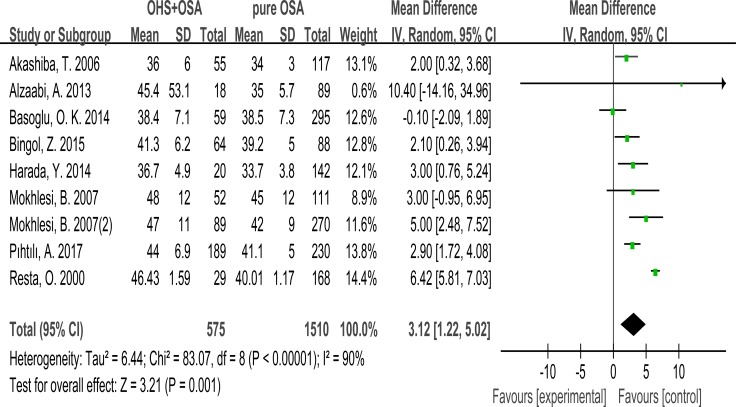
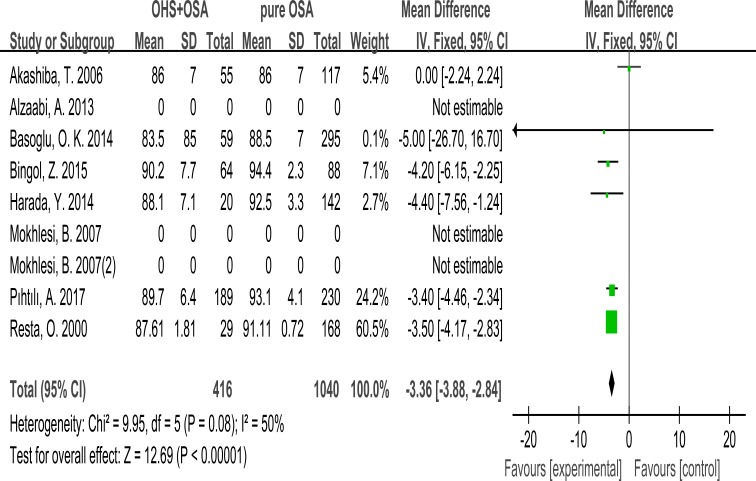
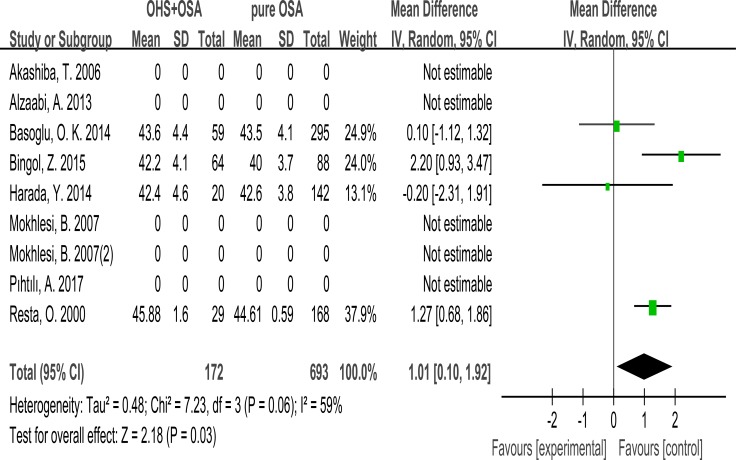
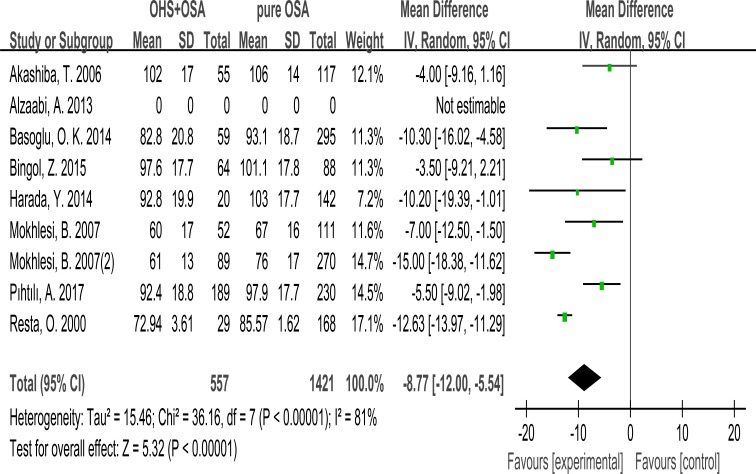
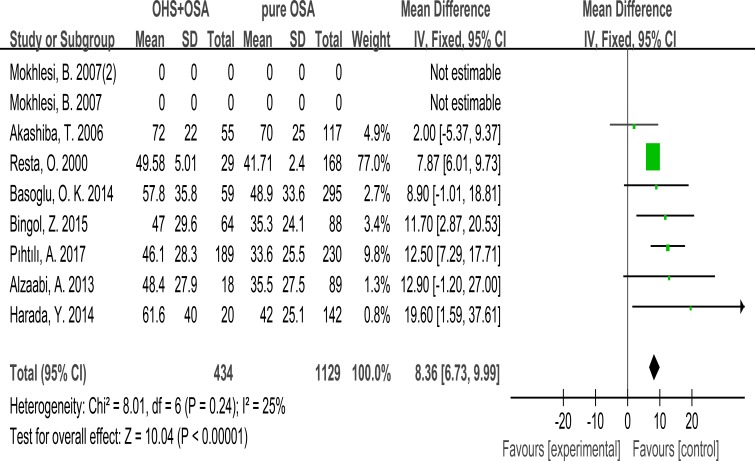
Obstructive Sleep Apnea and Obesity Hypoventilation Syndrome are two similar diseases. Obstructive Sleep Apnea has been receiving more and more attention while the diagnostic rate of Obesity Hypoventilation Syndrome is not high. Few studies directly evaluated the relationship between them. We systematically analyzed the relevance of the two diseases. MEDLINE, EMBASE and the Cochrane Library were carried out to find studies until May 2017. Pooled mean difference and 95% confidence interval were calculated to evaluate the value of clinical and physiologic variables in the prediction of Obesity Hypoventilation Syndrome. 9 Studies ( = 2085) fulfilled the predefined selection criteria. Totally 575 patients (28%) with Obesity Hypoventilation Syndrome were diagnosed from 2085 Obstructive Sleep Apnea patients. Among clearly diagnosed Obstructive Sleep Apnea patients, higher Body Mass Index levels(mean difference:4.72 kg/m; 95% confidence interval: 4.26 to 5.17; < 0.00001), higher Apnea-Hypopnea Index (mean difference: 8.36; 95% confidence interval: 3.88 to -2.84; < 0.00001), greater neck circumference (mean difference:1.01; 95% confidence interval: 0.10 to 1.92; = 0.03) and lower percent predicted FEV1 (mean difference:-10.28; 95% confidence interval:-11.33 to -9.22; < 0.00001)were associated with the occurrence with obesity hypoventilation syndrome. We should be highly skeptical of obesity hypoventilation syndrome in Obstructive Sleep Apnea patients with these factors as early identification and appropriate treatment can improve prognosis.
阻塞性睡眠呼吸暂停和肥胖低通气综合征是两种相似的疾病。阻塞性睡眠呼吸暂停已受到越来越多的关注,而肥胖低通气综合征的诊断率却不高。很少有研究直接评估它们之间的关系。我们系统地分析了这两种疾病的相关性。检索了MEDLINE、EMBASE和Cochrane图书馆,以查找截至2017年5月的研究。计算合并平均差和95%置信区间,以评估临床和生理变量在预测肥胖低通气综合征方面的价值。9项研究(n = 2085)符合预先设定的选择标准。在2085例阻塞性睡眠呼吸暂停患者中,共诊断出575例(28%)肥胖低通气综合征患者。在明确诊断的阻塞性睡眠呼吸暂停患者中,较高的体重指数水平(平均差:4.72 kg/m²;95%置信区间:4.26至5.17;P < 0.00001)、较高的呼吸暂停低通气指数(平均差:8.36;95%置信区间:3.88至12.84;P < 0.00001)、更大的颈围(平均差:1.01;95%置信区间:0.10至1.92;P = 0.03)和较低的预测第一秒用力呼气容积百分比(平均差:-10.28;95%置信区间:-11.33至-9.22;P < 0.00001)与肥胖低通气综合征的发生相关。对于具有这些因素的阻塞性睡眠呼吸暂停患者的肥胖低通气综合征,我们应高度怀疑,因为早期识别和适当治疗可改善预后。