Department of Surgery and Science, Graduate School of Medicine and Pharmaceutical Sciences, University of Toyama, Toyama city, Toyama 930-0194, Japan.
Department of Nanobio Drug Discovery, Graduate School of Pharmaceutical Sciences, Kyoto University, Sakyo-ku, Kyoto 606-8501, Japan.
Int J Oncol. 2017 Jul;51(1):49-62. doi: 10.3892/ijo.2017.4001. Epub 2017 May 16.
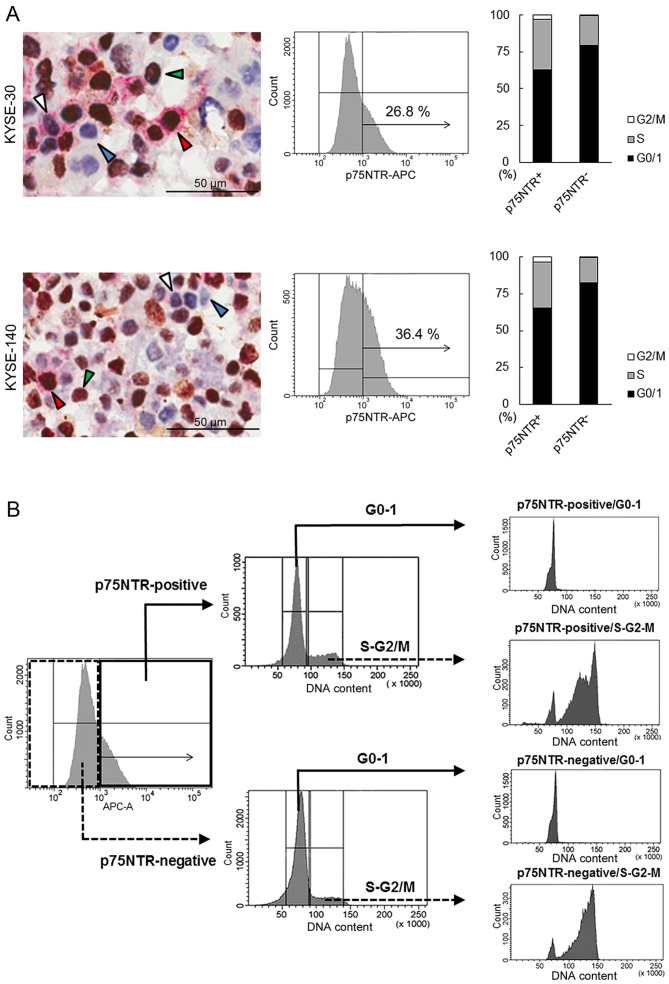
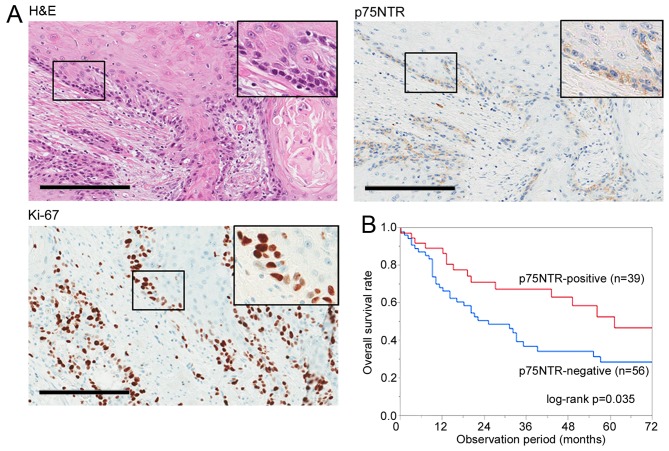
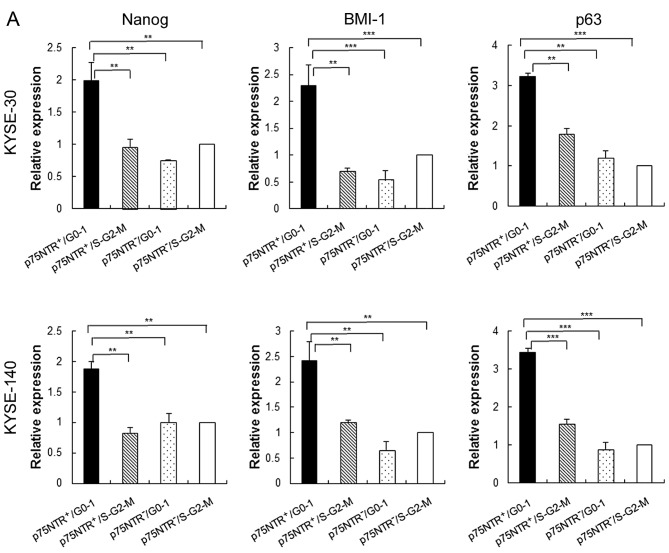
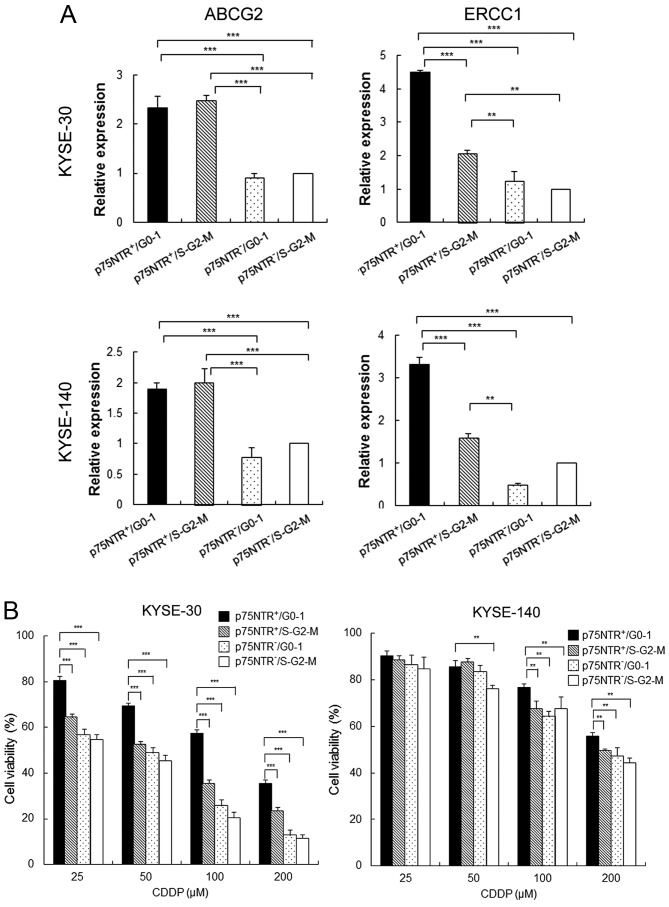
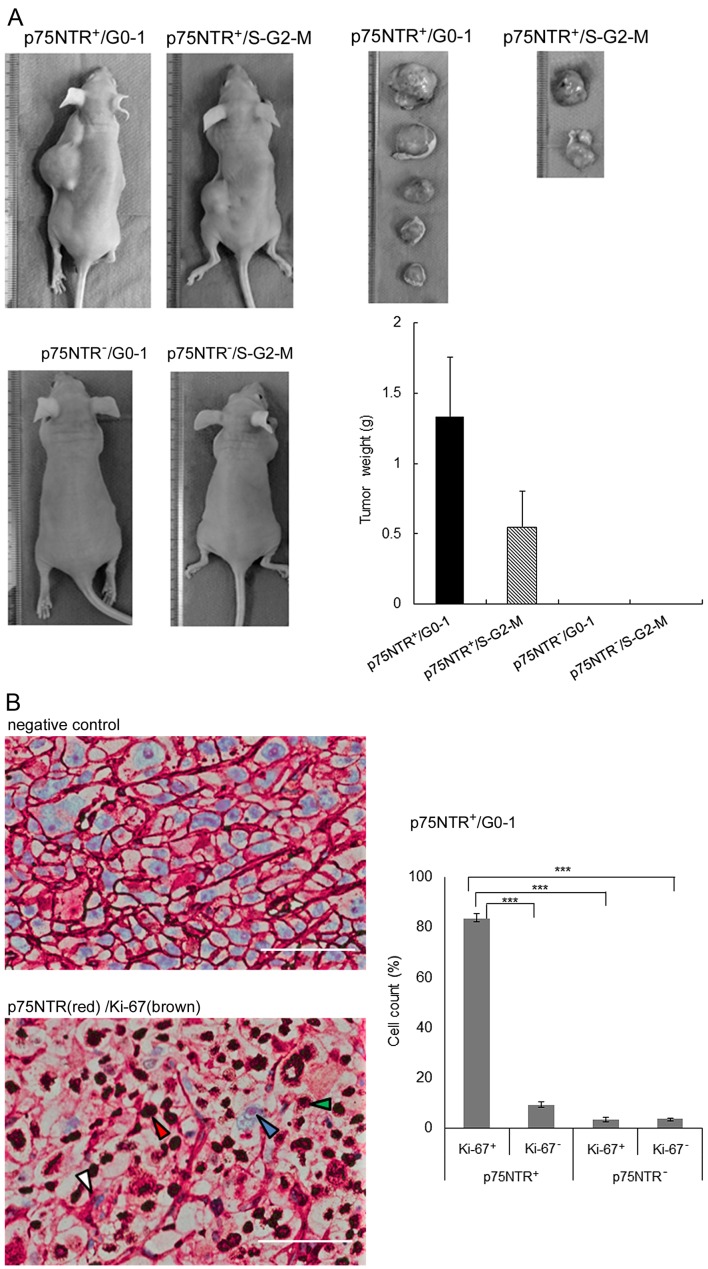
Mitotically quiescent cancer stem cells (CSCs) possess higher malignant potential than other CSCs, indicating their higher contribution to therapeutic resistance than that of other CSCs. In esophageal squamous cell carcinoma (ESCC), p75 neurotrophin receptor (p75NTR) is expressed in a candidate CSC population showing high tumorigenicity and chemoresistance. In the present study, we isolated and characterized quiescent CSCs population in ESCC based on p75NTR expression and cell cycle status. Expression of p75NTR and Ki-67 in ESCC cell lines (KYSE cells) and surgically resected ESCC specimens was detected by performing immunocytochemical analysis. p75NTR-positive KYSE cells were fractionated into quiescent and proliferating cells by performing flow cytometry with a fluorescent DNA-staining dye to determine their CSC phenotype. Immunocytochemical analysis showed that 21.8 and 36.5% of the p75NTR-positive cells were Ki-67-negative (G0), which accounted for 11.4 and 15.7% of cells in KYSE-30 and KYSE-140 cell lines, respectively. Flow cytometric cell sorting showed that p75NTR-positive cells in the G0-G1 phase (p75NTR-positive/G0-1 cells) but not in the S-G2-M phase (p75NTR-positive/S-G2-M cells) showed strong expression of stem cell-related genes Nanog, BMI-1, and p63; high colony formation ability; high tumorigenicity in a mouse xenograft model; and strong chemoresistance against cisplatin because of the expression of drug resistance genes ABCG2 and ERCC1. Label-retention assay showed that 3.4% p75NTR-positive cells retained fluorescent cell-tracing dye, but p75NTR-negative cells did not. Immunohistochemical analysis of ESCC specimens showed p75NTR expression in 39 of 95 (41.1%) patients, with a median of 13.2% (range, 3.0-80.1%) p75NTR-positive/Ki-67-negative cells, which were found to be associated with poorly differentiated histology. Our results suggest that p75NTR-positive/G0-1 cells represent quiescent CSCs in ESCC and indicate that these cells can be used as targets to investigate molecular processes regulating CSC phenotype and to develop novel therapeutic strategies.
有丝分裂静止的癌症干细胞(CSCs)比其他 CSCs 具有更高的恶性潜能,这表明它们对治疗的抵抗力比其他 CSCs 更高。在食管鳞状细胞癌(ESCC)中,p75 神经生长因子受体(p75NTR)在表现出高致瘤性和化疗耐药性的候选 CSC 群体中表达。在本研究中,我们基于 p75NTR 表达和细胞周期状态,分离并鉴定了 ESCC 中的静止 CSC 群体。通过免疫细胞化学分析检测 ESCC 细胞系(KYSE 细胞)和手术切除的 ESCC 标本中 p75NTR 和 Ki-67 的表达。通过使用荧光 DNA 染色染料进行流式细胞术将 p75NTR 阳性 KYSE 细胞分离为静止和增殖细胞,以确定其 CSC 表型。免疫细胞化学分析显示,21.8%和 36.5%的 p75NTR 阳性细胞为 Ki-67 阴性(G0),分别占 KYSE-30 和 KYSE-140 细胞系中细胞的 11.4%和 15.7%。流式细胞术细胞分选显示,p75NTR 阳性的 G0-G1 期(p75NTR 阳性/G0-1 细胞)而非 S-G2-M 期(p75NTR 阳性/S-G2-M 细胞)的细胞强烈表达干细胞相关基因 Nanog、BMI-1 和 p63;具有高集落形成能力;在小鼠异种移植模型中具有高致瘤性;并对顺铂具有较强的化疗耐药性,因为其表达耐药基因 ABCG2 和 ERCC1。标记保留实验表明,3.4%的 p75NTR 阳性细胞保留荧光细胞示踪染料,但 p75NTR 阴性细胞则没有。ESCC 标本的免疫组织化学分析显示,95 例患者中有 39 例(41.1%)表达 p75NTR,中位数为 13.2%(范围,3.0-80.1%)p75NTR 阳性/Ki-67 阴性细胞,与低分化组织学有关。我们的结果表明,p75NTR 阳性/G0-1 细胞代表 ESCC 中的静止 CSCs,并表明这些细胞可作为研究调节 CSC 表型的分子过程和开发新的治疗策略的靶点。