Corrigan Patrick W, Pickett Susan, Schmidt Annie, Stellon Edward, Hantke Erin, Kraus Dana, Dubke Rachel
Department of Psychology, Illinois Institute of Technology, Chicago, IL, USA.
Advocates in Human Potential, Chicago, IL, USA.
Psychiatry Res. 2017 Sep;255:101-103. doi: 10.1016/j.psychres.2017.05.020. Epub 2017 May 17.
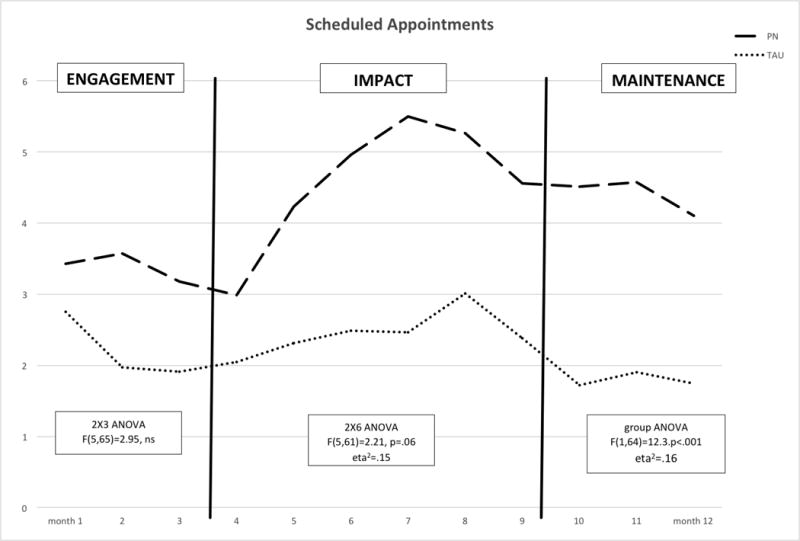
Homeless African Americans with serious mental illness experience higher rates of morbidity and mortality than adults with severe mental illness alone. Peer navigators, individuals with similar lived experiences, may help these individuals navigate the healthcare system to improve healthcare utilization. This study examined whether the Peer Navigator Program (PNP) improved scheduling and achieving healthcare appointments compared to treatment as usual (TAU) over the course of 12 months, including three periods within that timeframe: engagement (first three months), impact (middle six months), and maintenance (final six months). Results indicated no change during the first three months of the study, a significantly greater improvement in scheduled and achieved appointments for PNP compared to TAU during the middle six months, and maintenance of appointment change improvements over the final three months of the study. This research suggests peer navigators may offer a promising solution to barriers in utilizing the healthcare system for people with severe mental illness, especially those who may be homeless or from minority racial groups.
患有严重精神疾病的无家可归非裔美国人比仅患有严重精神疾病的成年人有更高的发病率和死亡率。同伴导航员,即有相似生活经历的人,可能会帮助这些人在医疗系统中顺利就医,以提高医疗服务利用率。本研究考察了在12个月的时间里,与常规治疗(TAU)相比,同伴导航员项目(PNP)在安排和实现医疗预约方面是否有所改善,这12个月包括三个时间段:参与期(前三个月)、影响期(中间六个月)和维持期(最后六个月)。结果表明,在研究的前三个月没有变化,在中间六个月,与常规治疗相比,同伴导航员项目在安排和实现预约方面有显著更大的改善,并且在研究的最后三个月保持了预约变化的改善。这项研究表明,同伴导航员可能为患有严重精神疾病的人,尤其是那些可能无家可归或属于少数种族群体的人,在利用医疗系统时遇到的障碍提供一个有前景的解决方案。