Pyper Evelyn, Harrington Daniel, Manson Heather
Public Health Ontario, 480 University Avenue, Suite 300, Toronto, ON, M5G 1V2, Canada.
School of Public Health and Health Systems, University of Waterloo, 200 University Avenue West, Waterloo, Toronto, ON, N2L 3G1, Canada.
BMC Public Health. 2017 May 24;17(1):432. doi: 10.1186/s12889-017-4334-4.
Sleep is an essential component of healthy cognitive and physical development. Lack of sleep may put children at risk for a variety of mental and physical health outcomes, including overweight, obesity and related chronic diseases. Given that children's sleep duration has decreased in recent decades, there is a need to understand the determinants of child sleep, including the role of parental support behaviours. This study aims to determine the relative contribution of different types of parental support behaviours for predicting the likelihood that children meet recently established Canadian sleep guidelines.
Data were collected using Computer Assisted Telephone Interviews (CATI) of parents or guardians with at least one child under the age of 18 living in Ontario, Canada. To align with sleep guidelines, parents included in this analysis had at least one child between 5 and 17 years of age (n = 1622). Two multivariable logistic regression models were built to predict whether or not parents reported their child was meeting sleep guidelines - one for weekday sleep and another for sleep on weekends. Independent variables included parent and child age and gender, motivational and regulatory parental support behaviours, and socio-demographic characteristics.
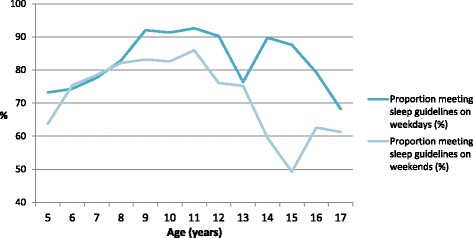
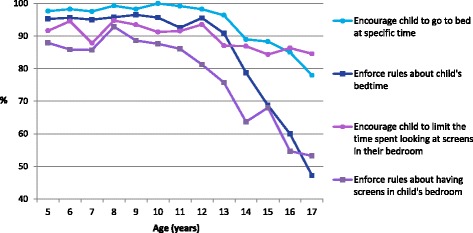
On weekdays, enforcing rules about child bedtime was a significant positive predictor of children meeting sleep guidelines (OR: 1.59; 95% CI: 1.03-2.44); while encouraging the child to go to bed at a specific time was a significant negative predictor of child meeting sleep guidelines (OR: 0.29; 95% CI: 0.13-0.65). On weekends, none of the parental support behaviours contributed significantly to the predictions of child sleep. For both weekdays and weekends, the child's age group was an important predictor of children meeting sleep guidelines.
The contribution of parental support behaviours to predictions of children meeting sleep guidelines varied with the type of support provided, and weekend versus weekday sleep. While only enforcing bedtime rules on weekdays contributed to children meeting sleep guidelines, the importance of children getting a good night's sleep, and the capacity of parents to help them do so, should be emphasized in public health efforts promoting healthy child development.
睡眠是健康认知和身体发育的重要组成部分。睡眠不足可能使儿童面临各种身心健康问题的风险,包括超重、肥胖及相关慢性病。鉴于近几十年来儿童的睡眠时间有所减少,有必要了解儿童睡眠的决定因素,包括父母支持行为的作用。本研究旨在确定不同类型的父母支持行为对预测儿童达到近期制定的加拿大睡眠指南的可能性的相对贡献。
通过计算机辅助电话访谈(CATI)收集居住在加拿大安大略省、家中至少有一名18岁以下儿童的父母或监护人的数据。为符合睡眠指南,纳入本分析的父母至少有一名5至17岁的儿童(n = 1622)。建立了两个多变量逻辑回归模型来预测父母是否报告其孩子符合睡眠指南,一个用于工作日睡眠,另一个用于周末睡眠。自变量包括父母和孩子的年龄及性别、父母的激励和监管支持行为以及社会人口学特征。
在工作日,执行关于孩子就寝时间的规定是孩子符合睡眠指南的显著正向预测因素(比值比:1.59;95%置信区间:1.03 - 2.44);而鼓励孩子在特定时间上床睡觉是孩子符合睡眠指南的显著负向预测因素(比值比:0.29;95%置信区间:0.13 - 0.65)。在周末,没有一种父母支持行为对预测孩子睡眠有显著贡献。对于工作日和周末而言,孩子的年龄组都是孩子符合睡眠指南的重要预测因素。
父母支持行为对预测孩子符合睡眠指南的贡献因所提供支持的类型以及周末与工作日睡眠的不同而有所差异。虽然只有在工作日执行就寝时间规定有助于孩子符合睡眠指南,但在促进儿童健康发育 的公共卫生工作中,应强调孩子获得良好夜间睡眠的重要性以及父母帮助他们做到这一点的能力。