Department of Therapeutic Recreation, Faculty of Child, Family, and Community Studies, Douglas College, 1250 Pinetree Way, Coquitlam, BC, V3B 7X3, Canada.
School of Health and Human Performance, Dalhousie University, PO Box 15000, Halifax, NS, B3H 4R2, Canada.
Int J Behav Nutr Phys Act. 2020 Jul 6;17(1):85. doi: 10.1186/s12966-020-00987-8.
Healthy childhood development is fostered through sufficient physical activity (PA; including time outdoors), limiting sedentary behaviours (SB), and adequate sleep; collectively known as movement behaviours. Though the COVID-19 virus outbreak has changed the daily lives of children and youth, it is unknown to what extent related restrictions may compromise the ability to play and meet movement behaviour recommendations. This secondary data analysis examined the immediate impacts of COVID-19 restrictions on movement and play behaviours in children and youth.
A national sample of Canadian parents (n = 1472) of children (5-11 years) or youth (12-17 years) (54% girls) completed an online survey that assessed immediate changes in child movement and play behaviours during the COVID-19 outbreak. Behaviours included PA and play, SB, and sleep. Family demographics and parental factors that may influence movement behaviours were assessed. Correlations between behaviours and demographic and parental factors were determined. For open-ended questions, word frequency distributions were reported.
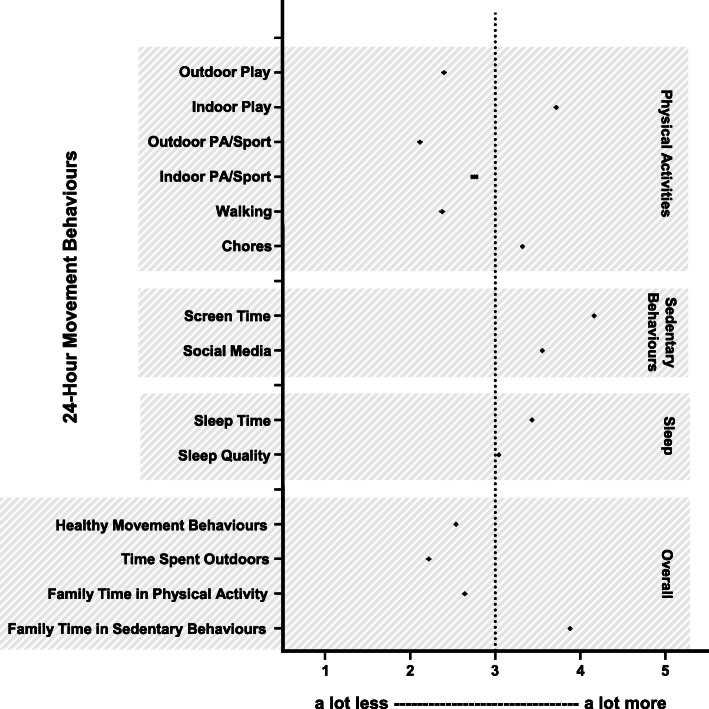
Only 4.8% (2.8% girls, 6.5% boys) of children and 0.6% (0.8% girls, 0.5% boys) of youth were meeting combined movement behaviour guidelines during COVID-19 restrictions. Children and youth had lower PA levels, less outside time, higher SB (including leisure screen time), and more sleep during the outbreak. Parental encouragement and support, parental engagement in PA, and family dog ownership were positively associated with healthy movement behaviours. Although families spent less time in PA and more time in SB, several parents reported adopting new hobbies or accessing new resources.
This study provides evidence of immediate collateral consequences of the COVID-19 outbreak, demonstrating an adverse impact on the movement and play behaviours of Canadian children and youth. These findings can guide efforts to preserve and promote child health during the COVID-19 outbreak and crisis recovery period, and to inform strategies to mitigate potential harm during future pandemics.
通过足够的身体活动(包括户外活动时间)、限制久坐行为和充足睡眠来促进健康的儿童发育;这些行为统称为运动行为。虽然 COVID-19 病毒的爆发改变了儿童和青少年的日常生活,但目前尚不清楚相关限制会在何种程度上影响他们玩耍和达到运动行为建议的能力。本二次数据分析了 COVID-19 限制对儿童和青少年运动和玩耍行为的直接影响。
加拿大的一项全国性父母样本(n=1472),其子女(5-11 岁)或青少年(12-17 岁)(54%为女孩)完成了一项在线调查,该调查评估了 COVID-19 爆发期间儿童运动和玩耍行为的即时变化。行为包括身体活动和玩耍、久坐行为和睡眠。评估了可能影响运动行为的家庭人口统计学和父母因素。确定了行为与人口统计学和父母因素之间的相关性。对于开放式问题,报告了单词频率分布。
只有 4.8%(2.8%女孩,6.5%男孩)的儿童和 0.6%(0.8%女孩,0.5%男孩)的青少年在 COVID-19 限制期间符合联合运动行为准则。儿童和青少年的身体活动水平较低、户外活动时间较少、久坐行为(包括休闲屏幕时间)较高、睡眠较多。父母的鼓励和支持、父母参与身体活动以及家庭养狗与健康的运动行为呈正相关。尽管家庭花在身体活动上的时间减少了,花在久坐行为上的时间增加了,但一些家长报告说他们采用了新的爱好或获得了新的资源。
本研究提供了 COVID-19 爆发的即时间接后果的证据,表明这对加拿大儿童和青少年的运动和玩耍行为产生了不利影响。这些发现可以指导在 COVID-19 爆发和危机恢复期内保护和促进儿童健康的努力,并为减轻未来大流行期间潜在危害的策略提供信息。