Lin Yu-Chen, Jeng King-Song, Lai Michael M C
Institute of Molecular Biology, Academia Sinica, Taipei, Taiwan.
National RNAi Core Facility, Academia Sinica, Taipei, Taiwan.
mBio. 2017 May 23;8(3):e00597-17. doi: 10.1128/mBio.00597-17.
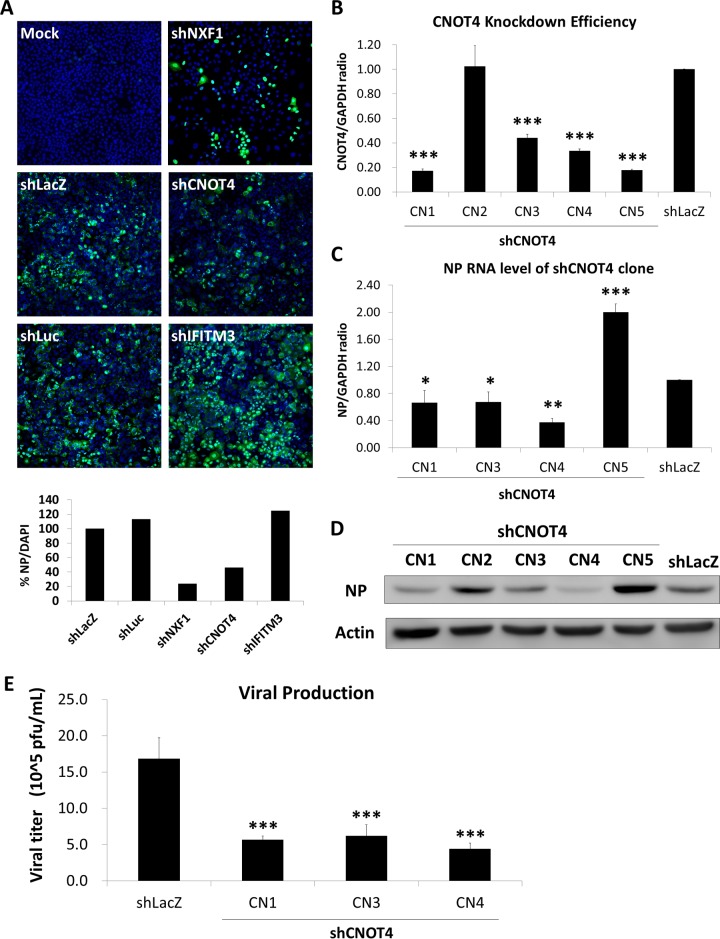
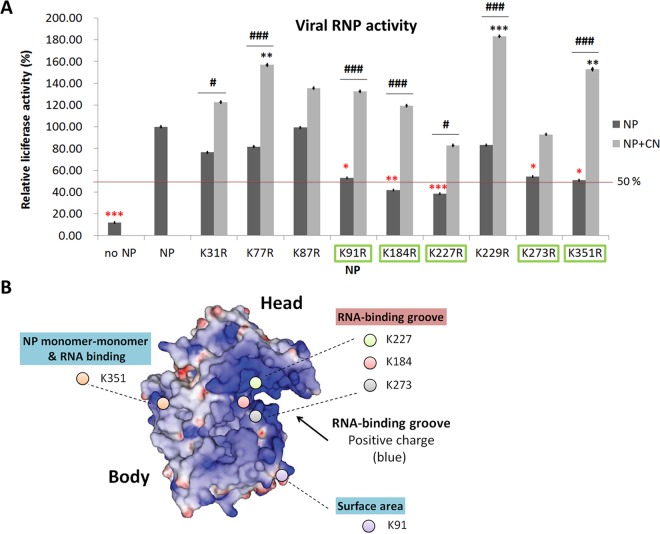
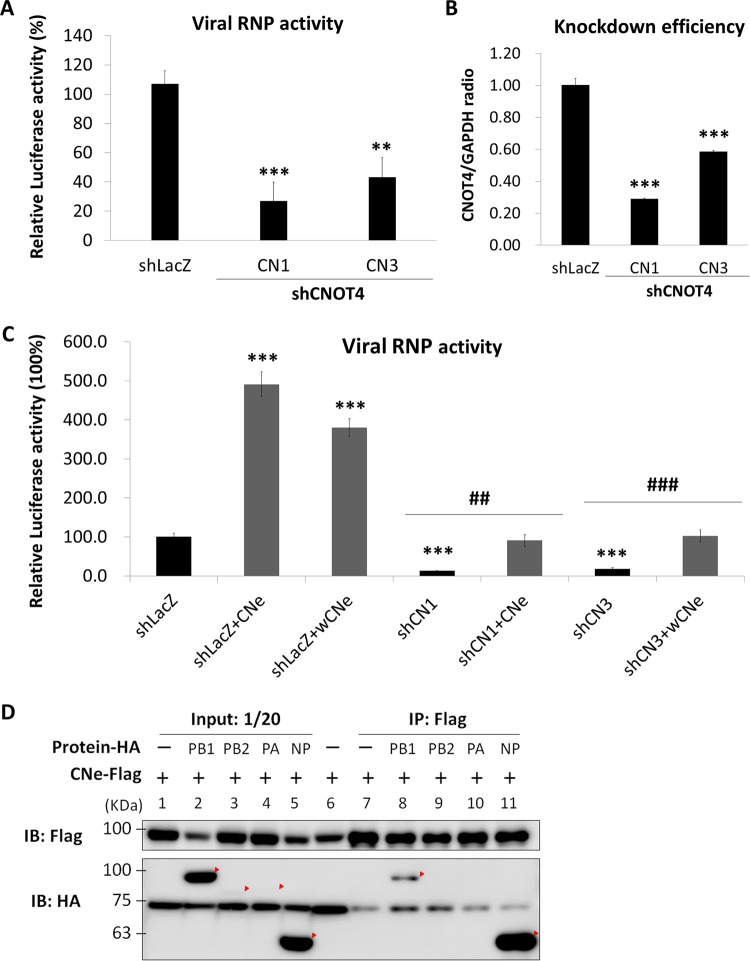
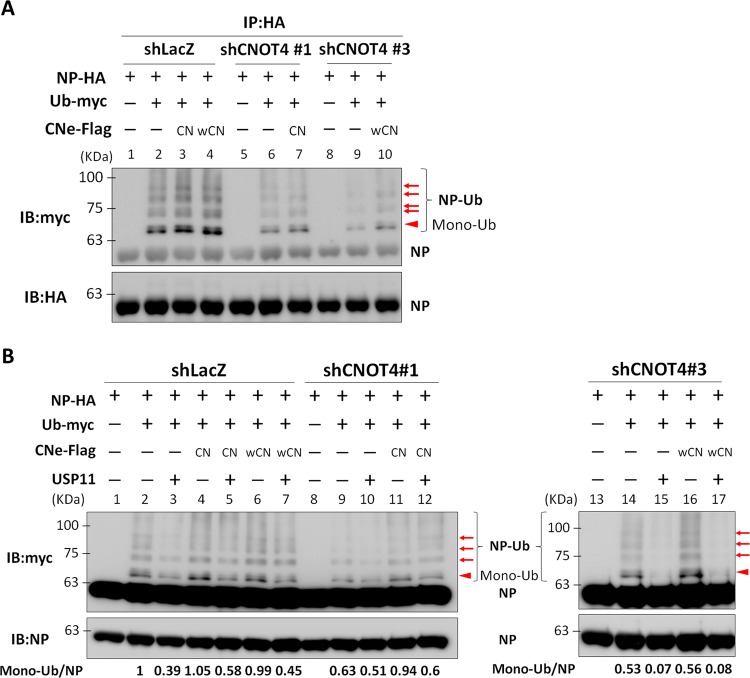
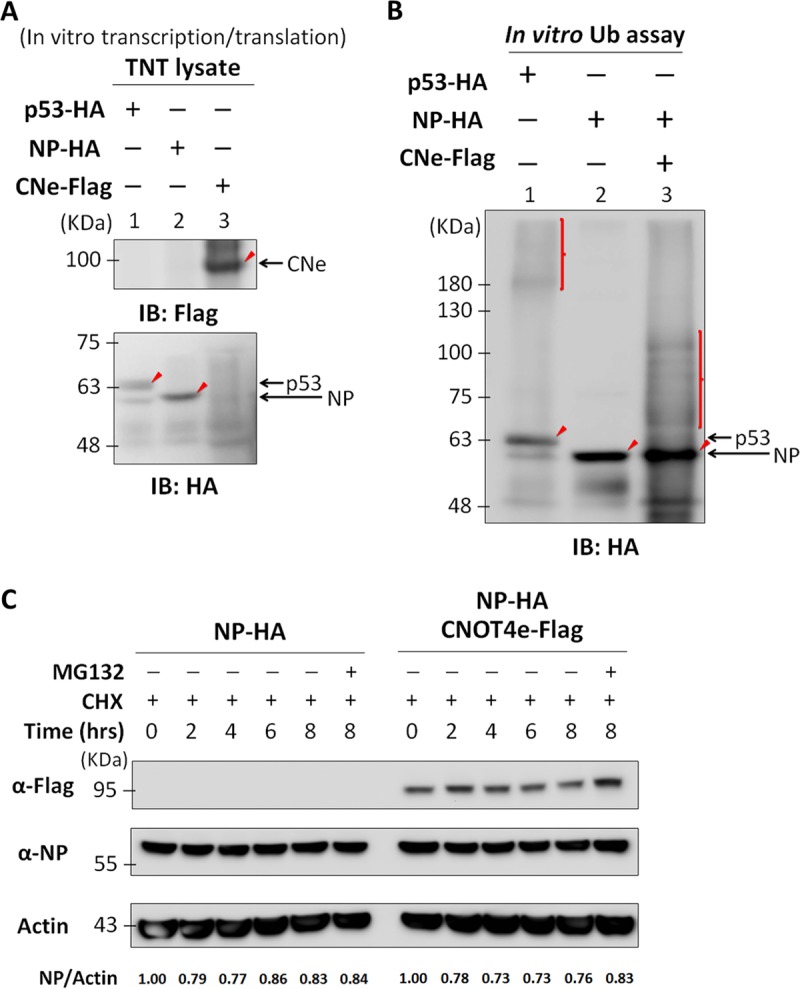
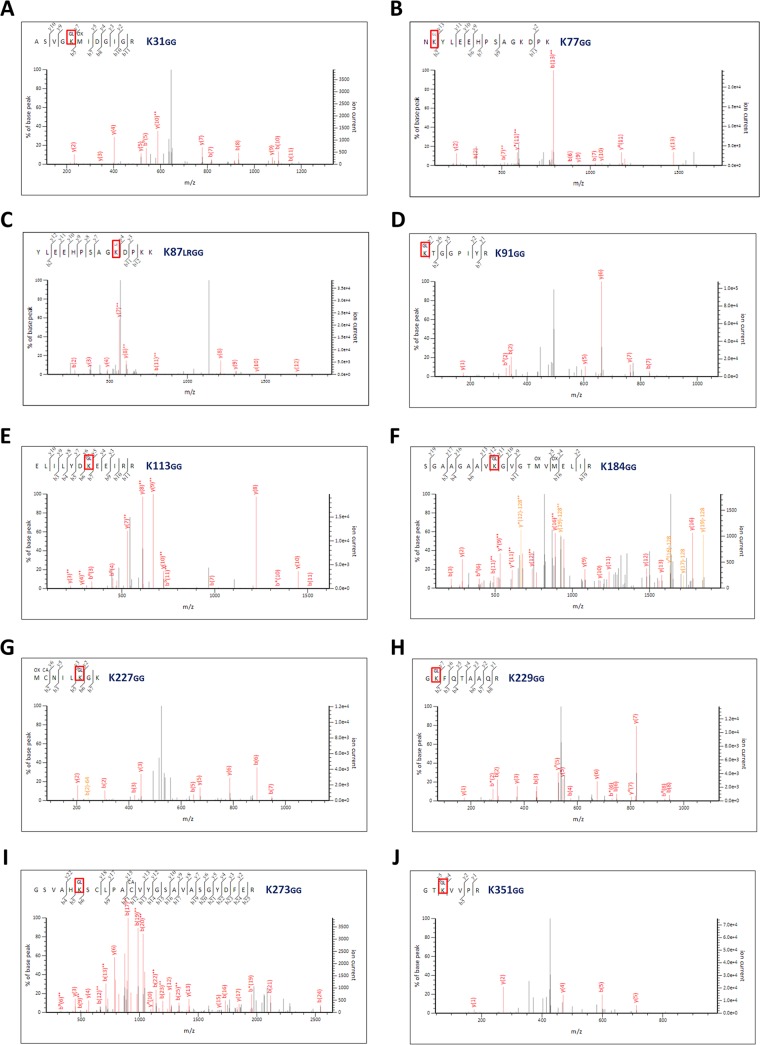
Influenza A virus (IAV) RNA segments are individually packaged with viral nucleoprotein (NP) and RNA polymerases to form a viral ribonucleoprotein (vRNP) complex. We previously reported that NP is a monoubiquitinated protein which can be deubiquitinated by a cellular ubiquitin protease, USP11. In this study, we identified an E3 ubiquitin ligase, CNOT4 (Ccr4-Not transcription complex subunit 4), which can ubiquitinate NP. We found that the levels of viral RNA, protein, viral particles, and RNA polymerase activity in CNOT4 knockdown cells were lower than those in the control cells upon IAV infection. Conversely, overexpression of CNOT4 rescued viral RNP activity. In addition, CNOT4 interacted with the NP in the cell. An ubiquitination assay also showed that NP could be ubiquitinated by -translated CNOT4, but ubiquitination did not affect the protein stability of NP. Significantly, CNOT4 increased NP ubiquitination, whereas USP11 decreased it. Mass spectrometry analysis of ubiquitinated NP revealed multiple ubiquitination sites on the various lysine residues of NP. Three of these, K184, K227, and K273, are located on the RNA-binding groove of NP. Mutations of these sites to arginine reduced viral RNA replication. These results indicate that CNOT4 is a ubiquitin ligase of NP, and ubiquitination of NP plays a positive role in viral RNA replication. Influenza virus, particularly influenza A virus, causes severe and frequent outbreaks among human and avian species. Finding potential target sites for antiviral agents is of utmost importance from the public health point of view. We previously found that viral nucleoprotein (NP) is ubiquitinated, and ubiquitination enhances viral RNA replication. In this study, we found a cellular ubiquitin ligase, CNOT4, capable of ubiquitinating NP. The ubiquitination sites are scattered on the surface of the NP molecule, which is critical for RNA replication. CNOT4 and a ubiquitin protease, USP11, together regulate the extent of NP ubiquitination and thereby the efficiency of RNA replication. This study thus identifies a potential antiviral target site and reveals a novel posttranslational mechanism for regulating viral replication. This represents a novel finding in the literature of influenza virus research.
甲型流感病毒(IAV)的RNA片段与病毒核蛋白(NP)和RNA聚合酶分别包装在一起,形成病毒核糖核蛋白(vRNP)复合物。我们之前报道过NP是一种单泛素化蛋白,可被细胞泛素蛋白酶USP11去泛素化。在本研究中,我们鉴定出一种E3泛素连接酶CNOT4(Ccr4-Not转录复合物亚基4),它可以使NP泛素化。我们发现,在IAV感染后,CNOT4敲低细胞中的病毒RNA、蛋白质、病毒颗粒水平以及RNA聚合酶活性均低于对照细胞。相反,CNOT4的过表达挽救了病毒RNP活性。此外,CNOT4在细胞中与NP相互作用。泛素化实验还表明,体外翻译的CNOT4可以使NP泛素化,但泛素化并不影响NP的蛋白质稳定性。值得注意的是,CNOT4增加了NP的泛素化,而USP11则降低了它。对泛素化NP的质谱分析揭示了NP不同赖氨酸残基上的多个泛素化位点。其中三个位点K184、K227和K273位于NP的RNA结合凹槽上。将这些位点突变为精氨酸会降低病毒RNA复制。这些结果表明CNOT4是NP的泛素连接酶,NP的泛素化在病毒RNA复制中起积极作用。流感病毒,尤其是甲型流感病毒,在人类和禽类中引起严重且频繁的疫情爆发。从公共卫生的角度来看,寻找抗病毒药物的潜在靶点至关重要。我们之前发现病毒核蛋白(NP)被泛素化,并且泛素化增强了病毒RNA复制。在本研究中,我们发现一种能够使NP泛素化的细胞泛素连接酶CNOT4。泛素化位点分散在NP分子表面,这对RNA复制至关重要。CNOT4和泛素蛋白酶USP11共同调节NP泛素化的程度,从而调节RNA复制的效率。因此,本研究确定了一个潜在的抗病毒靶点,并揭示了一种调节病毒复制的新型翻译后机制。这是流感病毒研究文献中的一项新发现。