Department of Investigational Cancer Therapeutics (Phase I Clinical Trials Program), The University of Texas MD Anderson Cancer Center, Houston, Texas.
Illumina, Inc., San Diego, California.
Clin Cancer Res. 2017 Sep 15;23(18):5648-5656. doi: 10.1158/1078-0432.CCR-17-0291. Epub 2017 May 23.
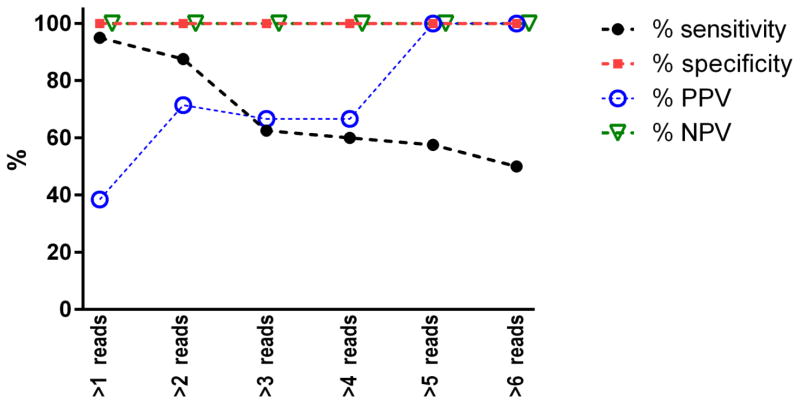
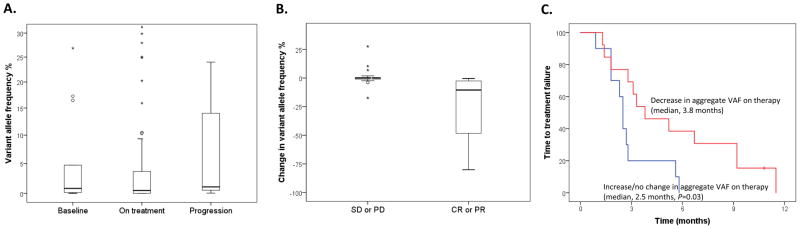
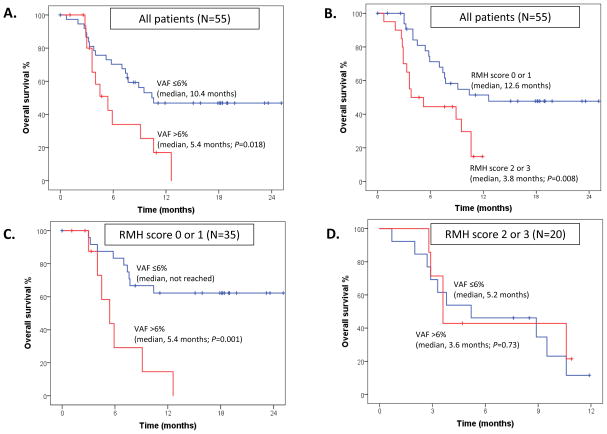
Tumor-derived cell-free DNA (cfDNA) in plasma can be used for molecular testing and provide an attractive alternative to tumor tissue. Commonly used PCR-based technologies can test for limited number of alterations at the time. Therefore, novel ultrasensitive technologies capable of testing for a broad spectrum of molecular alterations are needed to further personalized cancer therapy. We developed a highly sensitive ultradeep next-generation sequencing (NGS) assay using reagents from TruSeqNano library preparation and NexteraRapid Capture target enrichment kits to generate plasma cfDNA sequencing libraries for mutational analysis in 61 cancer-related genes using common bioinformatics tools. The results were retrospectively compared with molecular testing of archival primary or metastatic tumor tissue obtained at different points of clinical care. In a study of 55 patients with advanced cancer, the ultradeep NGS assay detected 82% (complete detection) to 87% (complete and partial detection) of the aberrations identified in discordantly collected corresponding archival tumor tissue. Patients with a low variant allele frequency (VAF) of mutant cfDNA survived longer than those with a high VAF did ( = 0.018). In patients undergoing systemic therapy, radiological response was positively associated with changes in cfDNA VAF ( = 0.02), and compared with unchanged/increased mutant cfDNA VAF, decreased cfDNA VAF was associated with longer time to treatment failure (TTF; = 0.03). Ultradeep NGS assay has good sensitivity compared with conventional clinical mutation testing of archival specimens. A high VAF in mutant cfDNA corresponded with shorter survival. Changes in VAF of mutated cfDNA were associated with TTF. .
肿瘤衍生的无细胞 DNA (cfDNA) 可用于分子检测,并为肿瘤组织提供有吸引力的替代方法。常用的基于 PCR 的技术一次只能检测有限数量的改变。因此,需要新型的超灵敏技术来检测广泛的分子改变,以进一步实现癌症的个体化治疗。我们使用 TruSeqNano 文库制备试剂盒和 NexteraRapid Capture 靶向富集试剂盒中的试剂,开发了一种超灵敏的超高深度下一代测序 (NGS) 检测方法,用于对 61 个癌症相关基因的 cfDNA 进行突变分析。使用常见的生物信息学工具生成测序文库。结果与在临床护理不同时间点获得的存档原发性或转移性肿瘤组织的分子检测进行回顾性比较。在一项对 55 名晚期癌症患者的研究中,超深度 NGS 检测到 82%(完全检测)至 87%(完全和部分检测)在不同时间点采集的不一致存档肿瘤组织中发现的异常。cfDNA 中突变等位基因频率 (VAF) 较低的患者比 VAF 较高的患者存活时间更长(= 0.018)。在接受系统治疗的患者中,cfDNA VAF 的变化与影像学反应呈正相关(= 0.02),与 cfDNA VAF 不变/增加相比,cfDNA VAF 降低与治疗失败时间 (TTF) 延长相关(= 0.03)。超深度 NGS 检测与传统的存档标本临床突变检测相比具有良好的敏感性。cfDNA 中突变的高 VAF 对应于较短的生存时间。突变 cfDNA 的 VAF 变化与 TTF 相关。