Khan Shahbaz, Anwar Sumera, Kuai Jie, Ullah Sana, Fahad Shah, Zhou Guangsheng
College of Plant Science and Technology, Huazhong Agricultural UniversityWuhan, China.
Front Plant Sci. 2017 May 9;8:532. doi: 10.3389/fpls.2017.00532. eCollection 2017.
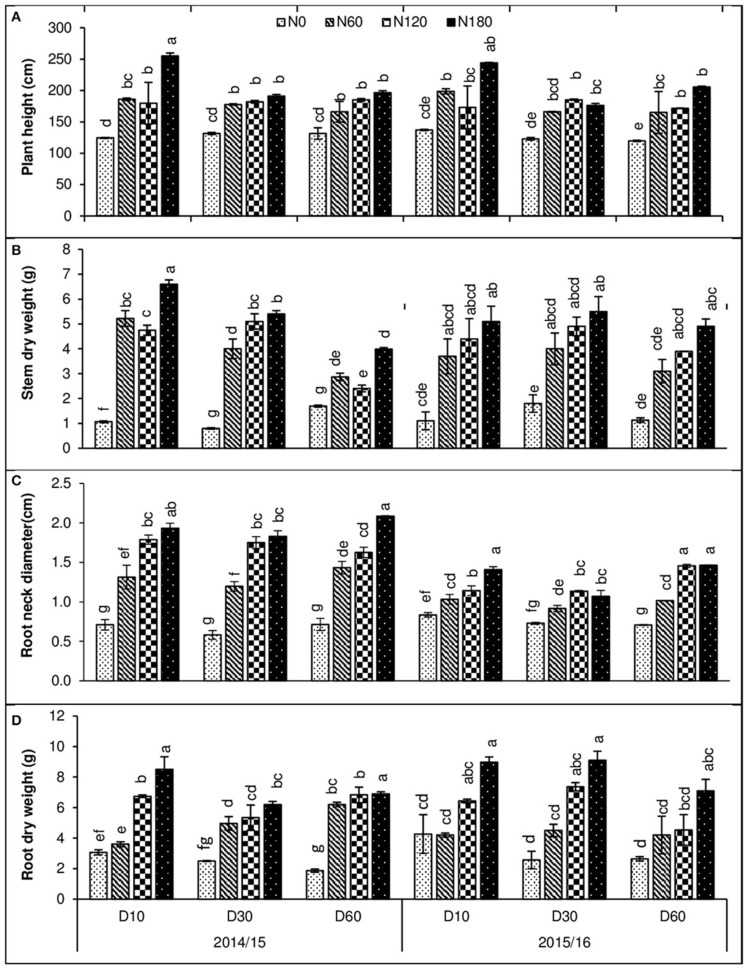
Yield and lodging related traits are essential for improving rapeseed production. The objective of the present study was to investigate the influence of plant density (D) and nitrogen (N) rates on morphological and physiological traits related to yield and lodging in rapeseed. We evaluated Huayouza 9 for two consecutive growing seasons (2014-2016) under three plant densities (LD, 10 plants m; MD, 30 plants m; HD, 60 plants m) and four N rates (0, 60, 120, and 180 kg ha). Experiment was laid out in split plot design using density as a main factor and N as sub-plot factor with three replications each. Seed yield was increased by increasing density and N rate, reaching a peak at HD with 180 kg N ha. The effect of N rate was consistently positive in increasing the plant height, pod area index, 1,000 seed weight, shoot and root dry weights, and root neck diameter, reaching a peak at 180 kg N ha. Plant height was decreased by increasing D, whereas the maximum radiation interception (~80%) and net photosynthetic rate were recorded at MD at highest N. Lodging resistance and nitrogen use efficiency significantly increased with increasing D from 10 to 30 plants m, and N rate up to 120 kg ha, further increase of D and N decreased lodging resistance and NUE. Hence, our study implies that planting density 30 plants m can improve yield, nitrogen use efficiency, and enhance lodging resistance by improving crop canopy.
产量和倒伏相关性状对于提高油菜籽产量至关重要。本研究的目的是调查种植密度(D)和施氮量(N)对油菜籽产量和倒伏相关形态及生理性状的影响。我们在连续两个生长季(2014 - 2016年)对华油杂9号进行了评估,设置了三种种植密度(低密度,10株/平方米;中密度,30株/平方米;高密度,60株/平方米)和四种施氮量(0、60、120和180千克/公顷)。试验采用裂区设计,以密度为主区因素,施氮量为副区因素,各处理重复三次。种子产量随着密度和施氮量的增加而提高,在高密度(60株/平方米)和180千克/公顷施氮量时达到峰值。施氮量对增加株高、荚面积指数、千粒重、地上部和根部干重以及根颈直径的影响始终呈正向,在180千克/公顷施氮量时达到峰值。株高随着种植密度的增加而降低,而在最高施氮量下,中密度处理的最大辐射截获率(约80%)和净光合速率最高。随着种植密度从10株/平方米增加到30株/平方米以及施氮量增加到120千克/公顷,抗倒伏性和氮素利用效率显著提高,种植密度和施氮量的进一步增加则降低了抗倒伏性和氮素利用效率。因此,我们的研究表明,30株/平方米的种植密度可以通过改善作物冠层来提高产量、氮素利用效率并增强抗倒伏性。