Brodersen Kasper E, Hammer Kathrine J, Schrameyer Verena, Floytrup Anja, Rasheed Michael A, Ralph Peter J, Kühl Michael, Pedersen Ole
Climate Change Cluster, Faculty of Science, University of Technology SydneySydney, NSW, Australia.
Freshwater Biological Laboratory, Department of Biology, University of CopenhagenCopenhagen, Denmark.
Front Plant Sci. 2017 May 9;8:657. doi: 10.3389/fpls.2017.00657. eCollection 2017.
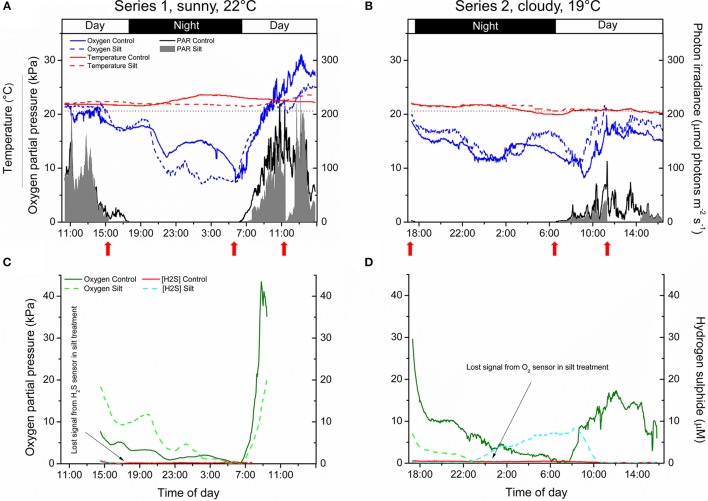
Sedimentation of fine sediment particles onto seagrass leaves severely hampers the plants' performance in both light and darkness, due to inadequate internal plant aeration and intrusion of phytotoxic HS. Anthropogenic activities leading to sediment re-suspension can have adverse effects on adjacent seagrass meadows, owing to reduced light availability and the settling of suspended particles onto seagrass leaves potentially impeding gas exchange with the surrounding water. We used microsensors to determine O fluxes and diffusive boundary layer (DBL) thickness on leaves of the seagrass with and without fine sediment particles, and combined these laboratory measurements with microsensor measurements of tissue O and HS concentrations. Net photosynthesis rates in leaves with fine sediment particles were down to ~20% of controls without particles, and the compensation photon irradiance increased from a span of 20-53 to 109-145 μmol photons m s. An ~2.5-fold thicker DBL around leaves with fine sediment particles impeded O influx into the leaves during darkness. leaf meristematic O concentrations of plants exposed to fine sediment particles were lower than in control plants and exhibited long time periods of complete meristematic anoxia during night-time. Insufficient internal aeration resulted in HS intrusion into the leaf meristematic tissues when exposed to sediment resuspension even at relatively high night-time water-column O concentrations. Fine sediment particles that settle on seagrass leaves thus negatively affect internal tissue aeration and thereby the plants' resilience against HS intrusion.
细小沉积物颗粒沉降到海草叶片上,会严重阻碍植物在光照和黑暗条件下的表现,这是由于植物内部通气不足以及具有植物毒性的硫化氢(HS)的侵入所致。导致沉积物再悬浮的人为活动可能会对相邻的海草草甸产生不利影响,这是因为光照可用性降低,以及悬浮颗粒沉降到海草叶片上可能会阻碍与周围水体的气体交换。我们使用微传感器来测定有无细小沉积物颗粒情况下海草叶片上的氧气通量和扩散边界层(DBL)厚度,并将这些实验室测量结果与组织中氧气和硫化氢浓度的微传感器测量结果相结合。有细小沉积物颗粒的叶片的净光合速率降至无颗粒对照组的约20%,补偿光子辐照度从20 - 53 μmol光子·m⁻²·s⁻¹增加到109 - 145 μmol光子·m⁻²·s⁻¹。有细小沉积物颗粒的叶片周围的DBL厚度增加了约2.5倍,这在黑暗期间阻碍了氧气流入叶片。暴露于细小沉积物颗粒的植物叶片分生组织中的氧气浓度低于对照植物,并且在夜间长时间处于完全的分生组织缺氧状态。即使在夜间水柱中氧气浓度相对较高时,当暴露于沉积物再悬浮时,内部通气不足也会导致硫化氢侵入叶片分生组织。因此,沉降在海草叶片上的细小沉积物颗粒会对内部组织通气产生负面影响,从而影响植物对硫化氢侵入的恢复能力。