Lim Taeho, Lee Sanghyun, Oh Jaehoon, Kang Hyunggoo, Ahn Chiwon, Song Yeongtak, Lee Juncheol, Shin Hyungoo
Department of Emergency Medicine, College of Medicine, Hanyang University, Seoul, Republic of Korea.
Convergence Technology Center for Disaster Preparedness, Hanyang University, Seoul, Republic of Korea.
Biomed Res Int. 2017;2017:7565706. doi: 10.1155/2017/7565706. Epub 2017 Apr 27.
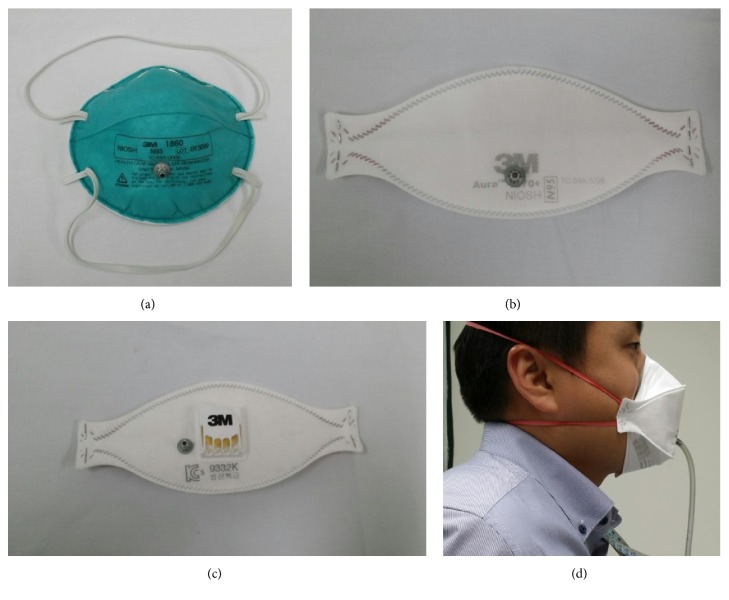
. Emergency physicians are at risk for infection during invasive procedures, and the respirators can reduce this risk. This study aimed to determine whether endotracheal intubation using direct laryngoscopes affected protection performances of respirators. . A randomized crossover study of 24 emergency physicians was performed. We performed quantitative fit tests using respirators (cup type, fold type without a valve, and fold type with a valve) before and during intubation. The primary outcome was respirators' fit factors (FF), and secondary outcomes were acceptable protection (percentage of scores above 100 FF [FF%]). . 24 pieces of data were analyzed. Compared to fold-type respirator without a valve, FF and FF% values were lower when participants wore a cup-type respirator (200 FF [200-200] versus 200 FF [102.75-200], 100% [78.61-100] versus 74.16% [36.1-98.9]; all < 0.05) or fold-type respirator with a valve (200 FF [200-200] versus 142.5 FF [63.50-200], 100% [76.10-100] versus 62.50% [8.13-100]; all < 0.05). There were no significant differences in intubation time and success rate according to respirator types. . Motion during endotracheal intubation using direct laryngoscopes influenced the protective performance of some respirators. Therefore, emergency physicians should identify and wear respirators that provide the best personalized fit for intended tasks.
急诊医生在进行侵入性操作时面临感染风险,而呼吸器可以降低这种风险。本研究旨在确定使用直接喉镜进行气管插管是否会影响呼吸器的防护性能。 对24名急诊医生进行了一项随机交叉研究。我们在插管前和插管过程中使用呼吸器(杯型、无阀折叠型和有阀折叠型)进行了定量适合性测试。主要结果是呼吸器的适合因数(FF),次要结果是可接受的防护(得分高于100 FF的百分比[FF%])。 分析了24条数据。与无阀折叠型呼吸器相比,参与者佩戴杯型呼吸器时FF和FF%值较低(200 FF [200 - 200] 对 200 FF [102.75 - 200],100% [78.61 - 100] 对 74.16% [36.1 - 98.9];均 < 0.05)或有阀折叠型呼吸器时(200 FF [200 - 200] 对 142.5 FF [63.50 - 200],100% [76.10 - 100] 对 62.50% [8.13 - 100];均 < 0.05)。根据呼吸器类型,插管时间和成功率没有显著差异。 使用直接喉镜进行气管插管时的动作会影响一些呼吸器的防护性能。因此,急诊医生应识别并佩戴最适合预期任务的个性化呼吸器。