Department of Experimental Plant Biology, Faculty of Science, Charles University in Prague, Vinicna 5, 128 44 Prague 2, Czech Republic.
Institute of Botany, Academy of Sciences, Zámek 1, 252 43 Pruhonice, Czech Republic.
Sensors (Basel). 2017 May 24;17(6):1202. doi: 10.3390/s17061202.
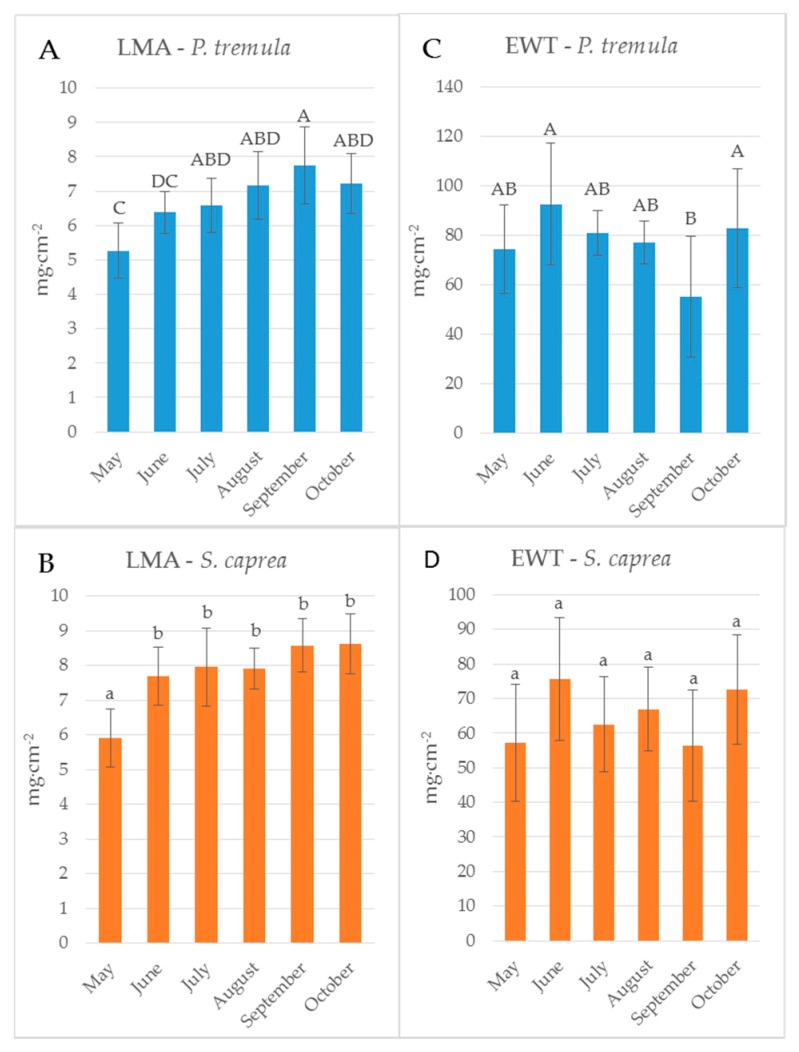
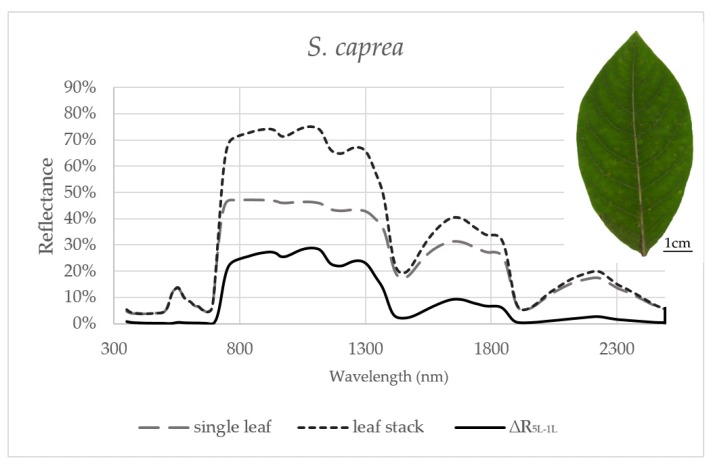
The aims of the study were: (i) to compare leaf reflectance in visible (VIS) (400-700 nm), near-infrared (NIR) (740-1140 nm) and short-wave infrared (SWIR) (2000-2400 nm) spectral ranges measured monthly by a contact probe on a single leaf and a stack of five leaves (measurement setup (MS)) of two broadleaved tree species during the vegetative season; and (ii) to test if and how selected vegetation indices differ under these two MS. In VIS, the pigment-related spectral region, the effect of MS on reflectance was negligible. The major influence of MS on reflectance was detected in NIR (up to 25%), the structure-related spectral range; and weaker effect in SWIR, the water-related spectral range. Vegetation indices involving VIS wavelengths were independent of MS while indices combining wavelengths from both VIS and NIR were MS-affected throughout the season. The effect of leaf stacking contributed to weakening the correlation between the leaf chlorophyll content and selected vegetation indices due to a higher leaf mass per area of the leaf sample. The majority of MS-affected indices were better correlated with chlorophyll content in both species in comparison with MS-unaffected indices. Therefore, in terms of monitoring leaf chlorophyll content using the contact probe reflectance measurement, these MS-affected indices should be used with caution, as discussed in the paper. If the vegetation indices are used for assessment of plant physiological status in various times of the vegetative season, then it is essential to take into consideration their possible changes induced by the particular contact probe measurement setup regarding the leaf stacking.
(i)比较单叶和五叶堆叠(测量设置(MS))在植被季节每月用接触探头测量的可见(VIS)(400-700nm)、近红外(NIR)(740-1140nm)和短波红外(SWIR)(2000-2400nm)光谱范围内的叶片反射率;(ii)测试在这两种 MS 下,所选植被指数是否以及如何存在差异。在 VIS 中,与色素相关的光谱区域,MS 对反射率的影响可以忽略不计。MS 对反射率的主要影响在 NIR(高达 25%)中被检测到,这是与结构相关的光谱范围;在 SWIR 中,水相关的光谱范围,影响较弱。涉及 VIS 波长的植被指数与 MS 无关,而结合 VIS 和 NIR 波长的指数在整个季节都受到 MS 的影响。叶片堆叠的影响导致叶片叶绿素含量与所选植被指数之间的相关性减弱,这是由于叶片样本的叶面积质量更高。与不受 MS 影响的指数相比,大多数受 MS 影响的指数与两种物种的叶片叶绿素含量相关性更好。因此,就使用接触探头反射率测量来监测叶片叶绿素含量而言,如本文所述,应谨慎使用这些受 MS 影响的指数。如果植被指数用于评估植被季节不同时间的植物生理状况,则必须考虑到叶片堆叠对特定接触探头测量设置可能引起的变化。