Center for Childhood Cancer and Blood Diseases, Nationwide Children's Hospital, The Ohio State University, Columbus, Ohio, USA.
The Ohio State University College of Medicine, Columbus, Ohio, USA.
Sci Rep. 2017 May 24;7(1):2396. doi: 10.1038/s41598-017-02503-8.
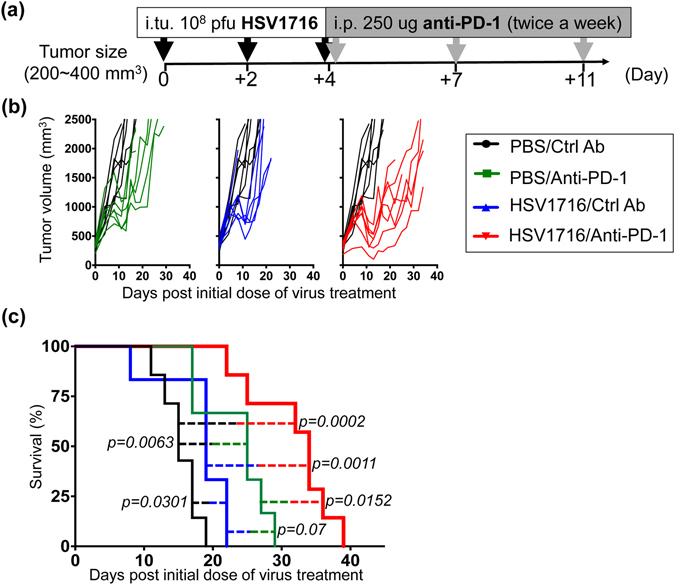
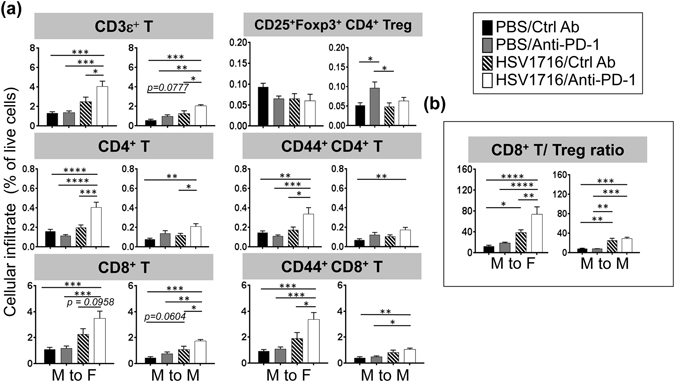
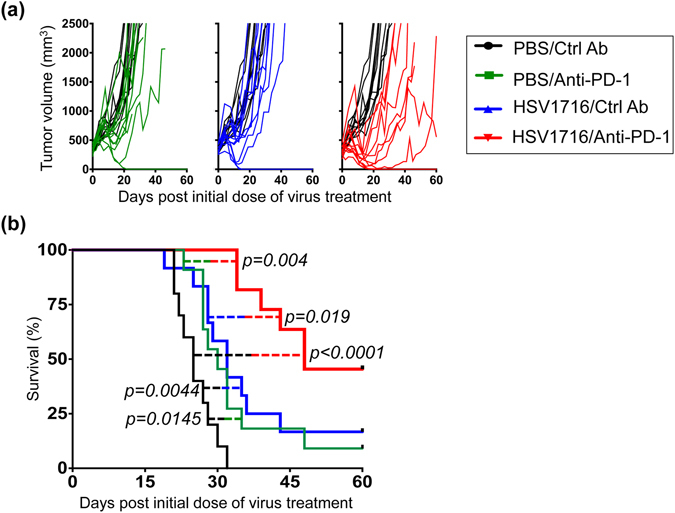
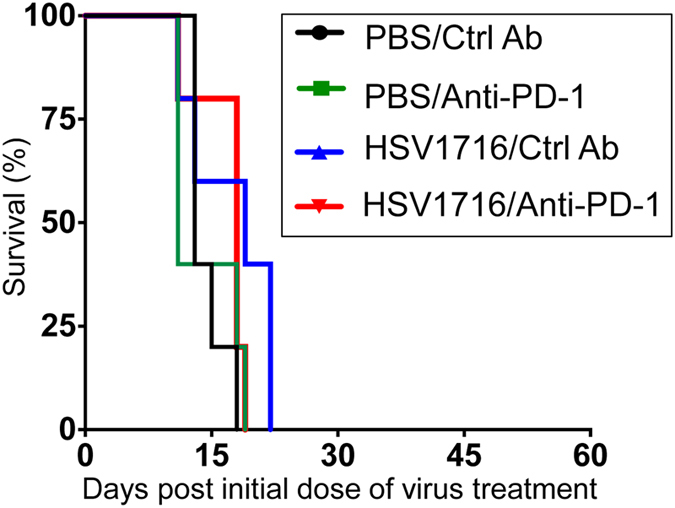
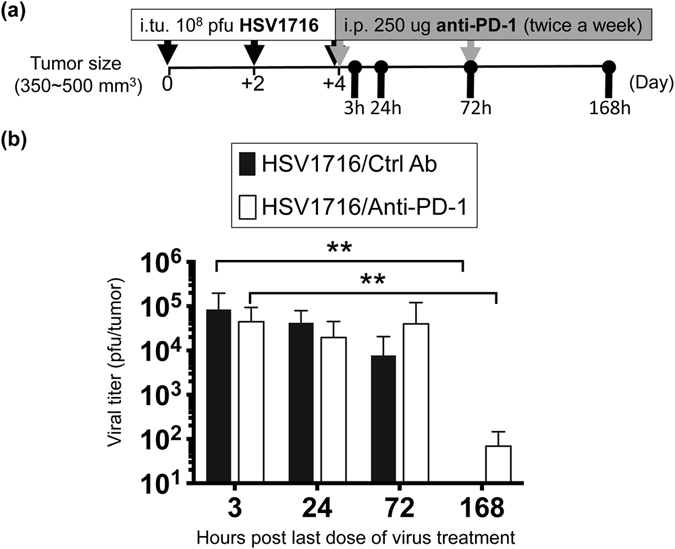
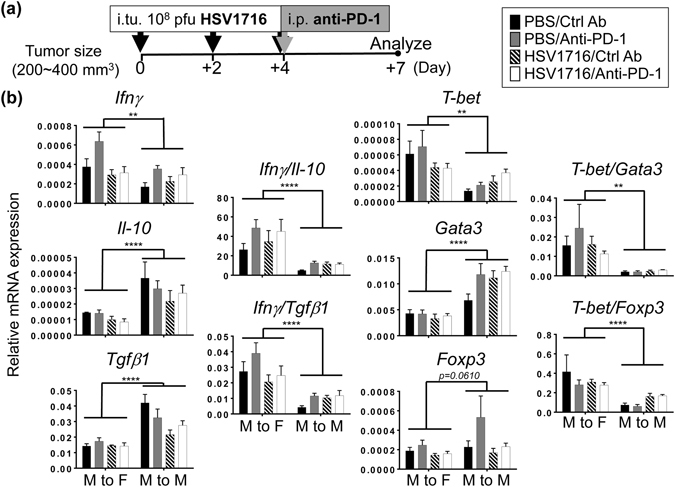
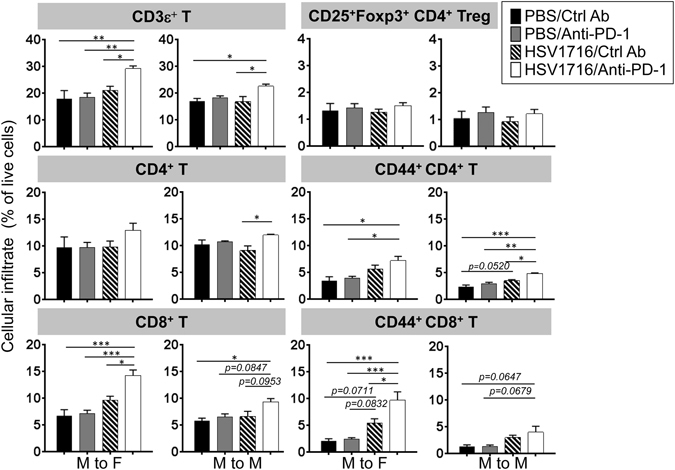
Oncolytic virotherapy is an effective immunotherapeutic approach for cancer treatment via a multistep process including direct tumor cell lysis, induction of cytotoxic or apoptosis-sensitizing cytokines and promotion of antitumor T cell responses. Solid tumors limit the effectiveness of immunotherapeutics in diverse ways such as secretion of immunosuppressive cytokines and expression of immune inhibitory ligands to inhibit antitumor T cell function. Blocking programmed cell death protein (PD)-1 signaling, which mediates T cell suppression via engagement of its inhibitory ligands, PD-L1 or PD-L2, is of particular interest due to recent successes in many types of cancer. In syngeneic murine rhabdomyosarcoma models, we found that M3-9-M (MHC I high) but not 76-9 (MHC I low) tumors respond to oncolytic herpes simplex virus-1 (oHSV-1) and PD-1 blockade combination therapy. In addition, the therapeutic outcomes in M3-9-M tumor models correlated with the increased incidence of CD4 and CD8 T cells but not with the CD4CD25Foxp3 regulatory T cell populations in the tumor. Overall, our data suggest the combination of PD-1 blockade and oHSV-1 may be an effective treatment strategy for childhood soft tissue sarcoma.
溶瘤病毒治疗是一种通过多步过程治疗癌症的有效免疫治疗方法,包括直接肿瘤细胞溶解、诱导细胞毒性或凋亡敏感细胞因子以及促进抗肿瘤 T 细胞反应。实体瘤通过分泌免疫抑制细胞因子和表达免疫抑制配体来抑制抗肿瘤 T 细胞功能,以多种方式限制免疫疗法的效果。由于在许多类型的癌症中取得了近期成功,阻断程序性细胞死亡蛋白 (PD)-1 信号通路(通过其抑制性配体 PD-L1 或 PD-L2 的结合来介导 T 细胞抑制)特别受到关注。在同种异体鼠横纹肌肉瘤模型中,我们发现 M3-9-M(MHC I 高)而不是 76-9(MHC I 低)肿瘤对溶瘤单纯疱疹病毒-1 (oHSV-1) 和 PD-1 阻断联合治疗有反应。此外,M3-9-M 肿瘤模型中的治疗结果与肿瘤中 CD4 和 CD8 T 细胞的增加发生率相关,而与 CD4CD25Foxp3 调节性 T 细胞群体无关。总的来说,我们的数据表明 PD-1 阻断和 oHSV-1 的联合可能是治疗儿童软组织肉瘤的有效治疗策略。