Chang XiaoYan, Yu ChunKai, Li Ji, Yu Shuangni, Chen Jie
Department of Pathology, Peking Union Medical College Hospital, Chinese Academy of Medical Sciences and Peking Union Medical College, Tsinghua University, Beijing 100730, China.
Department of Pathology, Beijing Shijitan Hospital, Capital Medical University, Beijing 100038, China.
Int J Med Sci. 2017 Apr 8;14(5):412-418. doi: 10.7150/ijms.18641. eCollection 2017.
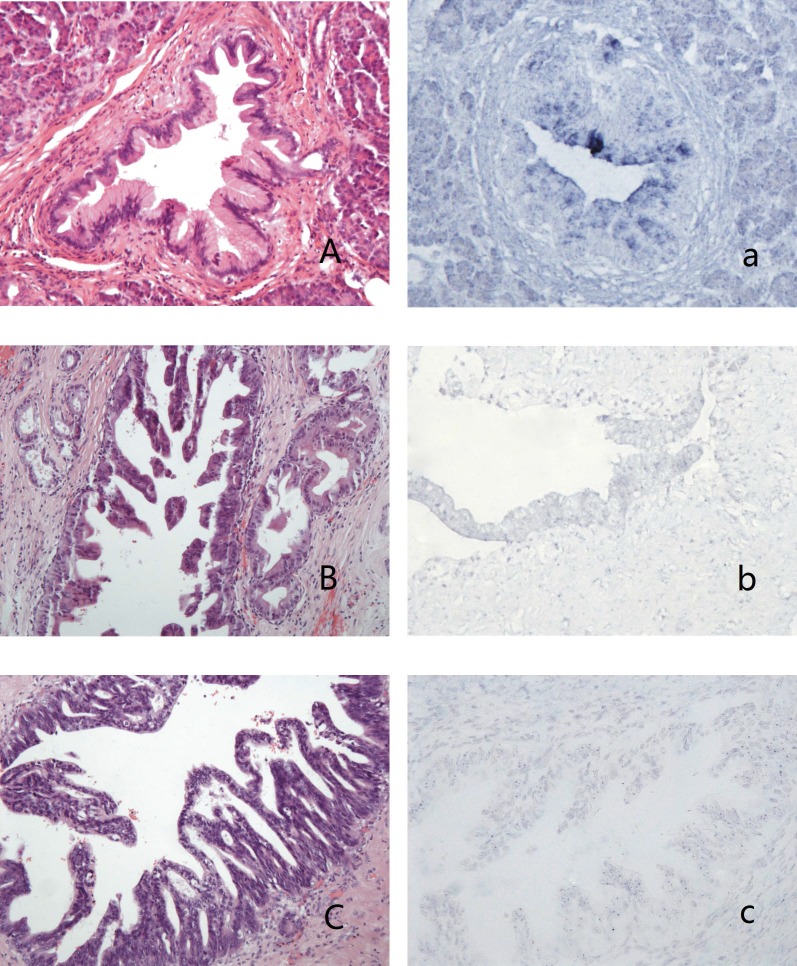
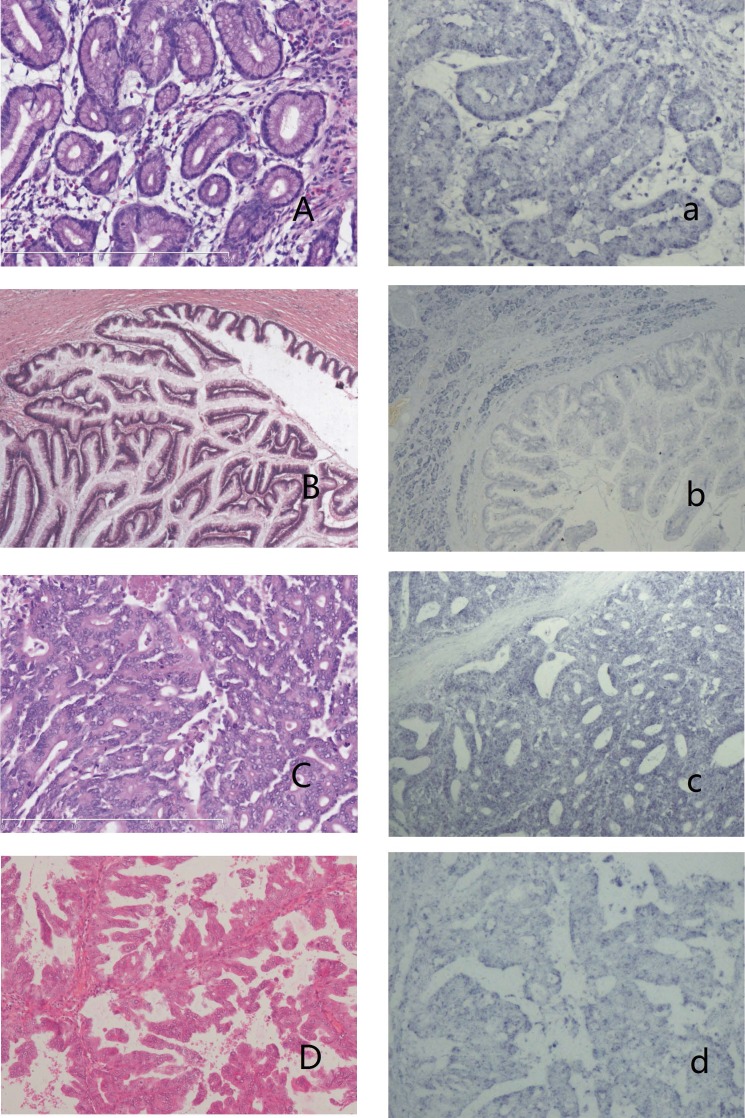
To compare the clinicopathological features of pancreatic intraepithelial neoplasias (PanINs) and intraductal papillary mucinous neoplasms (IPMNs), and to investigate the role of hsa-miR-96 and hsa-miR-217 in these two lesions. Formalin-fixed paraffin-embedded pancreatic specimens were selected in this study, including 58 cases of pancreatic intraepithelial neoplasias (PanINs), 45 cases of pancreatic ductal adenocarcinomas (PDAs), and 57 cases of intraductal papillary mucinous neoplasms (IPMNs). MiRNAs hsa-miR-96 and hsa-miR-217 were detected using locked nucleic acid hybridization (LNA-ISH) with the NBT/BCIP staining system. The differences in miRNA expression among sample sets were analyzed with the Chi-squared test. PanIN-PDAs were inclined to present with higher rate of invasion (p=0.033), lymph node metastasis (p=0.0004) and poorer differentiation (p<0.001). Of the 45 PDAs, only 2 cases were within AJCC Ⅰstage, while there were 11 cases of IPMN associated carcinomas (p=0.0018). In PanIN-1, PanIN-2 and PanIN-3, the expression of hsa-miR-96 was 91.3% (22/23), 78.6%(12/17) and 22.2%(4/18) respectively, while the expression of hsa-miR-217 was 95.7%(22/23) , 70.6% (12/17) and 27.8% (5/18). In IPMN with low-grade, intermediate-grade, high-grade dysplasia, associated carcinoma, the expression of hsa-miR-96 was 67%(9/13), 64%(7/11), 43%(3/7) and 27%(7/26) respectively, while the expression of hsa-miR-217 was 77%(10/13), 64%(7/11), 29%(2/7) and 38%(10/26). The expression of hsa-miR-96 and hsa-miR-217 in PanIN-1 lesions was not significantly different from that in the normal pancreatic ductal epithelium. However, their expression in PanIN-2/3 lesions was significantly different from that in normal pancreatic ductal epithelium (P<0.01). No difference was observed between PanIN derived adenocarcinomas and IPMN-associated carcinomas. IPMN associated carcinomas were in a statistically earlier stage than PanIN- PDAs at the time of operation. Abnormal expression of hsa-miR-96 and of hsa-miR-217 was observed in premalignant lesions (PanINs and IPMNs) of pancreatic carcinoma and down-regulated with increasing grades of PanINs and IPMNs. These microRNAs may serve as potentially early biomarker and act as tumor suppressor genes.
比较胰腺上皮内瘤变(PanINs)和导管内乳头状黏液性肿瘤(IPMNs)的临床病理特征,并研究hsa-miR-96和hsa-miR-217在这两种病变中的作用。本研究选取福尔马林固定石蜡包埋的胰腺标本,包括58例胰腺上皮内瘤变(PanINs)、45例胰腺导管腺癌(PDAs)和57例导管内乳头状黏液性肿瘤(IPMNs)。采用锁核酸杂交(LNA-ISH)及NBT/BCIP染色系统检测微小RNA hsa-miR-96和hsa-miR-217。用卡方检验分析样本组间微小RNA表达的差异。PanIN-PDAs倾向于表现出更高的侵袭率(p = 0.033)、淋巴结转移率(p = 0.0004)和更低的分化程度(p < 0.001)。在45例PDAs中,只有2例处于美国癌症联合委员会(AJCC)Ⅰ期,而有11例IPMN相关癌(p = 0.0018)。在PanIN-1、PanIN-2和PanIN-3中,hsa-miR-96的表达分别为91.3%(22/23)、78.6%(12/17)和22.2%(4/18),而hsa-miR-217的表达分别为95.7%(22/23)、70.6%(12/17)和27.8%(5/18)。在低级别、中级别、高级别不典型增生及相关癌的IPMN中,hsa-miR-96的表达分别为67%(9/13)、64%(7/11)、43%(3/7)和27%(7/26),而hsa-miR-217的表达分别为77%(10/13)、64%(7/11)、29%(2/7)和38%(10/26)。hsa-miR-96和hsa-miR-217在PanIN-1病变中的表达与正常胰腺导管上皮无显著差异。然而,它们在PanIN-2/3病变中的表达与正常胰腺导管上皮有显著差异(P < 0.01)。PanIN来源的腺癌与IPMN相关癌之间未观察到差异。IPMN相关癌在手术时的分期在统计学上早于PanIN-PDAs。在胰腺癌的癌前病变(PanINs和IPMNs)中观察到hsa-miR-96和hsa-miR-217的异常表达,且随着PanINs和IPMNs级别的增加而下调。这些微小RNA可能作为潜在的早期生物标志物,并发挥肿瘤抑制基因的作用。