Panhale V P, Gurav R S, Nahar S K
Department of Musculoskeletal Sciences, MGM College of Physiotherapy, Navi Mumbai, Maharashtra, India.
Ann Med Health Sci Res. 2016 Nov-Dec;6(6):375-379. doi: 10.4103/amhsr.amhsr_331_15.
Low back pain is a commonest musculoskeletal disorder affecting majority of people. Activity limitations are difficulties an individual may have in executing activities resulting from person's functioning and disability. According to the fear-avoidance model of low back pain, individuals who perceive pain as a sign of potential damage are more likely to avoid behaviors that increase their anxiety and show sub-maximal performance during physical activity.
Purpose of this study was to find the association between activity limitation and fear avoidance belief in patients with chronic low back pain.
Thirty subjects with chronic low back pain were included in the study. Activity limitation was measured using Back Performance Scale (BPS). Patients' fear of pain and avoidance of physical activities was assessed with Fear Avoidance Belief Questionnaire (FABQ).
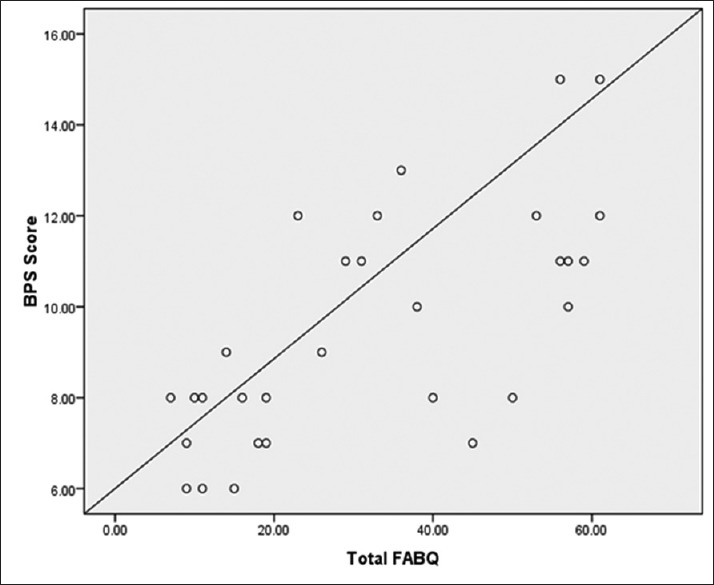
It was observed that performance was affected in roll up, fingertip to floor and lift test. In the two subscales of FABQ, 47 percent had more fear in physical activity component and 27 percent had more fear in work component. The scores of BPS and FABQ were correlated using Pearson's correlation test showed strong positive correlation ( = 0.685, value < 0.01). Higher scores on FABQ are indicative of greater fear and avoidance beliefs.
Higher scores on the FABQ 47% in physical activity and 27% in work component are indicative of greater fear and avoidance beliefs. A strong relationship exists between elevated fear avoidance beliefs (FABQ) and activity limitation (BPS) in patients with chronic low back pain.
腰痛是影响大多数人的最常见的肌肉骨骼疾病。活动受限是个体在执行因自身功能和残疾而导致的活动时可能遇到的困难。根据腰痛的恐惧回避模型,将疼痛视为潜在损伤迹象的个体更有可能避免那些会增加其焦虑的行为,并在体育活动中表现出次优表现。
本研究的目的是找出慢性腰痛患者活动受限与恐惧回避信念之间的关联。
本研究纳入了30名慢性腰痛患者。使用背部功能量表(BPS)测量活动受限情况。采用恐惧回避信念问卷(FABQ)评估患者对疼痛的恐惧和对体育活动的回避情况。
观察到在坐起、指尖触地和提举测试中表现受到影响。在FABQ的两个子量表中,47%的患者在体育活动部分有更多恐惧,27%的患者在工作部分有更多恐惧。使用Pearson相关检验对BPS和FABQ的得分进行相关性分析,结果显示呈强正相关( = 0.685,P值 < 0.01)。FABQ得分越高表明恐惧和回避信念越强。
FABQ在体育活动部分47%以及工作部分27%的较高得分表明恐惧和回避信念更强。慢性腰痛患者中,恐惧回避信念(FABQ)升高与活动受限(BPS)之间存在密切关系。