Lee Jea Y, Xu Kaya, Nguyen Hung, Guedes Vivian A, Borlongan Cesar V, Acosta Sandra A
Department of Neurosurgery and Brain Repair, Center of Excellence for Aging and Brain Repair, University of South Florida College of MedicineTampa, FL, USA.
Front Cell Dev Biol. 2017 May 10;5:51. doi: 10.3389/fcell.2017.00051. eCollection 2017.
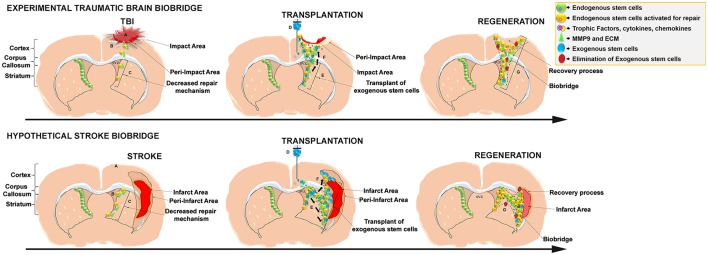
Notch-induced mesenchymal stromal cells (MSCs) mediate a distinct mechanism of repair after brain injury by forming a biobridge that facilitates biodistribution of host cells from a neurogenic niche to the area of injury. We have observed the biobridge in an area between the subventricular zone and the injured cortex using immunohistochemistry and laser capture. Cells in the biobridge express high levels of extracellular matrix metalloproteinases (MMPs), specifically MMP-9, which co-localized with a trail of MSCs graft. The transplanted stem cells then become almost undetectable, being replaced by newly recruited host cells. This stem cell-paved biobridge provides support for distal migration of host cells from the subventricular zone to the site of injury. Biobridge formation by transplanted stem cells seems to have a fundamental role in initiating endogenous repair processes. Two major stem cell-mediated repair mechanisms have been proposed thus far: direct cell replacement by transplanted grafts and bystander effects through the secretion of trophic factors including fibroblast growth factor 2 (FGF-2), epidermal growth factor (EGF), stem cell factor (SCF), erythropoietin, and brain-derived neurotrophic factor (BDNF) among others. This groundbreaking observation of biobridge formation by transplanted stem cells represents a novel mechanism for stem cell mediated brain repair. Future studies on graft-host interaction will likely establish biobridge formation as a fundamental mechanism underlying therapeutic effects of stem cells and contribute to the scientific pursuit of developing safe and efficient therapies not only for traumatic brain injury but also for other neurological disorders. The aim of this review is to hypothetically extend concepts related to the formation of biobridges in other central nervous system disorders.
Notch 诱导的间充质基质细胞(MSCs)通过形成生物桥介导脑损伤后的一种独特修复机制,该生物桥促进宿主细胞从神经源性小生境向损伤区域的生物分布。我们使用免疫组织化学和激光捕获技术在脑室下区和损伤皮质之间的区域观察到了生物桥。生物桥中的细胞表达高水平的细胞外基质金属蛋白酶(MMPs),特别是 MMP-9,其与 MSC 移植物的踪迹共定位。然后移植的干细胞几乎无法检测到,被新招募的宿主细胞所取代。这种由干细胞铺就的生物桥为宿主细胞从脑室下区向损伤部位的远距离迁移提供了支持。移植干细胞形成生物桥似乎在启动内源性修复过程中起基本作用。迄今为止,已经提出了两种主要的干细胞介导的修复机制:移植移植物直接进行细胞替代以及通过分泌包括成纤维细胞生长因子 2(FGF-2)、表皮生长因子(EGF)、干细胞因子(SCF)、促红细胞生成素和脑源性神经营养因子(BDNF)等在内的营养因子产生旁分泌效应。这一关于移植干细胞形成生物桥的开创性观察代表了干细胞介导脑修复的一种新机制。未来关于移植物与宿主相互作用的研究可能会将生物桥形成确立为干细胞治疗效果的基本机制,并有助于科学地追求开发不仅针对创伤性脑损伤而且针对其他神经系统疾病的安全有效的治疗方法。本综述的目的是假设性地扩展与其他中枢神经系统疾病中生物桥形成相关的概念。