a Center for Alaska Native Health Research , Institute of Arctic Biology, University of Alaska Fairbanks , Fairbanks , AK , USA.
Ethn Health. 2019 Apr;24(3):312-322. doi: 10.1080/13557858.2017.1331338. Epub 2017 May 25.
In remote, Alaska Native communities, traditional foods remain a significant source of essential nutrients and appear to protect against the development of chronic diseases. Relatively low intake of traditional foods among Alaska Native children is therefore of concern. The aim of this study was to identify household and parental predictors of child traditional food (TF) consumption and weight in remote Yup'ik communities of Alaska.
Children (10-18 years old) and parents in two communities (populations <500) were invited to participate in this cross-sectional study. Intake of traditional foods among children and parents was estimated from two-24 h recalls using NDS-R. Weight and height were measured and BMI calculated. Sociodemographic factors, including income and education, were collected from parents. A partial least square path modeling analysis and bootstrapping were performed to identify predictors of child TF consumption and weight.
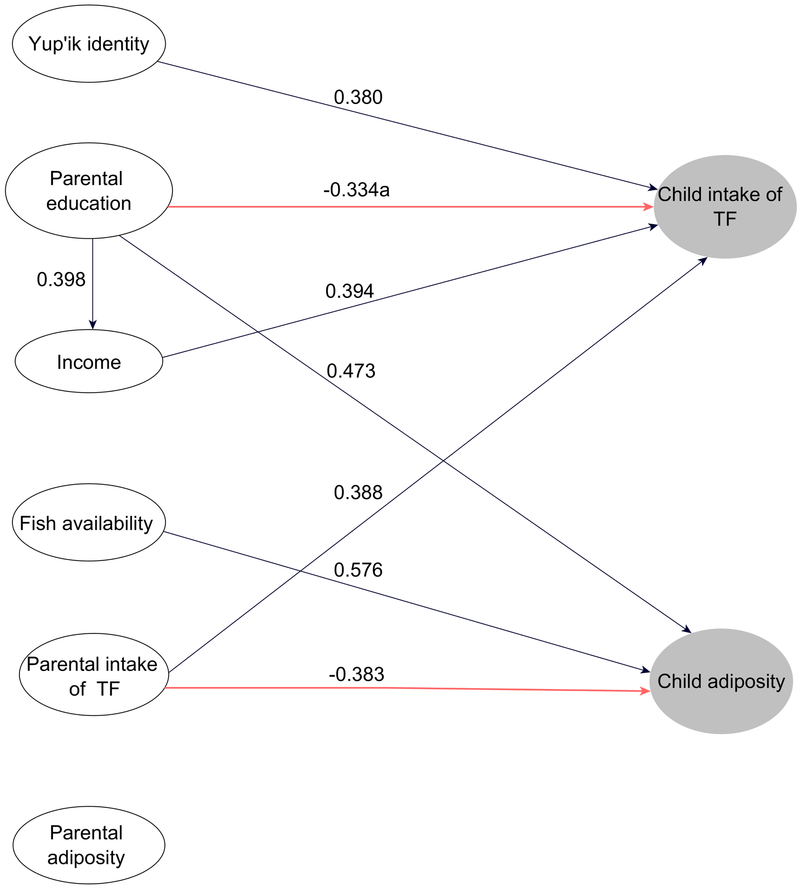
Parental intake of traditional foods, Yup'ik identity and income were positively associated with child intake of traditional foods. Further, parental intake of traditional foods predicted lower child BMI. Parental education was negatively associated with child traditional food intake and positively associated with child BMI.
Findings suggest that interventions targeting parents may be an effective strategy to increase intake of traditional foods and improve diet quality among Alaska Native youth.
在偏远的阿拉斯加原住民社区,传统食物仍然是重要营养物质的重要来源,并且似乎可以预防慢性病的发生。因此,阿拉斯加原住民儿童相对较低的传统食物摄入量令人担忧。本研究旨在确定阿拉斯加偏远尤皮克社区中家庭和父母因素对儿童传统食物(TF)消费和体重的预测作用。
邀请两个社区(人口<500)的儿童(10-18 岁)及其父母参与这项横断面研究。通过使用 NDS-R 进行两次 24 小时回忆,估计儿童和父母的传统食物摄入量。测量体重和身高,并计算 BMI。从父母那里收集社会人口因素,包括收入和教育。采用偏最小二乘路径建模分析和自举法来确定儿童 TF 消费和体重的预测因素。
父母传统食物的摄入量、尤皮克身份和收入与儿童传统食物的摄入量呈正相关。此外,父母传统食物的摄入量预测了儿童 BMI 降低。父母的教育与儿童传统食物的摄入量呈负相关,与儿童 BMI 呈正相关。
研究结果表明,针对父母的干预措施可能是增加阿拉斯加原住民青年传统食物摄入量和改善饮食质量的有效策略。