Philip Jacques, Ryman Tove K, Hopkins Scarlett E, O'Brien Diane M, Bersamin Andrea, Pomeroy Jeremy, Thummel Kenneth E, Austin Melissa A, Boyer Bert B, Dombrowski Kirk
Center for Alaska Native Health Research, University of Alaska Fairbanks, Fairbanks, Alaska, United States of America.
Bill and Melinda Gates Foundation, Seattle, Washington, United States of America.
PLoS One. 2017 Nov 1;12(11):e0183451. doi: 10.1371/journal.pone.0183451. eCollection 2017.
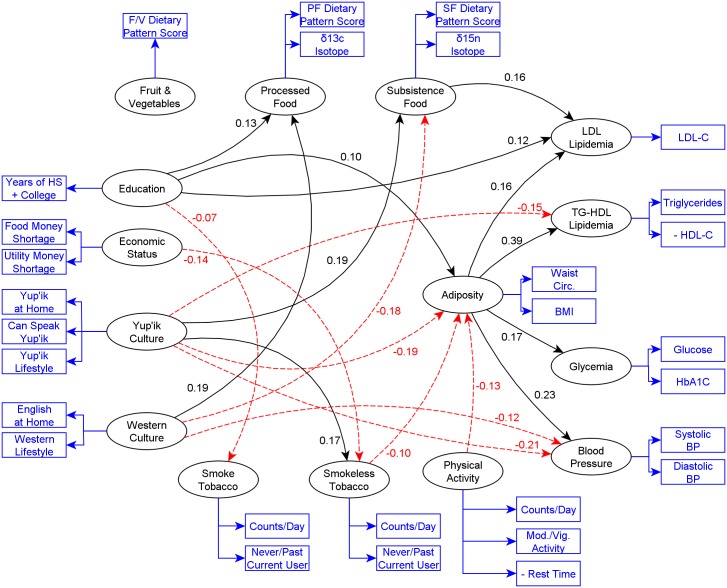
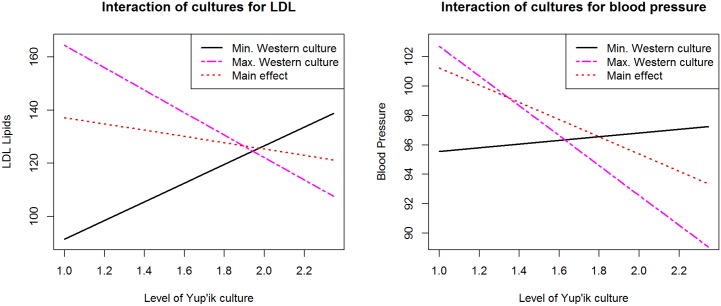
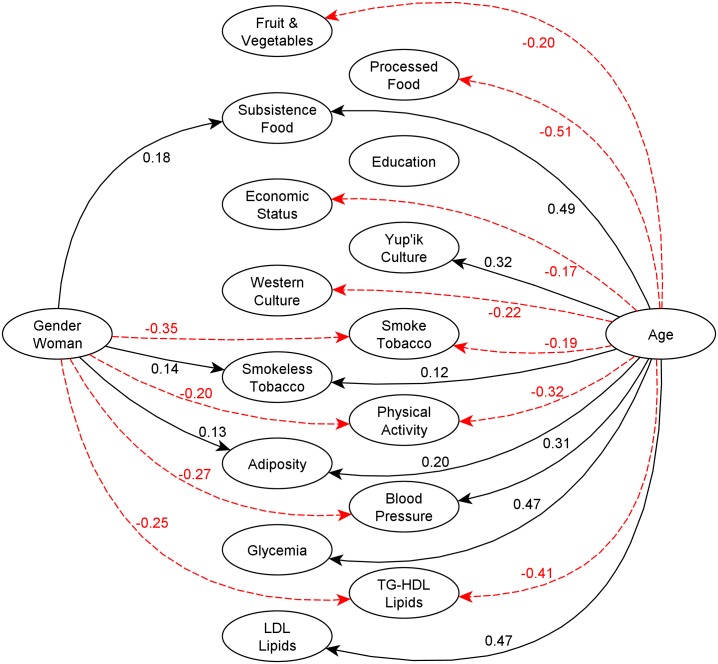
Alaska Native people experience disparities in mortality from heart disease and stroke. This work attempts to better understand the relationships between socioeconomic, behavioral, and cardiometabolic risk factors among Yup'ik people of southwestern Alaska, with a focus on the role of the socioeconomic, and cultural components. Using a cross-sectional sample of 486 Yup'ik adults, we fitted a Partial Least Squares Path Model (PLS-PM) to assess the associations between components, including demographic factors [age and gender], socioeconomic factors [education, economic status, Yup'ik culture, and Western culture], behavioral factors [diet, cigarette smoking and smokeless tobacco use, and physical activity], and cardiometabolic risk factors [adiposity, triglyceride-HDL and LDL lipids, glycemia, and blood pressure]. We found relatively mild associations of education and economic status with cardiometabolic risk factors, in contrast with studies in other populations. The socioeconomic factor and participation in Yup'ik culture had potentially protective associations with adiposity, triglyceride-HDL lipids, and blood pressure, whereas participation in Western culture had a protective association with blood pressure. We also found a moderating effect of participation in Western culture on the relationships between Yup'ik culture participation and both blood pressure and LDL lipids, indicating a potentially beneficial additional effect of bi-culturalism. Our results suggest that reinforcing protective effects of both Yup'ik and Western cultures could be useful for interventions aimed at reducing cardiometabolic health disparities.
阿拉斯加原住民在心脏病和中风死亡率方面存在差异。这项研究旨在更好地了解阿拉斯加西南部尤皮克族人群中社会经济、行为和心脏代谢风险因素之间的关系,重点关注社会经济和文化因素的作用。我们采用了486名尤皮克族成年人的横断面样本,拟合了偏最小二乘路径模型(PLS-PM),以评估各因素之间的关联,这些因素包括人口统计学因素(年龄和性别)、社会经济因素(教育程度、经济状况、尤皮克文化和西方文化)、行为因素(饮食、吸烟和使用无烟烟草以及身体活动)以及心脏代谢风险因素(肥胖、甘油三酯 - 高密度脂蛋白和低密度脂蛋白血脂、血糖和血压)。与其他人群的研究相比,我们发现教育程度和经济状况与心脏代谢风险因素之间的关联相对较弱。社会经济因素以及对尤皮克文化的参与与肥胖、甘油三酯 - 高密度脂蛋白血脂和血压之间可能存在保护关联,而参与西方文化与血压之间存在保护关联。我们还发现参与西方文化对尤皮克文化参与与血压和低密度脂蛋白血脂之间的关系具有调节作用,这表明双文化主义可能具有潜在的有益附加效应。我们的研究结果表明,强化尤皮克文化和西方文化的保护作用可能有助于开展旨在减少心脏代谢健康差异的干预措施。