Lee Jonghoo, Park Ju Hee, Jwa Hyeyoung, Kim Yee Hyung
Department of Internal Medicine, Jeju National University Hospital, Jeju National University School of Medicine, Jeju, Korea.
Division of Pulmonary and Critical Care Medicine, Seoul Metropolitan Government-Seoul National University Boramae Medical Center, Seoul, Korea.
Yonsei Med J. 2017 Jul;58(4):778-785. doi: 10.3349/ymj.2017.58.4.778.
Peramivir is the first intravenously administered neuramidase inhibitor for immediate delivery of an effective single-dose treatment in patients with influenza. However, limited data are available on intravenous (IV) peramivir treatment compared to oral oseltamivir for these patients.
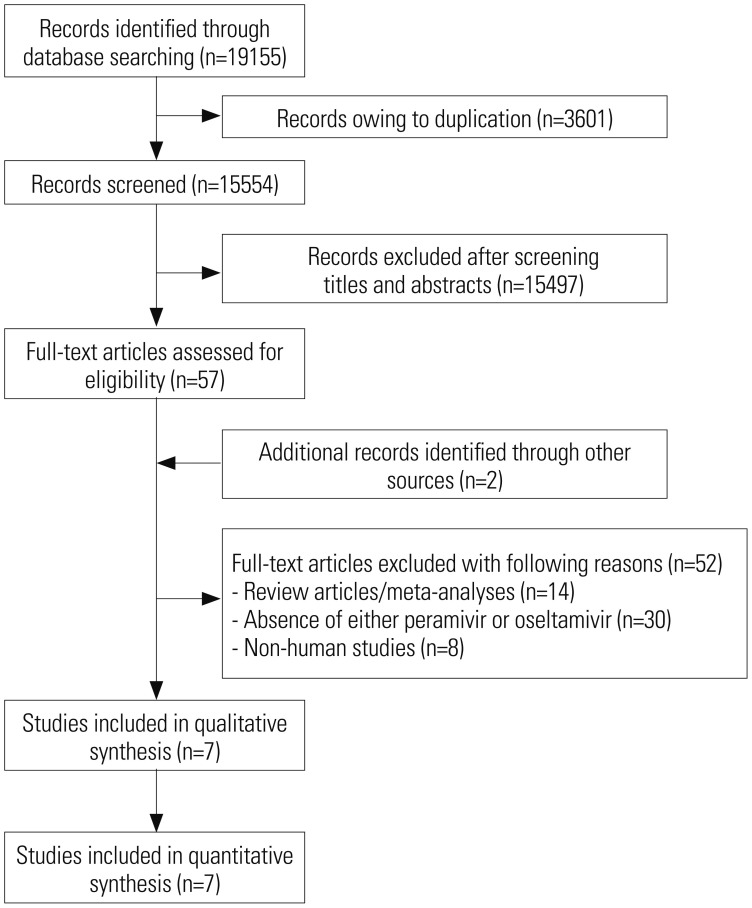
With a systematic review and meta-analysis, we compared the efficacy of IV peramivir with oral oseltamivir for treatment of patients with seasonal influenza. MEDLINE, EMBASE, and Cochrane Central Register were searched for relevant clinical trials.
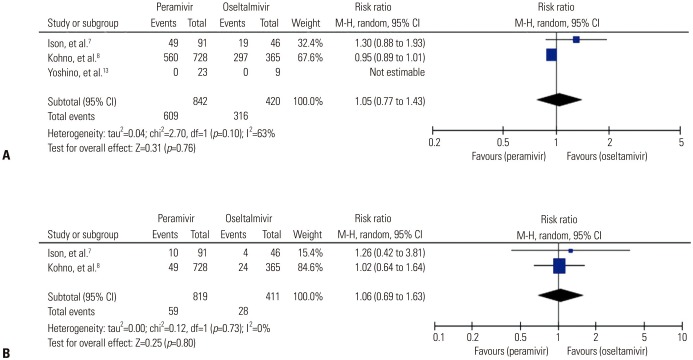
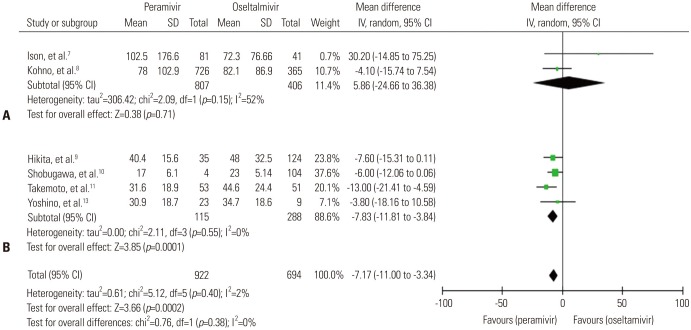
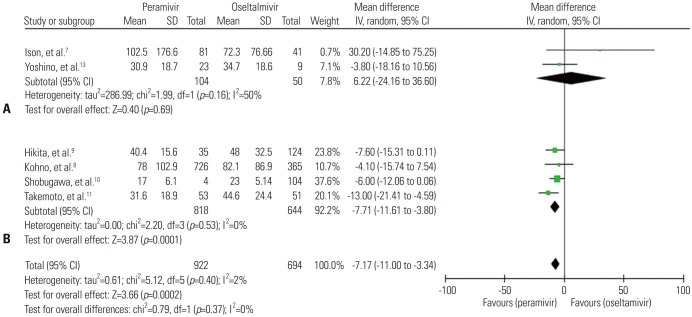
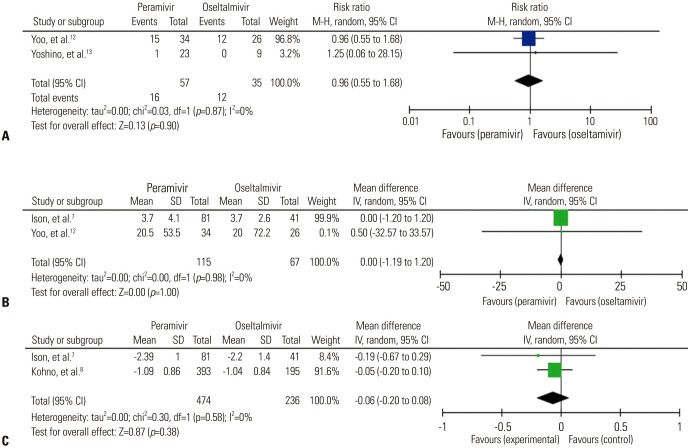
A total of seven trials [two randomized controlled trials (RCTs) and five non-randomized observational trials] involving 1676 patients were finally analyzed. The total number of peramivir- and oseltamivir-treated patients was 956 and 720, respectively. Overall, the time to alleviation of fever was lower in the peramivir-treated group compared with the oseltamivir-treated group [mean difference (MD), -7.17 hours; 95% confidence interval (CI) -11.00 to -3.34]. Especially, pooled analysis of observational studies (n=4) and studies of outpatients (n=4) demonstrated the superiority of the peramivir-treated group (MD, -7.83 hours; 95% CI -11.81 to -3.84 and MD, -7.71 hours; 95% CI -11.61 to -3.80, respectively). Mortality, length of hospital stay, change in virus titer 48 hours after admission, and the incidence of adverse events in these patients were not significantly different between the two groups.
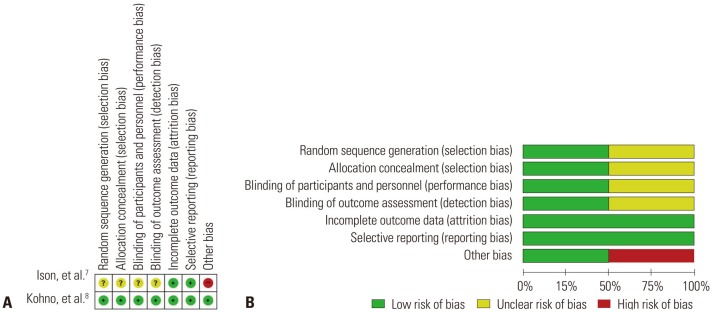
IV peramivir therapy might reduce the time to alleviation of fever in comparison with oral oseltamivir therapy in patients with influenza; however, we could not draw clear conclusions from a meta-analysis because of the few RCTs available and methodological limitations.
帕拉米韦是首个静脉注射的神经氨酸酶抑制剂,可用于流感患者的单剂量速效治疗。然而,与口服奥司他韦相比,关于静脉注射帕拉米韦治疗此类患者的数据有限。
通过系统评价和荟萃分析,我们比较了静脉注射帕拉米韦与口服奥司他韦治疗季节性流感患者的疗效。检索了MEDLINE、EMBASE和Cochrane中央对照试验注册库中的相关临床试验。
最终分析了涉及1676例患者的7项试验[2项随机对照试验(RCT)和5项非随机观察性试验]。接受帕拉米韦和奥司他韦治疗的患者总数分别为956例和720例。总体而言,与奥司他韦治疗组相比,帕拉米韦治疗组发热缓解时间更短[平均差(MD),-7.17小时;95%置信区间(CI)-11.00至-3.34]。特别是,观察性研究(n = 4)和门诊患者研究(n = 4)的汇总分析显示帕拉米韦治疗组具有优势(MD分别为-7.83小时;95%CI -11.81至-3.84和MD,-7.71小时;95%CI -11.61至-3.80)。两组患者的死亡率、住院时间、入院48小时后病毒滴度变化以及不良事件发生率无显著差异。
与口服奥司他韦治疗流感患者相比,静脉注射帕拉米韦治疗可能会缩短发热缓解时间;然而,由于可用的随机对照试验较少以及方法学上的局限性,我们无法从荟萃分析中得出明确结论。