Forde Corey, Stierman Bryan, Ramon-Pardo Pilar, Dos Santos Thais, Singh Nalini
Queen Elizabeth Hospital, Bridgetown, Barbados.
Children's National Health System, Washington DC, United States of America.
PLoS One. 2017 May 25;12(5):e0176779. doi: 10.1371/journal.pone.0176779. eCollection 2017.
Carbapenem-resistant Klebsiella pneumoniae (CRKP) is of growing concern globally. The risk for transmission of antimicrobial resistant organisms across several continents to the Caribbean is a real one given its tourism industry. After a cluster of cases of CRKP were detected, several studies detailed in this report were initiated to better characterize the problem.
A hospital-wide point prevalence study and active surveillance were performed at Queen Elizabeth Hospital (QEH) in Barbados in 2013 to assess the prevalence of CRKP infection/colonization. Following this, a 1-year longitudinal study measured the prevalence of CRKP isolates in the hospital and across all healthcare facilities in the country.
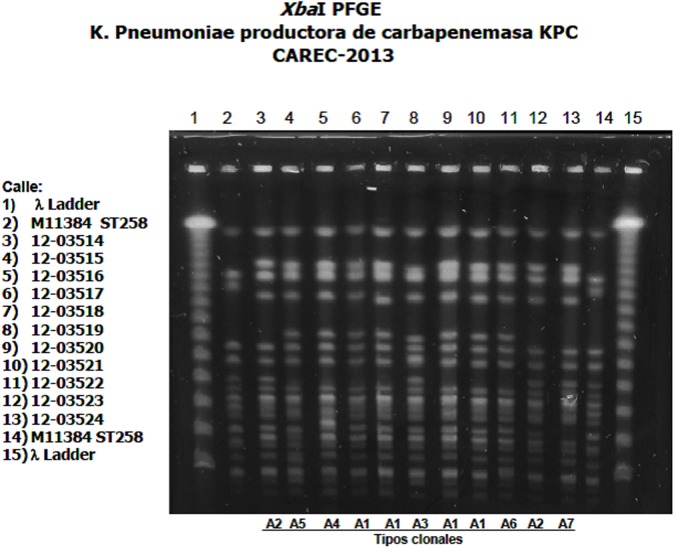
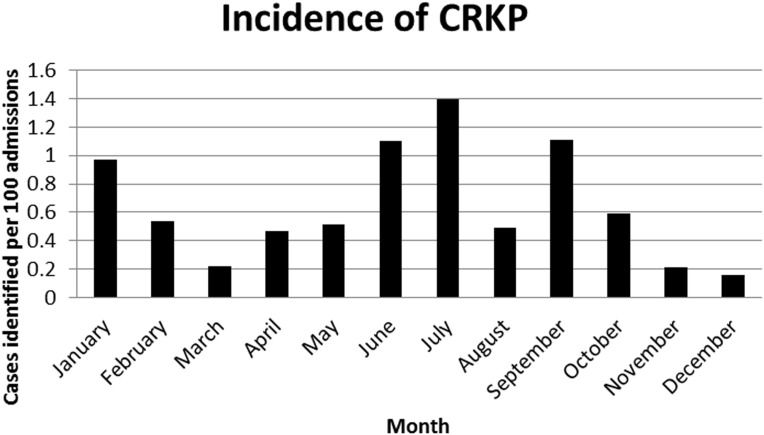
In 2013, eleven viable isolates of CRKP from cluster of cases were sent for molecular epidemiology studies. When sequenced, they were found to be the ST-258 clone. Identification of a cluster of cases of CRKP ST-258/512 clones indicated person-to-person transmission. In September 2013, the hospital-wide point prevalence study revealed 18% of patients (53/299) at the hospital were either colonized or infected with CRKP. The infection to colonization ratio was 1:7. Patients who were infected/colonized vs. non-colonized were older (64.7 vs. 48.7 years, p<0.0001), were hospitalized longer (42.5 days vs. 27 days, p = 0.0042), were more likely to have an invasive device (66% vs. 32%, p<0.0001), especially urinary catheters (55% vs. 24%, p<0.0001), and were more likely to have used antimicrobials within the prior 14 days (91% vs. 46%, p<0.0001). Specific antimicrobials, including fluoroquinolones and piperacillin-tazobactam, were significantly associated with infection/colonization. In 2014, the 12-month period prevalence of CRKP in Barbados was 49.6 per 100,000 population and of blood stream infections was 3.2 per 100,000 population.
This point prevalence study identified patients at-risk of acquisition of CRKP and allowed QEH to implement interventions aimed at decreasing the prevalence of CRKP. Organization of a National and regional Infection Prevention and Control Committee in 2014 aimed to strengthen antimicrobial resistance surveillance programs across the English-speaking Caribbean were established.
耐碳青霉烯类肺炎克雷伯菌(CRKP)在全球范围内日益受到关注。鉴于加勒比地区的旅游业,抗菌耐药菌跨多个大陆传播至该地区的风险是切实存在的。在检测到一系列CRKP病例后,启动了本报告中详细介绍的多项研究,以更好地描述这一问题。
2013年在巴巴多斯的伊丽莎白女王医院(QEH)进行了一项全院范围的现患率研究和主动监测,以评估CRKP感染/定植的患病率。在此之后,进行了一项为期1年的纵向研究,以测量该医院及该国所有医疗机构中CRKP分离株的患病率。
2013年,从一系列病例中分离出的11株存活的CRKP菌株被送去进行分子流行病学研究。测序后发现它们是ST-258克隆。CRKP ST-258/512克隆病例群的识别表明存在人际传播。2013年9月,全院范围的现患率研究显示,该医院18%的患者(53/299)被CRKP定植或感染。感染与定植的比例为1:7。与未被定植的患者相比,被感染/定植的患者年龄更大(64.7岁对48.7岁,p<0.0001),住院时间更长(42.5天对27天,p = 0.0042),更有可能使用侵入性设备(66%对32%,p<0.0001),尤其是导尿管(55%对24%,p<0.0001),并且在过去14天内更有可能使用过抗菌药物(91%对46%,p<0.0001)。包括氟喹诺酮类和哌拉西林-他唑巴坦在内的特定抗菌药物与感染/定植显著相关。2014年,巴巴多斯CRKP的12个月期间患病率为每10万人49.