
共表达的黑色素瘤相关抗原A(MAGE-A)蛋白之间的功能相互作用。
Functional interaction between co-expressed MAGE-A proteins.
作者信息
Laiseca Julieta E, Ladelfa María F, Cotignola Javier, Peche Leticia Y, Pascucci Franco A, Castaño Bryan A, Galigniana Mario D, Schneider Claudio, Monte Martin
机构信息
Lab. Oncología Molecular, Departamento de Química Biológica and IQUIBICEN-UBA/CONICET, Facultad de Ciencias Exactas y Naturales, Universidad de Buenos Aires, Buenos Aires, Argentina.
Lab. Inflamación y Cáncer, Departamento de Química Biológica and IQUIBICEN-UBA/CONICET, Facultad de Ciencias Exactas y Naturales, Universidad de Buenos Aires, Buenos Aires, Argentina.
出版信息
PLoS One. 2017 May 24;12(5):e0178370. doi: 10.1371/journal.pone.0178370. eCollection 2017.
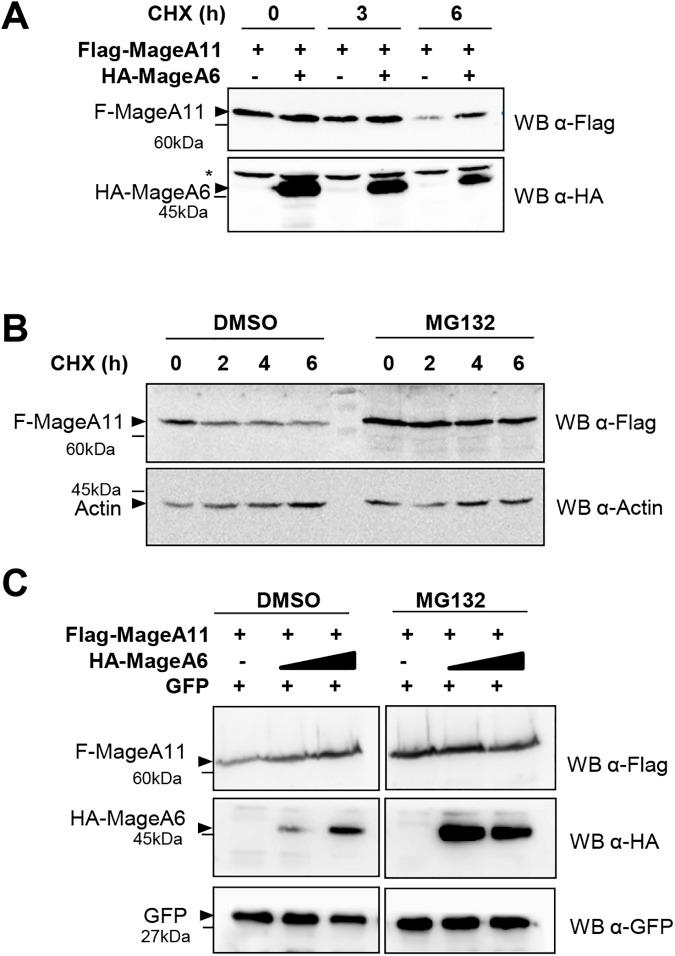
MAGE-A (Melanoma Antigen Genes-A) are tumor-associated proteins with expression in a broad spectrum of human tumors and normal germ cells. MAGE-A gene expression and function are being increasingly investigated to better understand the mechanisms by which MAGE proteins collaborate in tumorigenesis and whether their detection could be useful for disease prognosis purposes. Alterations in epigenetic mechanisms involved in MAGE gene silencing cause their frequent co-expression in tumor cells. Here, we have analyzed the effect of MAGE-A gene co-expression and our results suggest that MageA6 can potentiate the androgen receptor (AR) co-activation function of MageA11. Database search confirmed that MageA11 and MageA6 are co-expressed in human prostate cancer samples. We demonstrate that MageA6 and MageA11 form a protein complex resulting in the stabilization of MageA11 and consequently the enhancement of AR activity. The mechanism involves association of the Mage A6-MHD domain to MageA11, prevention of MageA11 ubiquitinylation on lysines 240 and 245 and decreased proteasome-dependent degradation. We experimentally demonstrate here for the first time that two MAGE-A proteins can act together in a non-redundant way to potentiate a specific oncogenic function. Overall, our results highlight the complexity of the MAGE gene networking in regulating cancer cell behavior.
黑色素瘤抗原基因A(MAGE-A)是与肿瘤相关的蛋白质,在多种人类肿瘤和正常生殖细胞中表达。人们对MAGE-A基因的表达和功能进行了越来越多的研究,以更好地理解MAGE蛋白在肿瘤发生过程中协同作用的机制,以及它们的检测是否有助于疾病预后。参与MAGE基因沉默的表观遗传机制的改变导致它们在肿瘤细胞中频繁共表达。在这里,我们分析了MAGE-A基因共表达的影响,我们的结果表明MageA6可以增强MageA11的雄激素受体(AR)共激活功能。数据库搜索证实MageA11和MageA6在人类前列腺癌样本中共表达。我们证明MageA6和MageA11形成一种蛋白质复合物,导致MageA11稳定,从而增强AR活性。其机制包括Mage A6-MHD结构域与MageA11的结合,防止MageA11在赖氨酸240和245处泛素化,并减少蛋白酶体依赖性降解。我们首次通过实验证明,两种MAGE-A蛋白可以以非冗余的方式共同作用,增强特定的致癌功能。总体而言,我们的结果突出了MAGE基因网络在调节癌细胞行为方面的复杂性。


 Zotero 插件