Baczyk Dora, Audette Melanie C, Drewlo Sascha, Levytska Khrystyna, Kingdom John C
Program in Development and Fetal Health, Lunenfeld-Tanenbaum Research Institute, Mount Sinai Hospital, Toronto, Canada.
Faculty of Medicine, University of Toronto, Toronto, Canada.
PLoS One. 2017 May 17;12(5):e0178056. doi: 10.1371/journal.pone.0178056. eCollection 2017.
Small ubiquitin-like modifiers (SUMOs) conjugate to proteins post-translationally, thereby affecting target localization, activity and stability. Functional SUMO family members identified in the human placenta include SUMO-1 to SUMO-3, which are elevated in pre-eclampsia. Whether the fourth isoform, SUMO-4, plays a role in placental development and function remains unknown.
We tested the hypothesis that SUMO-4 is expressed in the human placenta and demonstrates altered SUMOylation in pre-eclamptic pregnancies.
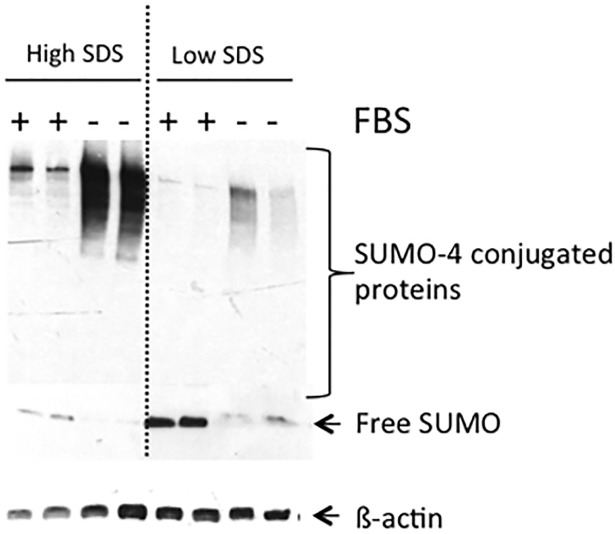
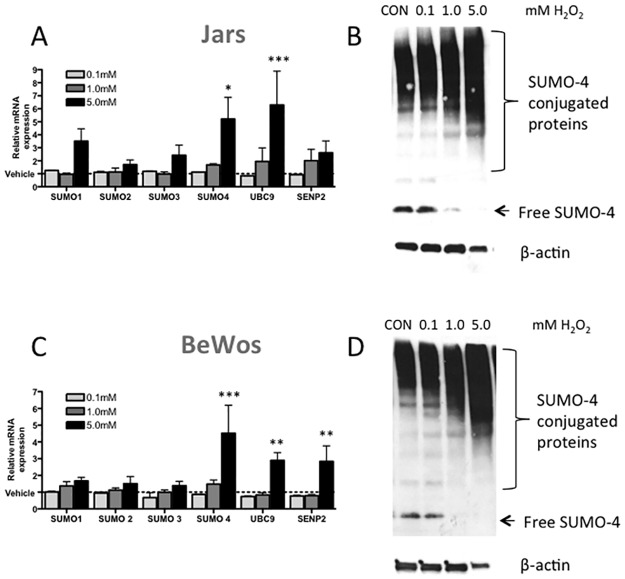
SUMO-4 mRNA (qRT-PCR) and protein (Western blot and immunohistochemistry) were measured in Jar cells, BeWo cells, first trimester placental villous explants and placental tissues across normal gestation and in pre-eclampsia. SUMO-4 expression in response to oxidative stress (H2O2: 0, 0.1, 1 and 5mM), as well as, hypoxia-reperfusion (O2: 1%, 8% and 20%) was measured. Lastly, SUMO-4 binding (covalently vs. non-covalently) to target proteins was investigated.
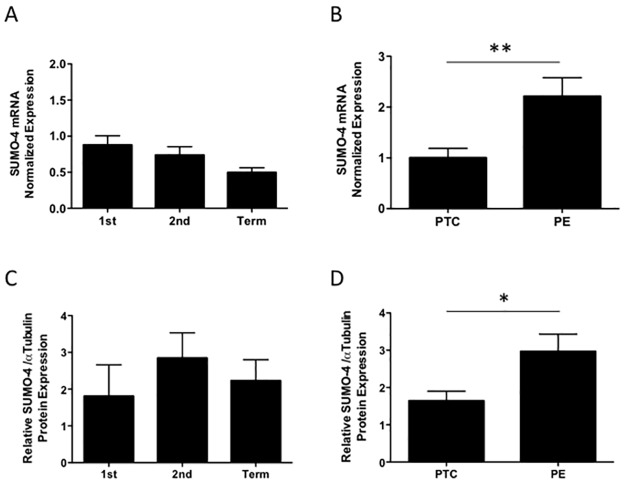
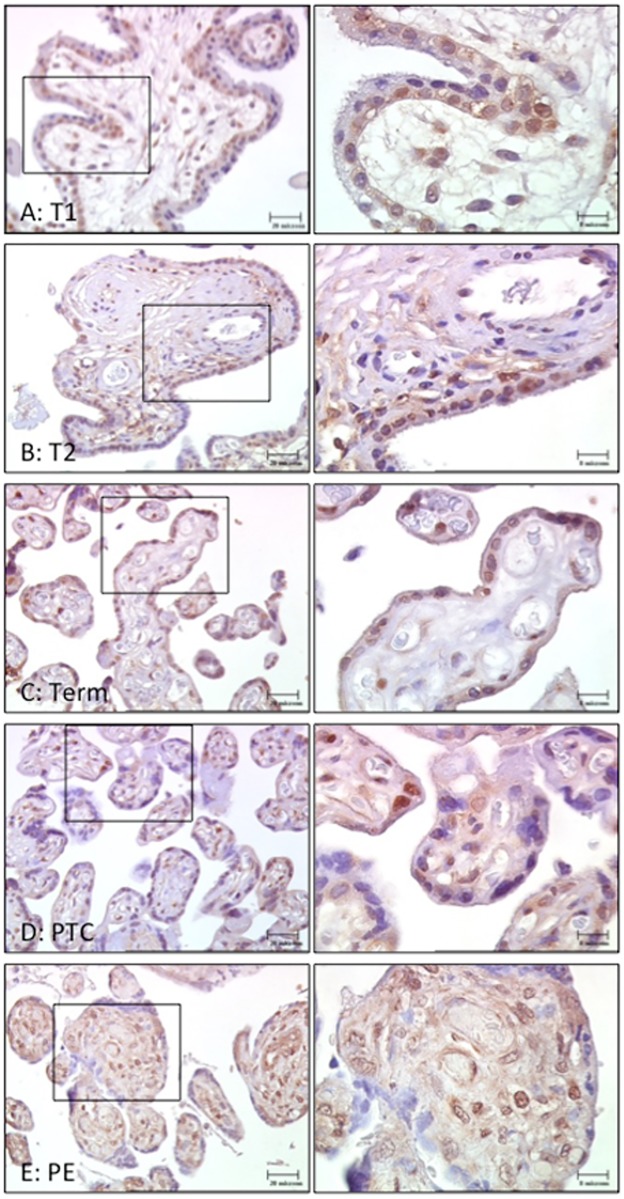
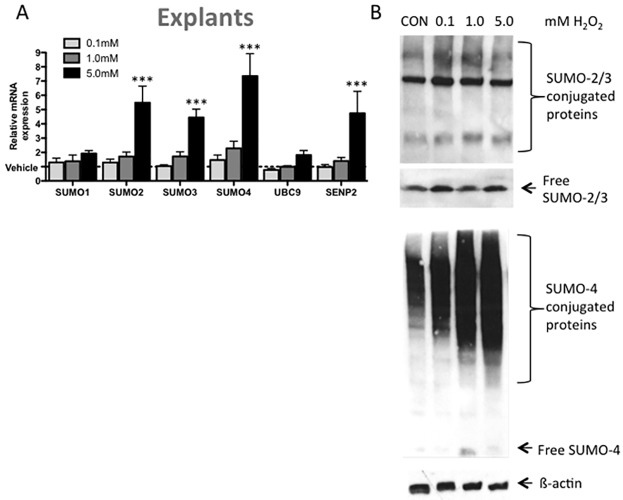
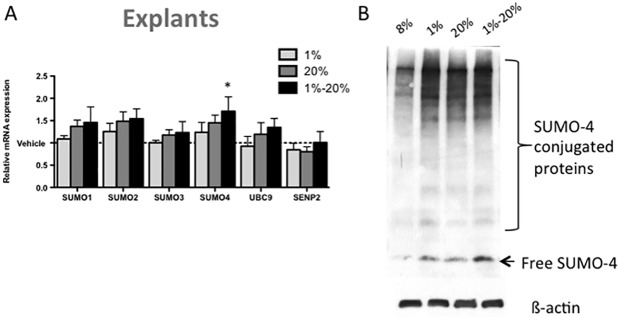
SUMO-4 mRNA and protein were unchanged across gestation. SUMO-4 was present in the villous trophoblast layer throughout gestation. SUMO-4 mRNA expression and protein levels were increased ~2.2-fold and ~1.8-fold in pre-eclamptic placentas compared to age-matched controls, respectively (p<0.01). SUMO-4 mRNA and protein expression increased in Jars, BeWos and first trimester placental explants with 5mM H2O2 treatment, as well as with exposure to hypoxia-reperfusion. SUMO-1 to SUMO-3 did not show consistent trends across models. SUMO-4 hyper-SUMOylation was predominantly covalent in nature.
SUMO-4 is expressed in normal placental development. SUMO-4 expression was increased in pre-eclamptic placentas and in models of oxidative stress and hypoxic injury. These data suggests that SUMO-4 hyper-SUMOylation may be a potential post-translational mechanism in the stressed pre-eclamptic placenta.
小泛素样修饰物(SUMO)在蛋白质翻译后与之结合,从而影响靶蛋白的定位、活性和稳定性。在人胎盘中鉴定出的功能性SUMO家族成员包括SUMO-1至SUMO-3,它们在子痫前期中表达升高。SUMO的第四种异构体SUMO-4是否在胎盘发育和功能中发挥作用尚不清楚。
我们检验了SUMO-4在人胎盘中表达且在子痫前期妊娠中SUMO化改变的假说。
采用实时定量逆转录聚合酶链反应(qRT-PCR)检测Jar细胞、BeWo细胞、孕早期胎盘绒毛外植体以及整个正常妊娠期和子痫前期胎盘组织中的SUMO-4信使核糖核酸(mRNA),采用蛋白质免疫印迹法和免疫组织化学法检测SUMO-4蛋白。检测SUMO-4在氧化应激(过氧化氢:0、0.1、1和5毫摩尔)以及缺氧再灌注(氧气:1%、8%和20%)条件下的表达。最后,研究SUMO-4与靶蛋白的结合(共价结合与非共价结合)情况。
SUMO-4的mRNA和蛋白在整个妊娠期无变化。SUMO-4在整个妊娠期均存在于绒毛滋养层。与年龄匹配的对照组相比,子痫前期胎盘组织中SUMO-4的mRNA表达和蛋白水平分别增加约2.2倍和约1.8倍(p<0.01)。经5毫摩尔过氧化氢处理以及暴露于缺氧再灌注条件下后,Jar细胞、BeWo细胞和孕早期胎盘外植体中SUMO-4的mRNA和蛋白表达增加。SUMO-1至SUMO-3在各模型中未表现出一致的趋势。SUMO-4的超SUMO化主要为共价性质。
SUMO-4在正常胎盘发育中表达。SUMO-4在子痫前期胎盘以及氧化应激和缺氧损伤模型中的表达增加。这些数据表明,SUMO-4的超SUMO化可能是应激子痫前期胎盘中一种潜在的翻译后机制。