Sumari Deborah, Mwingira Felista, Selemani Majige, Mugasa Joseph, Mugittu Kefas, Gwakisa Paul
Intervention and Clinical Trials Department, Ifakara Health Institute, Bagamoyo, Tanzania.
School of Life Sciences and Bioengineering, The Nelson Mandela African Institution for Science and Technology, Arusha, Tanzania.
Malar J. 2017 May 25;16(1):222. doi: 10.1186/s12936-017-1870-4.
Malaria prevalence continues to decline across sub-Saharan Africa as a result of various intervention strategies. However, the diseases still poses a public health concern in the region. While symptomatic malaria is recognized and treated, asymptomatic infections become increasingly important for interrupting transmission. A cross-sectional survey was conducted to assess malaria prevalence in symptomatic and asymptomatic children in Kiwangwa ward in Bagamoyo District in Tanzania.
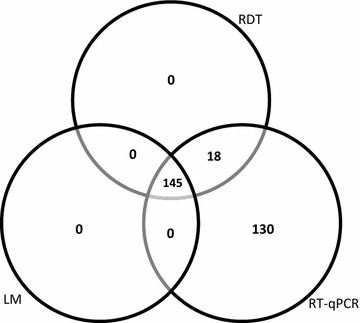
Four hundred school-aged children in Kiwanga ward were recruited in the study; 200 from Kiwangwa dispensary and 200 from nearby schools. Primary health parameters were examined and blood samples collected and examined for Plasmodium falciparum prevalence using rapid diagnostic test (RDT), light microscopy (LM) and reverse transcription quantitative PCR (RT-qPCR) targeting transcripts of A-type 18s rRNA of P. falciparum. Gametocytes were detected by LM and RT-qPCR targeting transcripts of gametocyte specific marker, Pfs25.
Overall P. falciparum prevalence was 73.3, 40.8 and 36.3% by RT-qPCR, RDT and LM in the study area, respectively (P < 0.001). As expected symptomatic children had a significantly higher prevalence of 89, 67.5 and 64.5% by qPCR, RDT and LM, compared to 57.5, 14 and 8% in the asymptomatic group, respectively. However, gametocyte prevalence in asymptomatic individuals was higher by both LM (2%) and qPCR (14%) than in symptomatic individuals LM (0.5%) and qPCR (3%).
A substantial difference in prevalence of symptomatic and asymptomatic infections observed in Kiwangwa ward underpins the use of molecular tools in malaria surveillance aiming at estimating prevalence and transmission. Notably, the higher gametocytaemia observed in asymptomatic children indicates the reservoir infections and points to the need for detection and treatment of both asymptomatic and symptomatic malaria.
由于采取了各种干预策略,撒哈拉以南非洲地区的疟疾流行率持续下降。然而,该疾病在该地区仍然是一个公共卫生问题。虽然有症状的疟疾能够得到识别和治疗,但无症状感染对于阻断传播变得越来越重要。在坦桑尼亚巴加莫约区基旺瓜病房进行了一项横断面调查,以评估有症状和无症状儿童的疟疾流行率。
在该研究中招募了基旺瓜病房的400名学龄儿童;其中200名来自基旺瓜药房,200名来自附近学校。检查主要健康参数,并采集血样,使用快速诊断测试(RDT)、光学显微镜(LM)以及针对恶性疟原虫A型18s rRNA转录本的逆转录定量PCR(RT-qPCR)检测恶性疟原虫的流行率。通过光学显微镜和针对配子体特异性标志物Pfs25转录本的RT-qPCR检测配子体。
在研究区域,通过RT-qPCR、RDT和LM检测到的恶性疟原虫总体流行率分别为73.3%、40.8%和36.3%(P < 0.001)。正如预期的那样,有症状儿童通过qPCR、RDT和LM检测到的流行率显著更高,分别为89%、67.5%和64.5%,而无症状组的流行率分别为57.5%、14%和8%。然而,无症状个体中配子体的流行率通过LM(2%)和qPCR(14%)均高于有症状个体,分别为LM(0.5%)和qPCR(3%)。
在基旺瓜病房观察到的有症状和无症状感染流行率存在显著差异,这支持了在疟疾监测中使用分子工具来估计流行率和传播情况。值得注意的是,在无症状儿童中观察到的较高配子体血症表明存在隐匿感染,这表明需要对无症状和有症状的疟疾进行检测和治疗。