• 文献检索
  • 文档翻译
  • 深度研究
  • 学术资讯
  • Suppr Zotero 插件Zotero 插件
  • 邀请有礼
  • 套餐&价格
  • 历史记录
应用&插件
Suppr Zotero 插件Zotero 插件浏览器插件Mac 客户端Windows 客户端微信小程序
定价
高级版会员购买积分包购买API积分包
服务
文献检索文档翻译深度研究API 文档MCP 服务
关于我们
关于 Suppr公司介绍联系我们用户协议隐私条款
关注我们

Suppr 超能文献

核心技术专利:CN118964589B侵权必究
粤ICP备2023148730 号-1Suppr @ 2026

文献检索

告别复杂PubMed语法,用中文像聊天一样搜索,搜遍4000万医学文献。AI智能推荐,让科研检索更轻松。

立即免费搜索

文件翻译

保留排版,准确专业,支持PDF/Word/PPT等文件格式,支持 12+语言互译。

免费翻译文档

深度研究

AI帮你快速写综述,25分钟生成高质量综述,智能提取关键信息,辅助科研写作。

立即免费体验

成纤维细胞生长因子受体1活性的抑制介导了索拉非尼在人恶性胸膜间皮瘤肿瘤起始细胞中的抗增殖作用。

The inhibition of FGF receptor 1 activity mediates sorafenib antiproliferative effects in human malignant pleural mesothelioma tumor-initiating cells.

作者信息

Pattarozzi Alessandra, Carra Elisa, Favoni Roberto E, Würth Roberto, Marubbi Daniela, Filiberti Rosa Angela, Mutti Luciano, Florio Tullio, Barbieri Federica, Daga Antonio

机构信息

Department of Internal Medicine (DiMI) and Centre of Excellence for Biomedical Research (CEBR), University of Genova, Viale Benedetto XV, 2, 16132, Genova, Italy.

Department of Experimental Medicine (DIMES), University of Genova, Via L.B. Alberti, 2, 16132, Genova, Italy.

出版信息

Stem Cell Res Ther. 2017 May 25;8(1):119. doi: 10.1186/s13287-017-0573-7.

DOI:10.1186/s13287-017-0573-7
PMID:28545562
原文链接:https://pmc.ncbi.nlm.nih.gov/articles/PMC5445511/
Abstract

BACKGROUND

Malignant pleural mesothelioma is an aggressive cancer, characterized by rapid progression and high mortality. Persistence of tumor-initiating cells (TICs, or cancer stem cells) after cytotoxic drug treatment is responsible for tumor relapse, and represents one of the main reasons for the poor prognosis of mesothelioma. In fact, identification of the molecules affecting TIC viability is still a significant challenge.

METHODS

TIC-enriched cultures were obtained from 10 human malignant pleural mesotheliomas and cultured in vitro. Three fully characterized tumorigenic cultures, named MM1, MM3, and MM4, were selected and used to assess antiproliferative effects of the multi-kinase inhibitor sorafenib. Cell viability was investigated by MTT assay, and cell cycle analysis as well as induction of apoptosis were determined by flow cytometry. Western blotting was performed to reveal the modulation of protein expression and the phosphorylation status of pathways associated with sorafenib treatment.

RESULTS

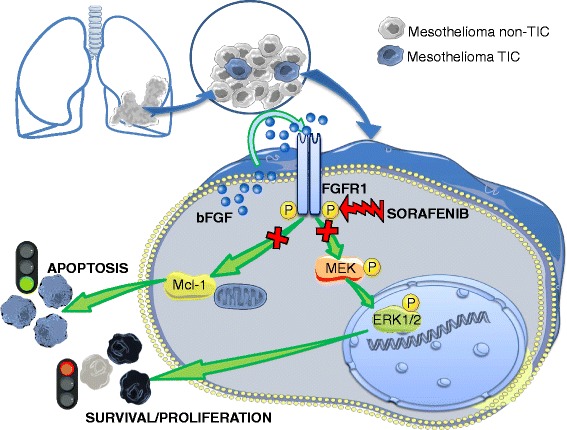
We analyzed the molecular mechanisms of the antiproliferative effects of sorafenib in mesothelioma TIC cultures. Sorafenib inhibited cell cycle progression in all cultures, but only in MM3 and MM4 cells was this effect associated with Mcl-1-dependent apoptosis. To investigate the mechanisms of sorafenib-mediated antiproliferative activity, TICs were treated with epidermal growth factor (EGF) or basic fibroblast growth factor (bFGF) causing, in MM3 and MM4 cells, MEK, ERK1/2, Akt, and STAT3 phosphorylation. These effects were abolished by sorafenib only in bFGF-treated cells, while a modest inhibition occurred after EGF stimulation, suggesting that sorafenib effects are mainly due to FGF receptor (FGFR) inhibition. Indeed, FGFR1 phosphorylation was inhibited by sorafenib. Moreover, in MM1 cells, which release high levels of bFGF and showed autocrine activation of FGFR1 and constitutive phosphorylation/activation of MEK-ERK1/2, sorafenib induced a more effective antiproliferative response, confirming that the main target of the drug is the inhibition of FGFR1 activity.

CONCLUSIONS

These results suggest that, in malignant pleural mesothelioma TICs, bFGF signaling is the main target of the antiproliferative response of sorafenib, acting directly on the FGFR1 activation. Patients with constitutive FGFR1 activation via an autocrine loop may be more sensitive to sorafenib treatment and the analysis of this possibility warrants further clinical investigation.

摘要

背景

恶性胸膜间皮瘤是一种侵袭性癌症,其特点是进展迅速且死亡率高。细胞毒性药物治疗后肿瘤起始细胞(TICs,即癌症干细胞)的持续存在导致肿瘤复发,这也是间皮瘤预后不良的主要原因之一。事实上,鉴定影响TIC生存能力的分子仍然是一项重大挑战。

方法

从10例人类恶性胸膜间皮瘤中获取富含TIC的培养物并进行体外培养。选择三种特征明确的致瘤培养物,命名为MM1、MM3和MM4,用于评估多激酶抑制剂索拉非尼的抗增殖作用。通过MTT法研究细胞活力,通过流式细胞术确定细胞周期分析以及凋亡诱导情况。进行蛋白质印迹分析以揭示与索拉非尼治疗相关的蛋白质表达调节和信号通路的磷酸化状态。

结果

我们分析了索拉非尼在间皮瘤TIC培养物中抗增殖作用的分子机制。索拉非尼在所有培养物中均抑制细胞周期进程,但仅在MM3和MM4细胞中,这种作用与Mcl-1依赖性凋亡相关。为了研究索拉非尼介导的抗增殖活性机制,用表皮生长因子(EGF)或碱性成纤维细胞生长因子(bFGF)处理TICs,导致MM3和MM4细胞中MEK、ERK1/2、Akt和STAT3磷酸化。索拉非尼仅在bFGF处理的细胞中消除了这些作用,而在EGF刺激后出现适度抑制,这表明索拉非尼的作用主要归因于对成纤维细胞生长因子受体(FGFR)的抑制。事实上,索拉非尼抑制了FGFR1磷酸化。此外,在释放高水平bFGF并显示FGFR1自分泌激活以及MEK-ERK1/2组成性磷酸化/激活的MM1细胞中,索拉非尼诱导了更有效的抗增殖反应,证实该药物的主要靶点是抑制FGFR1活性。

结论

这些结果表明,在恶性胸膜间皮瘤TICs中,bFGF信号是索拉非尼抗增殖反应的主要靶点,直接作用于FGFR1激活。通过自分泌环组成性激活FGFR1的患者可能对索拉非尼治疗更敏感,对此可能性的分析值得进一步的临床研究。
https://cdn.ncbi.nlm.nih.gov/pmc/blobs/032e/5445511/543dbfa6a4b5/13287_2017_573_Fig9_HTML.jpg

相似文献

1
The inhibition of FGF receptor 1 activity mediates sorafenib antiproliferative effects in human malignant pleural mesothelioma tumor-initiating cells.成纤维细胞生长因子受体1活性的抑制介导了索拉非尼在人恶性胸膜间皮瘤肿瘤起始细胞中的抗增殖作用。
Stem Cell Res Ther. 2017 May 25;8(1):119. doi: 10.1186/s13287-017-0573-7.
2
Sorafenib inhibits ERK1/2 and MCL-1(L) phosphorylation levels resulting in caspase-independent cell death in malignant pleural mesothelioma.索拉非尼抑制 ERK1/2 和 MCL-1(L)磷酸化水平,导致恶性胸膜间皮瘤中的 caspase 非依赖性细胞死亡。
Cancer Biol Ther. 2009 Dec;8(24):2406-16. doi: 10.4161/cbt.8.24.10824. Epub 2009 Dec 2.
3
Comprehensive Pharmacogenomic Profiling of Malignant Pleural Mesothelioma Identifies a Subgroup Sensitive to FGFR Inhibition.全面的恶性胸膜间皮瘤药物基因组分析确定了对 FGFR 抑制敏感的亚组。
Clin Cancer Res. 2018 Jan 1;24(1):84-94. doi: 10.1158/1078-0432.CCR-17-1172. Epub 2017 Oct 23.
4
Fibroblast growth factor receptor inhibition is active against mesothelioma and synergizes with radio- and chemotherapy.成纤维细胞生长因子受体抑制对间皮瘤有效,并与放化疗协同作用。
Am J Respir Crit Care Med. 2014 Oct 1;190(7):763-72. doi: 10.1164/rccm.201404-0658OC.
5
Gefitinib targets EGFR dimerization and ERK1/2 phosphorylation to inhibit pleural mesothelioma cell proliferation.吉非替尼通过靶向 EGFR 二聚化和 ERK1/2 磷酸化来抑制胸膜间皮瘤细胞增殖。
Curr Cancer Drug Targets. 2010 Mar;10(2):176-91. doi: 10.2174/156800910791054130.
6
PI3 Kinase Pathway and MET Inhibition is Efficacious in Malignant Pleural Mesothelioma.PI3 激酶通路和 MET 抑制在恶性胸膜间皮瘤中有效。
Sci Rep. 2016 Sep 13;6:32992. doi: 10.1038/srep32992.
7
The combination of sorafenib and everolimus shows antitumor activity in preclinical models of malignant pleural mesothelioma.索拉非尼和依维莫司联合用药在恶性胸膜间皮瘤的临床前模型中显示出抗肿瘤活性。
BMC Cancer. 2015 May 8;15:374. doi: 10.1186/s12885-015-1363-1.
8
Expression of FGFR1-4 in Malignant Pleural Mesothelioma Tissue and Corresponding Cell Lines and its Relationship to Patient Survival and FGFR Inhibitor Sensitivity.成纤维细胞生长因子受体 1-4 在恶性胸膜间皮瘤组织及相应细胞系中的表达及其与患者生存和 FGFR 抑制剂敏感性的关系。
Cells. 2019 Sep 16;8(9):1091. doi: 10.3390/cells8091091.
9
Sorafenib selectively depletes human glioblastoma tumor-initiating cells from primary cultures.索拉非尼可从原代培养物中选择性地耗竭人胶质母细胞瘤起始细胞。
Cell Cycle. 2013 Feb 1;12(3):491-500. doi: 10.4161/cc.23372. Epub 2013 Jan 16.
10
Trametinib plus 4-Methylumbelliferone Exhibits Antitumor Effects by ERK Blockade and CD44 Downregulation and Affects PD-1 and PD-L1 in Malignant Pleural Mesothelioma.曲美替尼联合 4-甲基伞形酮表现出通过 ERK 阻断和 CD44 下调的抗肿瘤作用,并影响恶性胸膜间皮瘤中的 PD-1 和 PD-L1。
J Thorac Oncol. 2017 Mar;12(3):477-490. doi: 10.1016/j.jtho.2016.10.023. Epub 2016 Nov 17.

引用本文的文献

1
The expression of pro-prion, a transmembrane isoform of the prion protein, leads to the constitutive activation of the canonical Wnt/β-catenin pathway to sustain the stem-like phenotype of human glioblastoma cells.朊病毒蛋白的跨膜异构体前体朊病毒的表达导致经典Wnt/β-连环蛋白信号通路的组成性激活,以维持人胶质母细胞瘤细胞的干细胞样表型。
Cancer Cell Int. 2024 Dec 23;24(1):426. doi: 10.1186/s12935-024-03581-1.
2
FuseLinker: Leveraging LLM's pre-trained text embeddings and domain knowledge to enhance GNN-based link prediction on biomedical knowledge graphs.FuseLinker:利用大语言模型的预训练文本嵌入和领域知识增强基于图神经网络的生物医学知识图谱的链接预测。
J Biomed Inform. 2024 Oct;158:104730. doi: 10.1016/j.jbi.2024.104730. Epub 2024 Sep 24.
3

本文引用的文献

1
Inhibition of the Autophagy Pathway Synergistically Potentiates the Cytotoxic Activity of Givinostat (ITF2357) on Human Glioblastoma Cancer Stem Cells.自噬途径的抑制协同增强了吉维司他(ITF2357)对人胶质母细胞瘤癌症干细胞的细胞毒活性。
Front Mol Neurosci. 2016 Oct 27;9:107. doi: 10.3389/fnmol.2016.00107. eCollection 2016.
2
Cellular prion protein controls stem cell-like properties of human glioblastoma tumor-initiating cells.细胞朊蛋白控制人胶质母细胞瘤肿瘤起始细胞的干细胞样特性。
Oncotarget. 2016 Jun 21;7(25):38638-38657. doi: 10.18632/oncotarget.9575.
3
Inhibition of FGF/FGFR autocrine signaling in mesothelioma with the FGF ligand trap, FP-1039/GSK3052230.
Ponatinib sensitizes myeloma cells to MEK inhibition in the high-risk VQ model.泊那替尼使高危 VQ 模型中的骨髓瘤细胞对 MEK 抑制敏感。
Sci Rep. 2022 Jun 23;12(1):10616. doi: 10.1038/s41598-022-14114-z.
4
Chloride intracellular channel 1 activity is not required for glioblastoma development but its inhibition dictates glioma stem cell responsivity to novel biguanide derivatives.氯离子细胞内通道 1 的活性对于神经胶质瘤的发展不是必需的,但它的抑制决定了神经胶质瘤干细胞对新型双胍衍生物的反应性。
J Exp Clin Cancer Res. 2022 Feb 8;41(1):53. doi: 10.1186/s13046-021-02213-0.
5
Carnosic acid increases sorafenib-induced inhibition of ERK1/2 and STAT3 signaling which contributes to reduced cell proliferation and survival of hepatocellular carcinoma cells.肌醇六磷酸增加了索拉非尼诱导的对ERK1/2和STAT3信号通路的抑制作用,这有助于减少肝癌细胞的增殖和存活。
Oncotarget. 2020 Aug 18;11(33):3129-3143. doi: 10.18632/oncotarget.27687.
6
Internalized FGF-2-Loaded Nanoparticles Increase Nuclear ERK1/2 Content and Result in Lung Cancer Cell Death.内化的载有FGF-2的纳米颗粒增加细胞核内ERK1/2含量并导致肺癌细胞死亡。
Nanomaterials (Basel). 2020 Mar 27;10(4):612. doi: 10.3390/nano10040612.
7
Experimental Evidence and Clinical Implications of Pituitary Adenoma Stem Cells.垂体腺瘤干细胞的实验证据和临床意义。
Front Endocrinol (Lausanne). 2020 Feb 20;11:54. doi: 10.3389/fendo.2020.00054. eCollection 2020.
8
The phytohormone forchlorfenuron decreases viability and proliferation of malignant mesothelioma cells and .植物激素氯吡脲可降低恶性间皮瘤细胞的活力和增殖能力。
Oncotarget. 2019 Dec 10;10(65):6944-6956. doi: 10.18632/oncotarget.27341.
9
Expression of FGFR1-4 in Malignant Pleural Mesothelioma Tissue and Corresponding Cell Lines and its Relationship to Patient Survival and FGFR Inhibitor Sensitivity.成纤维细胞生长因子受体 1-4 在恶性胸膜间皮瘤组织及相应细胞系中的表达及其与患者生存和 FGFR 抑制剂敏感性的关系。
Cells. 2019 Sep 16;8(9):1091. doi: 10.3390/cells8091091.
10
A novel 2-aminobenzimidazole-based compound Jzu 17 exhibits anti-angiogenesis effects by targeting VEGFR-2 signalling.一种新型的 2-氨基苯并咪唑类化合物 Jzu17 通过靶向 VEGFR-2 信号通路发挥抗血管生成作用。
Br J Pharmacol. 2019 Oct;176(20):4034-4049. doi: 10.1111/bph.14813. Epub 2019 Sep 15.
使用FGF配体陷阱FP-1039/GSK3052230抑制间皮瘤中的FGF/FGFR自分泌信号传导。
Oncotarget. 2016 Jun 28;7(26):39861-39871. doi: 10.18632/oncotarget.9515.
4
Fibroblast Growth Factor Receptor (FGFR): A New Target for Non-small Cell Lung Cancer Therapy.成纤维细胞生长因子受体(FGFR):非小细胞肺癌治疗的新靶点。
Anticancer Agents Med Chem. 2016;16(9):1142-54. doi: 10.2174/1871520616666160204112347.
5
The histone demethylase KDM5A is a key factor for the resistance to temozolomide in glioblastoma.组蛋白去甲基化酶KDM5A是胶质母细胞瘤中对替莫唑胺耐药的关键因素。
Cell Cycle. 2015;14(21):3418-29. doi: 10.1080/15384101.2015.1090063.
6
Molecular Pharmacology of Malignant Pleural Mesothelioma: Challenges and Perspectives From Preclinical and Clinical Studies.恶性胸膜间皮瘤的分子药理学:临床前和临床研究的挑战与展望
Curr Drug Targets. 2016;17(7):824-49. doi: 10.2174/1389450116666150804110714.
7
Sorafenib: 10 years after the first pivotal trial.索拉非尼:首个关键试验十年后
Future Oncol. 2015;11(13):1863-80. doi: 10.2217/fon.15.85.
8
The combination of sorafenib and everolimus shows antitumor activity in preclinical models of malignant pleural mesothelioma.索拉非尼和依维莫司联合用药在恶性胸膜间皮瘤的临床前模型中显示出抗肿瘤活性。
BMC Cancer. 2015 May 8;15:374. doi: 10.1186/s12885-015-1363-1.
9
Identification of a unique hepatocellular carcinoma line, Li-7, with CD13(+) cancer stem cells hierarchy and population change upon its differentiation during culture and effects of sorafenib.鉴定一种独特的肝癌细胞系Li-7,其具有CD13(+)癌干细胞层级结构,在培养过程中分化时细胞群体发生变化以及索拉非尼对其的影响。
BMC Cancer. 2015 Apr 11;15:260. doi: 10.1186/s12885-015-1297-7.
10
Sorafenib inhibits intracellular signaling pathways and induces cell cycle arrest and cell death in thyroid carcinoma cells irrespective of histological origin or BRAF mutational status.索拉非尼抑制甲状腺癌细胞内的信号通路,诱导细胞周期停滞和细胞死亡,无论其组织学来源或BRAF突变状态如何。
BMC Cancer. 2015 Mar 26;15:184. doi: 10.1186/s12885-015-1186-0.