Imami Ledina, Zilioli Samuele, Tobin Erin T, Saleh Daniel J, Kane Heidi S, Slatcher Richard B
Wayne State University, United States.
Wayne State University, United States.
J Psychosom Res. 2017 May;96:15-20. doi: 10.1016/j.jpsychores.2017.02.011. Epub 2017 Feb 21.
Among older children and adolescents, keeping secrets from parents is consistently associated with lower levels of psychological well-being. Further, concealing one's thoughts and emotions has been associated with poor physical health outcomes in adults. However, it remains an open question whether secret-keeping is associated with poorer health and health-related behaviors (such as sleep) among youth and, if those hypothesized links exist, what the psychological mechanisms might be. We investigated the associations among youth secrecy towards parents, daily asthma symptoms and daily sleep behaviors in a sample of low-income youth with asthma aged 10-17 and tested negative affect as a possible mediator of these associations.
One hundred and seventy two youths reported the extent to which they kept secrets towards parents over a period of four days. Asthma symptoms, nighttime awakenings, sleep onset latency, and subjective sleep quality were assessed with daily diaries completed by youths.
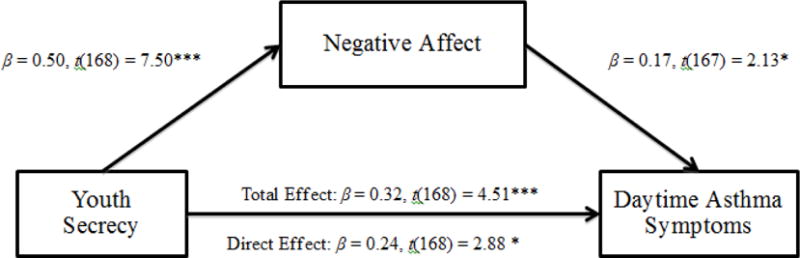
More frequent secret-keeping was associated with more severe asthma symptoms, lower ratings of sleep quality and greater number of nighttime awakenings. Secrecy was also associated with increased negative affect, which accounted for the associations between secrecy and number of awakenings and daytime asthma symptoms. These findings remained significant after controlling for youth age and other relevant demographic factors.
Our findings suggest that secrecy towards parents can have consequential health outcomes for youth with asthma and point to the importance of investigating affective processes as mediators of the influence of secret-keeping on youth health.
在大龄儿童和青少年中,对父母隐瞒秘密一直与较低的心理健康水平相关。此外,在成年人中,隐藏自己的想法和情绪与不良的身体健康结果有关。然而,保密是否与青少年较差的健康状况及与健康相关的行为(如睡眠)有关,以及如果这些假设的联系存在,其心理机制可能是什么,仍是一个悬而未决的问题。我们调查了10至17岁患有哮喘的低收入青少年样本中,青少年对父母的保密情况、每日哮喘症状和每日睡眠行为之间的关联,并测试了消极情绪作为这些关联的可能中介因素。
172名青少年报告了他们在四天时间里对父母隐瞒秘密的程度。青少年通过填写每日日记来评估哮喘症状、夜间觉醒、入睡潜伏期和主观睡眠质量。
更频繁地隐瞒秘密与更严重的哮喘症状、更低的睡眠质量评分以及更多的夜间觉醒次数相关。保密还与消极情绪增加有关,消极情绪解释了保密与觉醒次数和白天哮喘症状之间的关联。在控制了青少年年龄和其他相关人口统计学因素后,这些发现仍然显著。
我们的研究结果表明,对父母保密可能会给患有哮喘的青少年带来相应的健康后果,并指出调查情感过程作为保密对青少年健康影响的中介因素的重要性。