• 文献检索
  • 文档翻译
  • 深度研究
  • 学术资讯
  • Suppr Zotero 插件Zotero 插件
  • 邀请有礼
  • 套餐&价格
  • 历史记录
应用&插件
Suppr Zotero 插件Zotero 插件浏览器插件Mac 客户端Windows 客户端微信小程序
定价
高级版会员购买积分包购买API积分包
服务
文献检索文档翻译深度研究API 文档MCP 服务
关于我们
关于 Suppr公司介绍联系我们用户协议隐私条款
关注我们

Suppr 超能文献

核心技术专利:CN118964589B侵权必究
粤ICP备2023148730 号-1Suppr @ 2026

文献检索

告别复杂PubMed语法,用中文像聊天一样搜索,搜遍4000万医学文献。AI智能推荐,让科研检索更轻松。

立即免费搜索

文件翻译

保留排版,准确专业,支持PDF/Word/PPT等文件格式,支持 12+语言互译。

免费翻译文档

深度研究

AI帮你快速写综述,25分钟生成高质量综述,智能提取关键信息,辅助科研写作。

立即免费体验

利用手机技术对中风患者进行活动识别:旨在提高家庭环境中的性能。

Activity Recognition for Persons With Stroke Using Mobile Phone Technology: Toward Improved Performance in a Home Setting.

作者信息

O'Brien Megan K, Shawen Nicholas, Mummidisetty Chaithanya K, Kaur Saninder, Bo Xiao, Poellabauer Christian, Kording Konrad, Jayaraman Arun

机构信息

Max Nader Lab for Rehabilitation Technologies and Outcomes Research, Rehabilitation Institute of Chicago, Chicago, IL, United States.

Department of Physical Medicine and Rehabilitation, Northwestern University, Chicago, IL, United States.

出版信息

J Med Internet Res. 2017 May 25;19(5):e184. doi: 10.2196/jmir.7385.

DOI:10.2196/jmir.7385
PMID:28546137
原文链接:https://pmc.ncbi.nlm.nih.gov/articles/PMC5465379/
Abstract

BACKGROUND

Smartphones contain sensors that measure movement-related data, making them promising tools for monitoring physical activity after a stroke. Activity recognition (AR) systems are typically trained on movement data from healthy individuals collected in a laboratory setting. However, movement patterns change after a stroke (eg, gait impairment), and activities may be performed differently at home than in a lab. Thus, it is important to validate AR for gait-impaired stroke patients in a home setting for accurate clinical predictions.

OBJECTIVE

In this study, we sought to evaluate AR performance in a home setting for individuals who had suffered a stroke, by using different sets of training activities. Specifically, we compared AR performance for persons with stroke while varying the origin of training data, based on either population (healthy persons or persons with stoke) or environment (laboratory or home setting).

METHODS

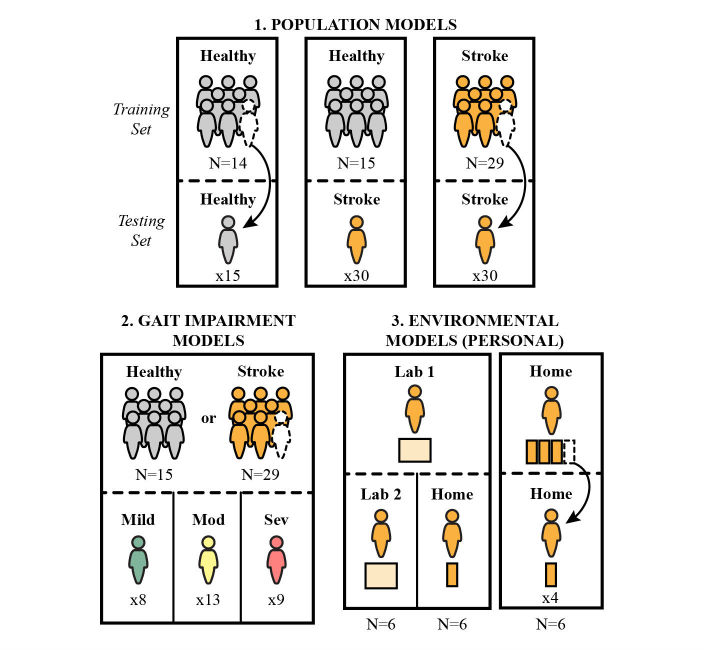
Thirty individuals with stroke and fifteen healthy subjects performed a series of mobility-related activities, either in a laboratory or at home, while wearing a smartphone. A custom-built app collected signals from the phone's accelerometer, gyroscope, and barometer sensors, and subjects self-labeled the mobility activities. We trained a random forest AR model using either healthy or stroke activity data. Primary measures of AR performance were (1) the mean recall of activities and (2) the misclassification of stationary and ambulatory activities.

RESULTS

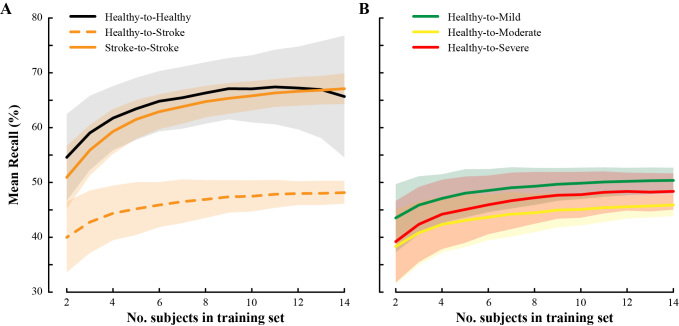
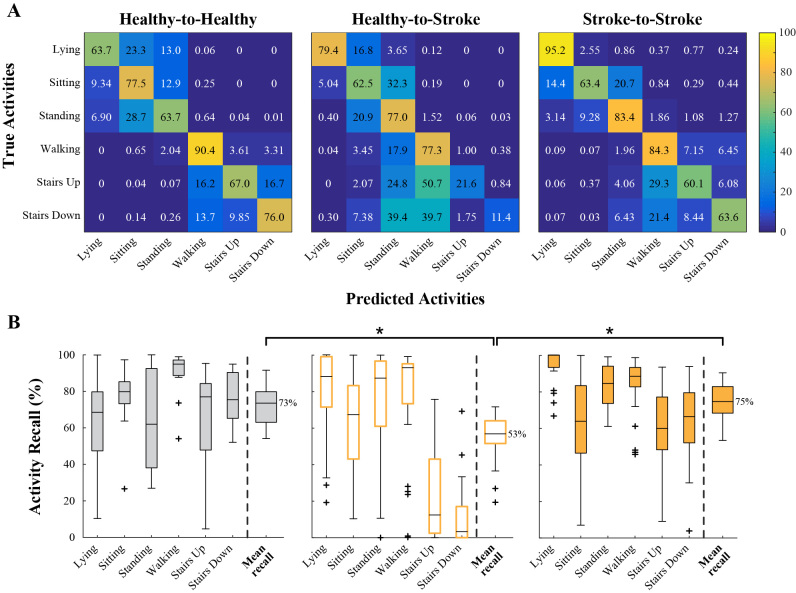
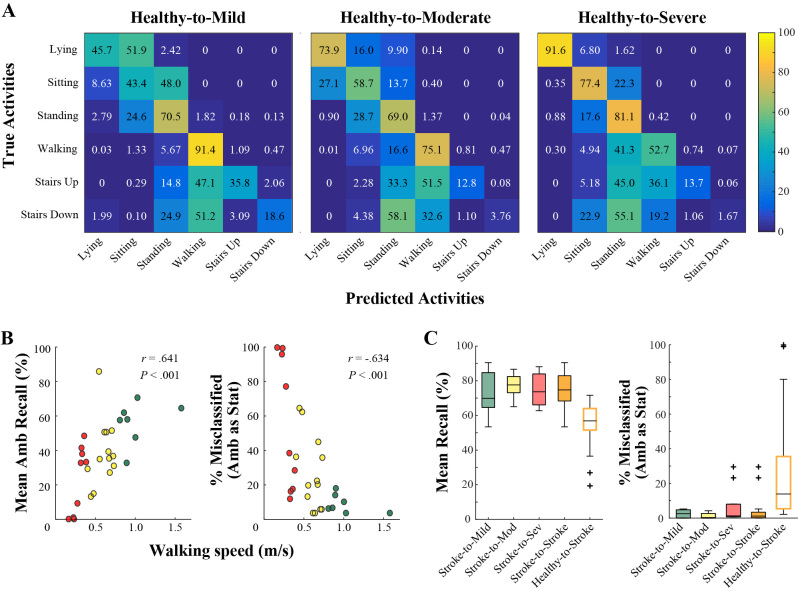
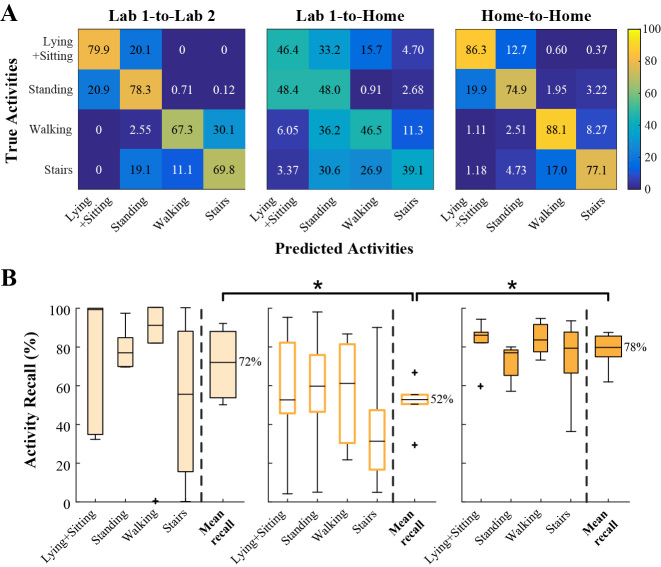
A classifier trained on stroke activity data performed better than one trained on healthy activity data, improving average recall from 53% to 75%. The healthy-trained classifier performance declined with gait impairment severity, more often misclassifying ambulatory activities as stationary ones. The classifier trained on in-lab activities had a lower average recall for at-home activities (56%) than for in-lab activities collected on a different day (77%).

CONCLUSIONS

Stroke-based training data is needed for high quality AR among gait-impaired individuals with stroke. Additionally, AR systems for home and community monitoring would likely benefit from including at-home activities in the training data.

摘要

背景

智能手机包含可测量与运动相关数据的传感器,使其成为中风后监测身体活动的有前景的工具。活动识别(AR)系统通常在实验室环境中收集的健康个体的运动数据上进行训练。然而,中风后运动模式会发生变化(例如步态障碍),并且活动在家庭中的执行方式可能与在实验室中不同。因此,在家庭环境中验证针对步态受损中风患者的AR以进行准确的临床预测很重要。

目的

在本研究中,我们试图通过使用不同的训练活动集来评估家庭环境中中风患者的AR性能。具体而言,我们基于人群(健康人或中风患者)或环境(实验室或家庭环境)改变训练数据的来源,比较中风患者的AR性能。

方法

30名中风患者和15名健康受试者在佩戴智能手机的情况下,在实验室或家中进行了一系列与移动性相关的活动。一个定制应用程序收集来自手机加速度计、陀螺仪和气压计传感器的信号,受试者对移动性活动进行自我标记。我们使用健康或中风活动数据训练了一个随机森林AR模型。AR性能的主要指标是(1)活动的平均召回率和(2)静止和动态活动的错误分类。

结果

在中风活动数据上训练的分类器比在健康活动数据上训练的分类器表现更好,将平均召回率从53%提高到了75%。健康训练的分类器性能随着步态障碍严重程度的增加而下降,更常将动态活动错误分类为静止活动。在实验室活动上训练的分类器对家庭活动的平均召回率(56%)低于在不同日期收集的实验室活动的平均召回率(77%)。

结论

对于步态受损的中风患者,高质量的AR需要基于中风的训练数据。此外,用于家庭和社区监测的AR系统可能会从将家庭活动纳入训练数据中受益。
https://cdn.ncbi.nlm.nih.gov/pmc/blobs/da76/5465379/95c27a48dd85/jmir_v19i5e184_fig6.jpg
https://cdn.ncbi.nlm.nih.gov/pmc/blobs/da76/5465379/d57f6a0ff5b0/jmir_v19i5e184_fig1.jpg
https://cdn.ncbi.nlm.nih.gov/pmc/blobs/da76/5465379/b2b1dc757d87/jmir_v19i5e184_fig2.jpg
https://cdn.ncbi.nlm.nih.gov/pmc/blobs/da76/5465379/3d8c043e5826/jmir_v19i5e184_fig3.jpg
https://cdn.ncbi.nlm.nih.gov/pmc/blobs/da76/5465379/aedecc9a97d5/jmir_v19i5e184_fig4.jpg
https://cdn.ncbi.nlm.nih.gov/pmc/blobs/da76/5465379/26e858567b92/jmir_v19i5e184_fig5.jpg
https://cdn.ncbi.nlm.nih.gov/pmc/blobs/da76/5465379/95c27a48dd85/jmir_v19i5e184_fig6.jpg
https://cdn.ncbi.nlm.nih.gov/pmc/blobs/da76/5465379/d57f6a0ff5b0/jmir_v19i5e184_fig1.jpg
https://cdn.ncbi.nlm.nih.gov/pmc/blobs/da76/5465379/b2b1dc757d87/jmir_v19i5e184_fig2.jpg
https://cdn.ncbi.nlm.nih.gov/pmc/blobs/da76/5465379/3d8c043e5826/jmir_v19i5e184_fig3.jpg
https://cdn.ncbi.nlm.nih.gov/pmc/blobs/da76/5465379/aedecc9a97d5/jmir_v19i5e184_fig4.jpg
https://cdn.ncbi.nlm.nih.gov/pmc/blobs/da76/5465379/26e858567b92/jmir_v19i5e184_fig5.jpg
https://cdn.ncbi.nlm.nih.gov/pmc/blobs/da76/5465379/95c27a48dd85/jmir_v19i5e184_fig6.jpg

相似文献

1
Activity Recognition for Persons With Stroke Using Mobile Phone Technology: Toward Improved Performance in a Home Setting.利用手机技术对中风患者进行活动识别:旨在提高家庭环境中的性能。
J Med Internet Res. 2017 May 25;19(5):e184. doi: 10.2196/jmir.7385.
2
Evaluation of a smartphone human activity recognition application with able-bodied and stroke participants.对一款适用于健全人和中风患者的智能手机人体活动识别应用程序的评估。
J Neuroeng Rehabil. 2016 Jan 20;13:5. doi: 10.1186/s12984-016-0114-0.
3
In-lab versus at-home activity recognition in ambulatory subjects with incomplete spinal cord injury.脊髓损伤不完全的非卧床受试者的实验室与家庭活动识别
J Neuroeng Rehabil. 2017 Feb 6;14(1):10. doi: 10.1186/s12984-017-0222-5.
4
Evaluation of Three State-of-the-Art Classifiers for Recognition of Activities of Daily Living from Smart Home Ambient Data.基于智能家居环境数据的日常生活活动识别的三种最先进分类器的评估。
Sensors (Basel). 2015 May 21;15(5):11725-40. doi: 10.3390/s150511725.
5
Human Physical Activity Recognition Using Smartphone Sensors.使用智能手机传感器进行人体活动识别。
Sensors (Basel). 2019 Jan 23;19(3):458. doi: 10.3390/s19030458.
6
Feasibility of a smartphone-based balance assessment system for subjects with chronic stroke.基于智能手机的慢性脑卒中患者平衡评估系统的可行性。
Comput Methods Programs Biomed. 2018 Jul;161:191-195. doi: 10.1016/j.cmpb.2018.04.027. Epub 2018 Apr 28.
7
Recognizing upper limb movements with wrist worn inertial sensors using k-means clustering classification.使用k均值聚类分类法通过腕部佩戴的惯性传感器识别上肢运动。
Hum Mov Sci. 2015 Apr;40:59-76. doi: 10.1016/j.humov.2014.11.013. Epub 2014 Dec 19.
8
Measuring Functional Arm Movement after Stroke Using a Single Wrist-Worn Sensor and Machine Learning.使用单个腕部佩戴式传感器和机器学习测量中风后的手臂功能运动
J Stroke Cerebrovasc Dis. 2017 Dec;26(12):2880-2887. doi: 10.1016/j.jstrokecerebrovasdis.2017.07.004. Epub 2017 Aug 4.
9
Accelerometer monitoring of home- and community-based ambulatory activity after stroke.中风后基于家庭和社区的动态活动的加速度计监测
Arch Phys Med Rehabil. 2004 Dec;85(12):1997-2001. doi: 10.1016/j.apmr.2003.11.035.
10
Evaluation of a Smartphone-based Human Activity Recognition System in a Daily Living Environment.基于智能手机的人类活动识别系统在日常生活环境中的评估。
J Vis Exp. 2015 Dec 11(106):e53004. doi: 10.3791/53004.

引用本文的文献

1
Pain Assessment in Osteoarthritis: Present Practices and Future Prospects Including the Use of Biomarkers and Wearable Technologies, and AI-Driven Personalized Medicine.骨关节炎的疼痛评估:当前实践与未来前景,包括生物标志物和可穿戴技术的应用以及人工智能驱动的个性化医疗。
J Orthop Res. 2025 Jul;43(7):1217-1229. doi: 10.1002/jor.26082. Epub 2025 Apr 9.
2
Determining the Prioritization of Behavior Change Techniques for Long-Term Stroke Rehabilitation: Delphi Survey Study.确定长期中风康复行为改变技术的优先级:德尔菲调查研究
Interact J Med Res. 2025 Apr 7;14:e59172. doi: 10.2196/59172.
3
A systematic review of portable technologies for the early assessment of motor development in infants.

本文引用的文献

1
Activity recognition in patients with lower limb impairments: do we need training data from each patient?下肢功能障碍患者的活动识别:我们是否需要每个患者的训练数据?
Annu Int Conf IEEE Eng Med Biol Soc. 2016 Aug;2016:3265-3268. doi: 10.1109/EMBC.2016.7591425.
2
In-lab versus at-home activity recognition in ambulatory subjects with incomplete spinal cord injury.脊髓损伤不完全的非卧床受试者的实验室与家庭活动识别
J Neuroeng Rehabil. 2017 Feb 6;14(1):10. doi: 10.1186/s12984-017-0222-5.
3
Field evaluation of a random forest activity classifier for wrist-worn accelerometer data.
关于用于婴儿运动发育早期评估的便携式技术的系统评价。
NPJ Digit Med. 2025 Jan 27;8(1):63. doi: 10.1038/s41746-025-01450-3.
4
Automate, Illuminate, Predict: A Universal Framework for Integrating Wearable Sensors in Healthcare.自动化、智能化、预测化:一种将可穿戴传感器集成到医疗保健中的通用框架。
Digit Biomark. 2024 Aug 26;8(1):149-158. doi: 10.1159/000540492. eCollection 2024 Jan-Dec.
5
Sensor-Based Gait and Balance Assessment in Healthy Adults: Analysis of Short-Term Training and Sensor Placement Effects.基于传感器的健康成年人步态和平衡评估:短期训练和传感器放置效果分析。
Sensors (Basel). 2024 Aug 29;24(17):5598. doi: 10.3390/s24175598.
6
Predictive Data Analytics in Telecare and Telehealth: Systematic Scoping Review.远程护理和远程医疗中的预测性数据分析:系统综述
Online J Public Health Inform. 2024 Aug 7;16:e57618. doi: 10.2196/57618.
7
Sensor-Based Quantification of MDS-UPDRS III Subitems in Parkinson's Disease Using Machine Learning.基于传感器的帕金森病 MDS-UPDRS III 亚项的机器学习量化。
Sensors (Basel). 2024 Mar 29;24(7):2195. doi: 10.3390/s24072195.
8
Data Augmentation Techniques for Accurate Action Classification in Stroke Patients with Hemiparesis.用于偏瘫中风患者准确动作分类的数据增强技术
Sensors (Basel). 2024 Mar 1;24(5):1618. doi: 10.3390/s24051618.
9
Investigating Activity Recognition for Hemiparetic Stroke Patients Using Wearable Sensors: A Deep Learning Approach with Data Augmentation.使用可穿戴传感器研究偏瘫中风患者的活动识别:基于数据增强的深度学习方法。
Sensors (Basel). 2023 Dec 29;24(1):210. doi: 10.3390/s24010210.
10
AI in Rehabilitation Medicine: Opportunities and Challenges.康复医学中的人工智能:机遇与挑战。
Ann Rehabil Med. 2023 Dec;47(6):444-458. doi: 10.5535/arm.23131. Epub 2023 Dec 14.
用于腕部佩戴式加速度计数据的随机森林活动分类器的现场评估。
J Sci Med Sport. 2017 Jan;20(1):75-80. doi: 10.1016/j.jsams.2016.06.003. Epub 2016 Jun 23.
4
Accelerometer and Global Positioning System Measurement of Recovery of Community Ambulation Across the First 6 Months After Stroke: An Exploratory Prospective Study.中风后最初6个月社区行走恢复情况的加速度计和全球定位系统测量:一项探索性前瞻性研究
Arch Phys Med Rehabil. 2016 Sep;97(9):1465-1472. doi: 10.1016/j.apmr.2016.04.013. Epub 2016 Jun 1.
5
Evaluation of a smartphone human activity recognition application with able-bodied and stroke participants.对一款适用于健全人和中风患者的智能手机人体活动识别应用程序的评估。
J Neuroeng Rehabil. 2016 Jan 20;13:5. doi: 10.1186/s12984-016-0114-0.
6
The Specific Requirements of Neural Repair Trials for Stroke.中风神经修复试验的具体要求
Neurorehabil Neural Repair. 2016 Jun;30(5):470-8. doi: 10.1177/1545968315604400. Epub 2015 Sep 10.
7
How is physical activity monitored in people following stroke?中风患者的身体活动是如何监测的?
Disabil Rehabil. 2015;37(19):1717-31. doi: 10.3109/09638288.2014.978508. Epub 2014 Nov 6.
8
A comparison of activity classification in younger and older cohorts using a smartphone.使用智能手机对年轻和老年人群体的活动分类进行比较。
Physiol Meas. 2014 Nov;35(11):2269-86. doi: 10.1088/0967-3334/35/11/2269. Epub 2014 Oct 23.
9
Sedentary behavior in the first year after stroke: a longitudinal cohort study with objective measures.中风后第一年的久坐行为:一项采用客观测量方法的纵向队列研究。
Arch Phys Med Rehabil. 2015 Jan;96(1):15-23. doi: 10.1016/j.apmr.2014.08.015. Epub 2014 Sep 16.
10
Identifying Active Travel Behaviors in Challenging Environments Using GPS, Accelerometers, and Machine Learning Algorithms.利用 GPS、加速度计和机器学习算法在具有挑战性的环境中识别积极出行行为。
Front Public Health. 2014 Apr 22;2:36. doi: 10.3389/fpubh.2014.00036. eCollection 2014.