Grist Rebecca, Porter Joanna, Stallard Paul
Child and Adolescent Mental Health Group, Department for Health, University of Bath, Bath, United Kingdom.
Child and Family Mental Health, Temple House, Oxford Health National Health Service Foundation Trust, Keynsham, United Kingdom.
J Med Internet Res. 2017 May 25;19(5):e176. doi: 10.2196/jmir.7332.
There are an increasing number of mobile apps available for adolescents with mental health problems and an increasing interest in assimilating mobile health (mHealth) into mental health services. Despite the growing number of apps available, the evidence base for their efficacy is unclear.
This review aimed to systematically appraise the available research evidence on the efficacy and acceptability of mobile apps for mental health in children and adolescents younger than 18 years.
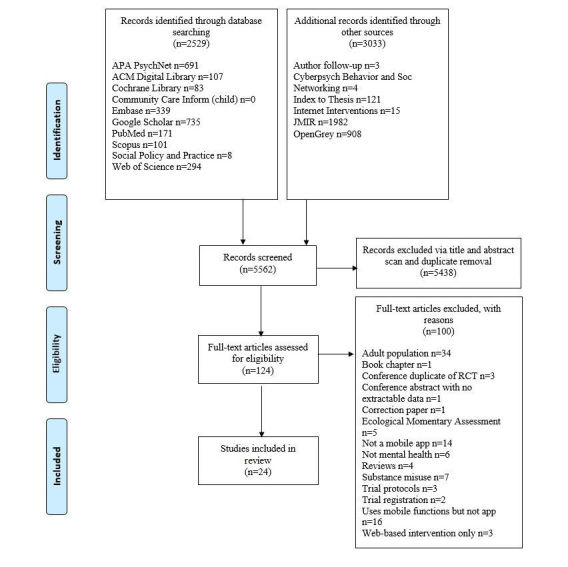
The following were systematically searched for relevant publications between January 2008 and July 2016: APA PsychNet, ACM Digital Library, Cochrane Library, Community Care Inform-Children, EMBASE, Google Scholar, PubMed, Scopus, Social Policy and Practice, Web of Science, Journal of Medical Internet Research, Cyberpsychology, Behavior and Social Networking, and OpenGrey. Abstracts were included if they described mental health apps (targeting depression, bipolar disorder, anxiety disorders, self-harm, suicide prevention, conduct disorder, eating disorders and body image issues, schizophrenia, psychosis, and insomnia) for mobile devices and for use by adolescents younger than 18 years.
A total of 24 publications met the inclusion criteria. These described 15 apps, two of which were available to download. Two small randomized trials and one case study failed to demonstrate a significant effect of three apps on intended mental health outcomes. Articles that analyzed the content of six apps for children and adolescents that were available to download established that none had undergone any research evaluation. Feasibility outcomes suggest acceptability of apps was good and app usage was moderate.
Overall, there is currently insufficient research evidence to support the effectiveness of apps for children, preadolescents, and adolescents with mental health problems. Given the number and pace at which mHealth apps are being released on app stores, methodologically robust research studies evaluating their safety, efficacy, and effectiveness is promptly needed.
针对有心理健康问题的青少年的移动应用程序越来越多,人们也越来越有兴趣将移动健康(mHealth)融入心理健康服务。尽管可用的应用程序数量不断增加,但其疗效的证据基础尚不清楚。
本综述旨在系统评价18岁以下儿童和青少年使用移动应用程序促进心理健康的疗效和可接受性的现有研究证据。
系统检索了2008年1月至2016年7月期间的相关出版物,包括:美国心理学会心理学文摘数据库(APA PsychNet)、美国计算机协会数字图书馆(ACM Digital Library)、考科蓝图书馆(Cochrane Library)、儿童社区护理信息库(Community Care Inform-Children)、荷兰医学文摘数据库(EMBASE)、谷歌学术(Google Scholar)、医学期刊数据库(PubMed)、Scopus数据库、社会政策与实践数据库、科学引文索引(Web of Science)、医学互联网研究杂志(Journal of Medical Internet Research)、网络心理学、行为与社交网络杂志(Cyberpsychology, Behavior and Social Networking)以及OpenGrey数据库。如果摘要描述了针对移动设备且供18岁以下青少年使用的心理健康应用程序(针对抑郁症、双相情感障碍、焦虑症、自我伤害、自杀预防、品行障碍、饮食失调和身体形象问题、精神分裂症、精神病和失眠),则纳入研究。
共有24篇出版物符合纳入标准。这些文献描述了15款应用程序,其中两款可供下载。两项小型随机试验和一项案例研究未能证明三款应用程序对预期心理健康结果有显著影响。分析了六款可供下载的儿童和青少年应用程序内容的文章表明,没有一款应用程序经过任何研究评估。可行性结果表明应用程序的可接受性良好,应用程序的使用情况一般。
总体而言,目前尚无足够的研究证据支持应用程序对有心理健康问题的儿童、青春期前儿童和青少年有效的观点。鉴于移动健康应用程序在应用商店发布的数量和速度,迫切需要开展方法严谨的研究来评估其安全性、疗效和有效性。