van Dijk R, Kuijpers D, Kaandorp T A M, van Dijkman P R M, Vliegenthart R, van der Harst P, Oudkerk M
Center for Medical Imaging, University Medical Center Groningen, University of Groningen, Hanzeplein 1 EB 45, Groningen, The Netherlands.
Department of Cardiology, University Medical Center Groningen, University of Groningen, Groningen, The Netherlands.
Int J Cardiovasc Imaging. 2017 Nov;33(11):1753-1759. doi: 10.1007/s10554-017-1157-4. Epub 2017 May 25.
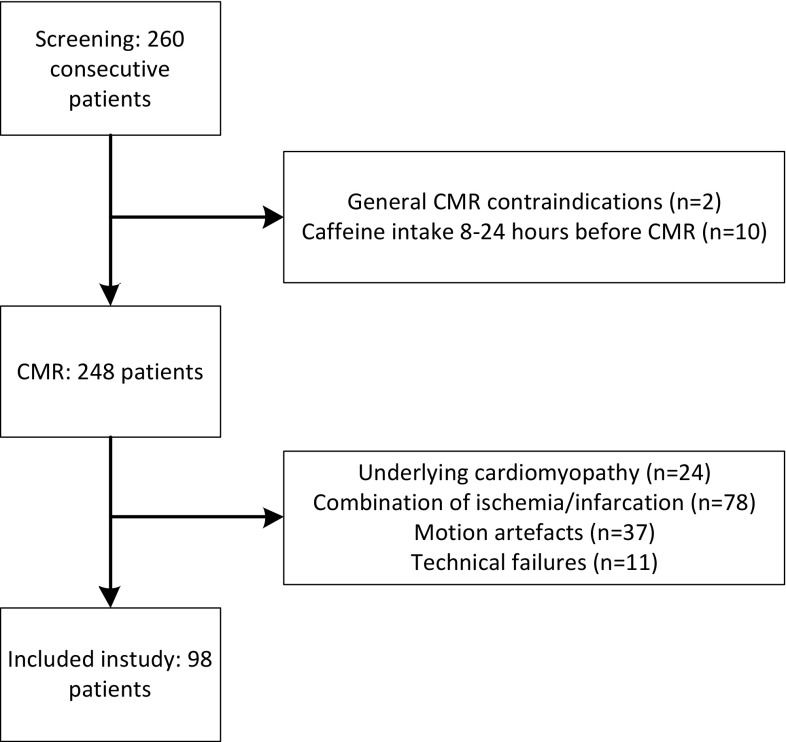
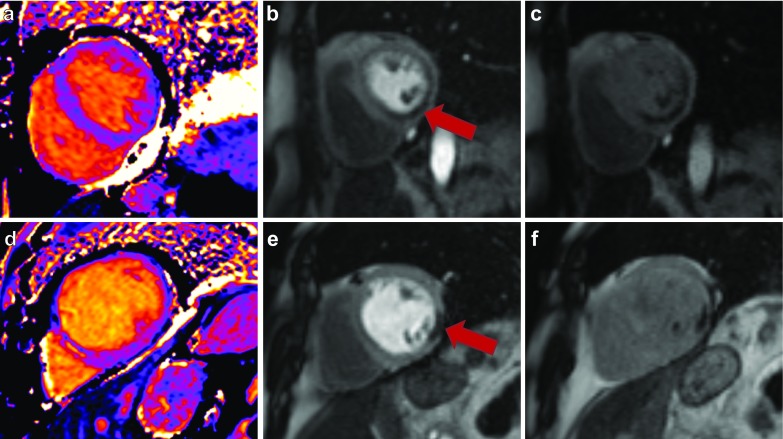
The antagonistic effects of caffeine on adenosine receptors are a possible cause of false-negative stress perfusion imaging. The purpose of this study was to determine the effects of coffee intake <4 h prior to stress perfusion cardiac magnetic resonance imaging (CMR) in regadenoson- versus adenosine-induced hyperemia as measured with T1-mapping. 98 consecutive patients with suspected coronary artery disease referred for either adenosine or regadenoson perfusion CMR were included in this analysis. Twenty-four patients reported coffee consumption <4 h before CMR (15 patients with adenosine, and 9 patients with regadenoson); 74 patients reported no coffee intake (50 patients with adenosine, and 24 patients with regadenoson). T1 mapping was performed using a modified look-locker inversion recovery sequence. T1 reactivity was determined by subtracting T1 from T1. T1, T1, and T1 reactivity in patients referred for regadenoson perfusion CMR were not significantly different when comparing patients with <4 h coffee intake and patients who reported no coffee intake (976 ± 4 ms, 1019 ± 48 ms, and 4.4 ± 3.2% vs 971 ± 33 ms, 1023 ± 43 ms, and 5.4 ± 2.4%) (p = 0.70, 0.79, and 0.40), and similar to values in patients without coffee intake undergoing adenosine CMR. In patients with <4 h coffee intake, T1, and T1 reactivity were significantly lower for adenosine (898 ± 51 ms, and -7.8 ± 5.0%) compared to regadenoson perfusion CMR (p < 0.001). Coffee intake <4 h prior to regadenoson perfusion CMR has no effect on stress-induced hyperemia as measured with T1 mapping.
咖啡因对腺苷受体的拮抗作用可能是导致应激灌注成像假阴性的原因。本研究的目的是确定在使用T1映射测量瑞加腺苷和腺苷诱发的充血时,在应激灌注心脏磁共振成像(CMR)前<4小时摄入咖啡的影响。本分析纳入了98例因腺苷或瑞加腺苷灌注CMR而被转诊的疑似冠心病患者。24例患者报告在CMR前<4小时饮用了咖啡(15例接受腺苷检查,9例接受瑞加腺苷检查);74例患者报告未摄入咖啡(50例接受腺苷检查,24例接受瑞加腺苷检查)。使用改良的锁相环反转恢复序列进行T1映射。T1反应性通过从T1中减去T1来确定。在比较<4小时咖啡摄入量的患者和未摄入咖啡的患者时,接受瑞加腺苷灌注CMR的患者的T1、T1和T1反应性无显著差异(分别为976±4毫秒、1019±48毫秒和4.4±3.2%,对比971±33毫秒、1023±43毫秒和5.4±2.4%)(p = 0.70、0.79和0.40),且与未摄入咖啡而接受腺苷CMR检查的患者的值相似。在<4小时咖啡摄入量的患者中,与瑞加腺苷灌注CMR相比,腺苷的T1和T1反应性显著更低(分别为898±51毫秒和-7.8±5.0%)(p < 0.001)。在瑞加腺苷灌注CMR前<4小时摄入咖啡对用T1映射测量的应激诱发充血无影响。