Naburi Helga, Ekström Anna Mia, Mujinja Phares, Kilewo Charles, Manji Karim, Biberfeld Gunnel, Sando David, Chalamila Guerino, Bärnighausen Till
Department of Pediatrics and Child Health, Muhimbili University of Health and Allied Sciences (MUHAS), Dar es Salaam, Tanzania.
Department of Public Health Sciences, Global Health (IHCAR), Karolinska Institutet, Stockholm, Sweden.
Hum Resour Health. 2017 May 26;15(1):35. doi: 10.1186/s12960-017-0207-2.
In many African countries, prevention of mother-to-child transmission of HIV (PMTCT) services are predominantly delivered by nurses. Although task-shifting is not yet well established, community health workers (CHWs) are often informally used as part of PMTCT delivery. According to the 2008 World Health Organization (WHO) Task-shifting Guidelines, many PMTCT tasks can be shifted from nurses to CHWs.
The aim of this time and motion study in Dar es Salaam, Tanzania, was to estimate the potential of task-shifting in PMTCT service delivery to reduce nurses' workload and health system costs. The time used by nurses to accomplish PMTCT activities during antenatal care (ANC) and postnatal care (PNC) visits was measured. These data were then used to estimate the costs that could be saved by shifting tasks from nurses to CHWs in the Tanzanian public-sector health system.
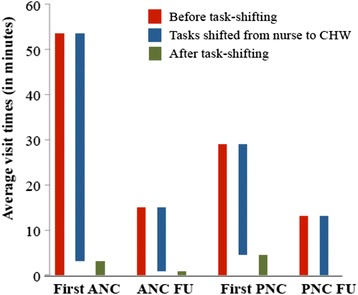
A total of 1121 PMTCT-related tasks carried out by nurses involving 179 patients at ANC and PNC visits were observed at 26 health facilities. The average time of the first ANC visit was the longest, 54 (95% confidence interval (CI) 42-65) min, followed by the first PNC visit which took 29 (95% CI 26-32) minutes on average. ANC and PNC follow-up visits were substantially shorter, 15 (95% CI 14-17) and 13 (95% CI 11-16) minutes, respectively. During both the first and the follow-up ANC visits, 94% of nurses' time could be shifted to CHWs, while 84% spent on the first PNC visit and 100% of the time spent on the follow-up PNC visit could be task-shifted. Depending on CHW salary estimates, the cost savings due to task-shifting in PMTCT ranged from US$ 1.3 to 2.0 (first ANC visit), US$ 0.4 to 0.6 (ANC follow-up visit), US$ 0.7 to 1.0 (first PNC visit), and US$ 0.4 to 0.5 (PNC follow-up visit).
Nurses working in PMTCT spend large proportions of their time on tasks that could be shifted to CHWs. Such task-shifting could allow nurses to spend more time on specialized PMTCT tasks and can substantially reduce the average cost per PMTCT patient.
在许多非洲国家,预防艾滋病母婴传播(PMTCT)服务主要由护士提供。尽管任务转移尚未得到充分确立,但社区卫生工作者(CHW)常被非正式地用作PMTCT服务的一部分。根据2008年世界卫生组织(WHO)的任务转移指南,许多PMTCT任务可以从护士转移给社区卫生工作者。
在坦桑尼亚达累斯萨拉姆进行的这项时间与动作研究的目的是评估在PMTCT服务提供中任务转移的潜力,以减轻护士的工作量并降低卫生系统成本。测量了护士在产前护理(ANC)和产后护理(PNC)访视期间完成PMTCT活动所花费的时间。然后利用这些数据估算在坦桑尼亚公共部门卫生系统中通过将任务从护士转移给社区卫生工作者可节省的成本。
在26个卫生设施中观察到护士进行的总共1121项与PMTCT相关的任务,涉及179名在ANC和PNC访视的患者。首次ANC访视的平均时间最长,为54(95%置信区间(CI)42 - 65)分钟,其次是首次PNC访视,平均用时29(95%CI 26 - 32)分钟。ANC和PNC的随访时间明显较短,分别为15(95%CI 14 - 17)分钟和13(95%CI 11 - 16)分钟。在首次和随访ANC访视期间,护士94%的时间可以转移给社区卫生工作者,而在首次PNC访视上花费的84%的时间以及在随访PNC访视上花费的100%的时间都可以进行任务转移。根据对社区卫生工作者薪资的估算,PMTCT任务转移带来的成本节省范围为:首次ANC访视1.3至2.0美元,ANC随访访视0.4至0.6美元,首次PNC访视0.7至1.0美元,PNC随访访视0.4至0.5美元。
从事PMTCT工作的护士将大量时间花费在可以转移给社区卫生工作者的任务上。这种任务转移可以使护士有更多时间用于专门的PMTCT任务,并能大幅降低每位PMTCT患者的平均成本。