Kindgren Erik, Fredrikson Mats, Ludvigsson Johnny
Department of Pediatrics, Västervik Hospital, Västervik, Sweden.
Division of Pediatrics, Department of Clinical and Experimental Medicine, Linköping University, Linköping, Sweden.
Pediatr Rheumatol Online J. 2017 May 26;15(1):46. doi: 10.1186/s12969-017-0175-z.
Juvenile idiopathic arthritis (JIA) is considered to be an autoimmune disease, but the etiology is unknown. We decided to study the influence of early nutrition on later development of JIA.
All parents with children born between October 1, 1997 and October 1, 1999 in Southeast Sweden were asked to participate in the ABIS prospective cohort study (All Babies in Southeast Sweden), At 1 year, questionnaires with information on breastfeeding and introduction of foods were completed by 10,565 families. We identified 32 children with JIA and 111 children with non-chronic arthritis with completed questionnaires after delivery and after 1 year. A multivariable logistic regression model, adjusted for relevant factors, was performed to calculate the association between JIA and feeding during the first year of life.
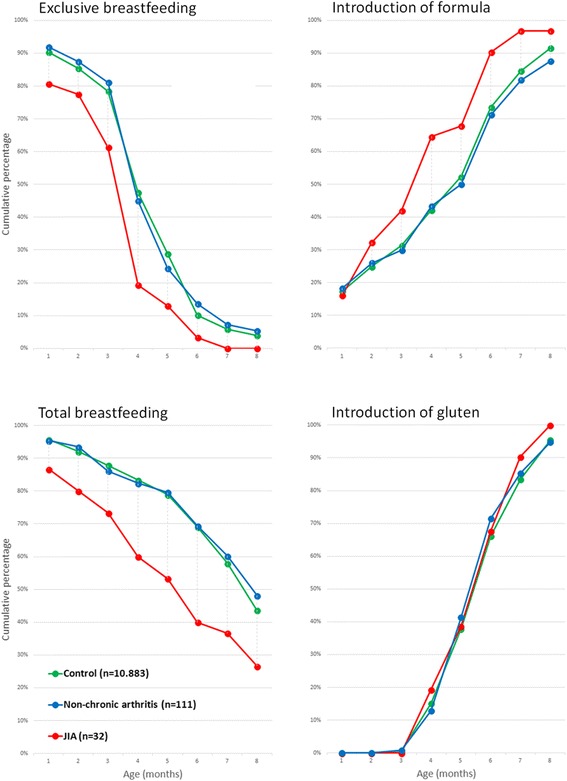
An increased risk for JIA was found in children who had breast fed for less than 4 months, as opposed to those who were continued on breast milk beyond 4 months of age (aOR 3.5, 95% CI 1.4-8,5; p = 0.006). A short duration of exclusive as well as total breastfeeding was associated with an increased risk of JIA (aOR 1.3, 95% CI 1.1-1.6; p = 0.008 and aOR 1.2, 95% CI 1.1-1.3; p < 0.001). All associations between breastfeeding and JIA persisted after adjustment. There was no relationship between early nutrition and non-chronic arthritis.
Our results indicate that there are different disease mechanisms for different types of arthritis in childhood. Longer duration of breastfeeding (both total and exclusive) may protect against development of JIA. Mothers should be encouraged to breast-feed their babies exclusively, if at all possible, for 4 months and continue partial breastfeeding for an extended time when foreign proteins are introduced.
幼年特发性关节炎(JIA)被认为是一种自身免疫性疾病,但其病因尚不清楚。我们决定研究早期营养对JIA后期发展的影响。
邀请所有在1997年10月1日至1999年10月1日期间在瑞典东南部出生孩子的父母参与ABIS前瞻性队列研究(瑞典东南部所有婴儿)。在1岁时,10565个家庭完成了关于母乳喂养和食物引入的问卷调查。我们确定了32名患有JIA的儿童和111名患有非慢性关节炎的儿童,他们在分娩后和1年后完成了问卷调查。采用多变量逻辑回归模型,并对相关因素进行调整,以计算JIA与出生后第一年喂养之间的关联。
与母乳喂养超过4个月的儿童相比,母乳喂养少于4个月的儿童患JIA的风险增加(调整后比值比[aOR]为3.5,95%置信区间[CI]为1.4 - 8.5;p = 0.006)。纯母乳喂养和总母乳喂养时间短与JIA风险增加相关(aOR为1.3,95%CI为1.1 - 1.6;p = 0.008;aOR为1.2,95%CI为1.1 - 1.3;p < 0.001)。调整后,母乳喂养与JIA之间的所有关联均持续存在。早期营养与非慢性关节炎之间没有关系。
我们的结果表明,儿童不同类型关节炎存在不同的疾病机制。更长时间的母乳喂养(包括纯母乳喂养和总母乳喂养)可能预防JIA的发生。应鼓励母亲尽可能纯母乳喂养婴儿4个月,并在引入外来蛋白质时延长部分母乳喂养时间。