Boyce Guilaine, Button Emily, Soo Sonja, Wellington Cheryl
Department of Pathology and Laboratory Medicine, Djavad Mowafaghian Centre for Brain Health, University of British Columbia, Vancouver, BC V6T 1Z3, Canada.
J Biomed Res. 2017 May 26;32(3):164-82. doi: 10.7555/JBR.31.20160103.
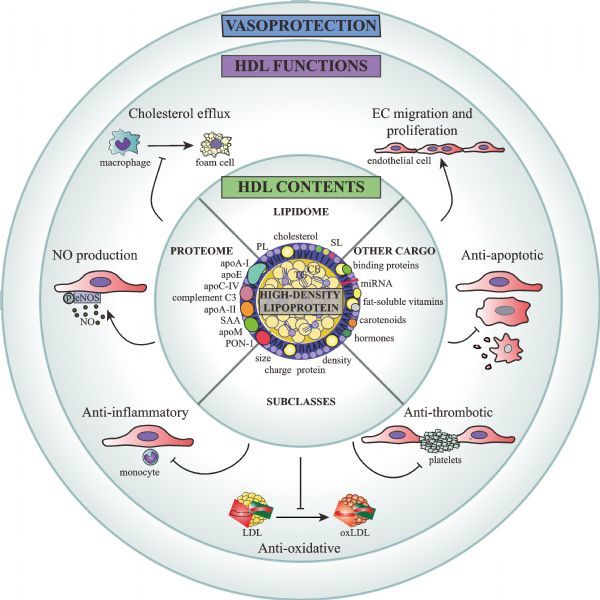
The pleiotropic functions of circulating high density lipoprotein (HDL) on peripheral vascular health are well established. HDL plays a pivotal role in reverse cholesterol transport and is also known to suppress inflammation, endothelial activation and apoptosis in peripheral vessels. Although not expressed in the central nervous system, HDL has nevertheless emerged as a potential resilience factor for dementia in multiple epidemiological studies. Animal model data specifically support a role for HDL in attenuating the accumulation of β-amyloid within cerebral vessels concomitant with reduced neuroinflammation and improved cognitive performance. As the vascular contributions to dementia are increasingly appreciated, this review seeks to summarize recent literature focused on the vasoprotective properties of HDL that may extend to cerebral vessels, discuss potential roles of HDL in dementia relative to brain-derived lipoproteins, identify gaps in current knowledge, and highlight new opportunities for research and discovery.
循环高密度脂蛋白(HDL)对周围血管健康的多效性功能已得到充分证实。HDL在逆向胆固醇转运中起关键作用,并且已知还可抑制周围血管中的炎症、内皮细胞活化和细胞凋亡。尽管HDL不在中枢神经系统中表达,但在多项流行病学研究中,它已成为痴呆症的一种潜在恢复力因素。动物模型数据特别支持HDL在减轻脑血管内β-淀粉样蛋白积累方面的作用,同时伴有神经炎症减轻和认知能力改善。随着血管对痴呆症的影响越来越受到重视,本综述旨在总结近期关注HDL可能扩展至脑血管的血管保护特性的文献,讨论HDL相对于脑源性脂蛋白在痴呆症中的潜在作用,识别当前知识中的空白,并突出新的研究和发现机会。