Moore Kathleen A, Howell Jacqui
School of Health Sciences and Psychology, Federation University AustraliaChurchill, VIC, Australia.
Front Psychol. 2017 May 12;8:753. doi: 10.3389/fpsyg.2017.00753. eCollection 2017.
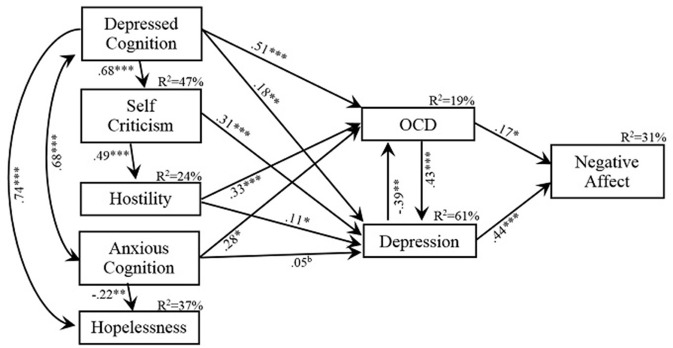
Although Obsessive-Compulsive Disorder (OCD) and Depression are classified as separate disorders, the high incidence of co-morbidity and the strong correlations between measures of each has led to debate about the nature of their relationship. Some authors have proposed that OCD is in fact a mood disorder while others have suggested that the two disorders are grounded in negative affectivity. A third proposition is that depression is an essential part of OCD but that OCD is a separate disorder from depression. The aim in this study was to investigate these diverse propositions in a non-clinical sample and also to determine whether factors implicated in each, that is anxious and depressive cognitions, hopelessness, and self-criticism, would demonstrate commonality as predictors of the symptoms of OCD and of depression. Two hundred participants (59% female) ( age = 34 years, = 16) completed the Padua Inventory, Carroll Rating Scale, Cognitions Checklist, Self-Criticism Scale, Beck Hopelessness Scale, Buss-Durkee Hostility Inventory-Revised and a Negative Affectivity Schedule. Results indicated a strong correlation between OCD and depression, depression, and negative affectivity but a weaker relationship between OCD and negative affectivity. Path analyses revealed that both anxious and depressive cognitions, as well as hostility predicted both disorders but the Beta-weights were stronger on OCD. Self-criticism predicted only depression while hopelessness failed to predict either disorder but was itself predicted by depressive cognitions. Depression was a stronger indicator of negative affect than OCD and while OCD positively predicted depression, depression was a negative indicator of OCD. These results support the hypothesis that OCD and depression are discrete disorders and indicate that while depression is implicated in OCD, the reverse does not hold. While both disorders are related to negative affectivity, this relationship is much stronger for depression thus failing to confirm that both are subsumed by a common factor, in this case, negative affectivity. The proposition that depression is part of OCD but that OCD is not necessarily implicated in depression and is, in fact, a separate disorder, is supported by the current model. Further research is required to support the utility of the model in clinical samples.
尽管强迫症(OCD)和抑郁症被归类为不同的疾病,但它们的高共病率以及各项测量指标之间的强相关性引发了关于它们关系本质的争论。一些作者提出强迫症实际上是一种情绪障碍,而另一些人则认为这两种疾病都源于消极情感。第三种观点是抑郁症是强迫症的一个重要组成部分,但强迫症是一种与抑郁症不同的疾病。本研究的目的是在非临床样本中调查这些不同的观点,并确定与每种疾病相关的因素,即焦虑和抑郁认知、绝望感和自我批评,是否会作为强迫症和抑郁症症状的预测指标表现出共性。200名参与者(59%为女性)(年龄 = 34岁,标准差 = 16)完成了帕多瓦量表、卡罗尔评定量表、认知清单、自我批评量表、贝克绝望量表、修订后的布斯 - 杜克敌意量表和消极情感量表。结果表明,强迫症与抑郁症、抑郁症与消极情感之间存在强相关性,但强迫症与消极情感之间的关系较弱。路径分析显示,焦虑和抑郁认知以及敌意都能预测这两种疾病,但对强迫症的标准化回归系数更强。自我批评仅预测抑郁症,而绝望感未能预测任何一种疾病,但它本身由抑郁认知所预测。抑郁症比强迫症更能表明消极情感,虽然强迫症正向预测抑郁症,但抑郁症是强迫症的负向指标。这些结果支持了强迫症和抑郁症是离散疾病的假设,并表明虽然抑郁症与强迫症有关,但反之不成立。虽然这两种疾病都与消极情感有关,但这种关系在抑郁症中更强,因此未能证实它们都被一个共同因素(即消极情感)所涵盖。抑郁症是强迫症的一部分但强迫症不一定与抑郁症有关且实际上是一种独立疾病的观点得到了当前模型的支持。需要进一步的研究来支持该模型在临床样本中的实用性。