Department of Psychiatry and Psychotherapy, University Medical Center Hamburg-Eppendorf, Hamburg, Germany.
Department of Clinical Psychology and Psychotherapy, Ludwig-Maximilians University, Leopoldstr. 13, 80802, Munich, Germany.
Eur Arch Psychiatry Clin Neurosci. 2021 Sep;271(6):1179-1191. doi: 10.1007/s00406-020-01199-8. Epub 2020 Nov 5.
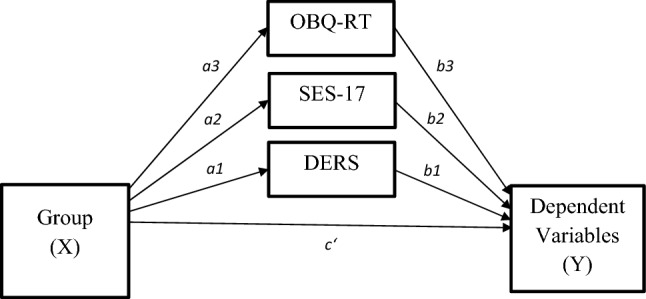
According to psychodynamic and cognitive models of obsessive-compulsive disorder (OCD), anger and aggression play an important role in the development and maintenance of the disorder. (Sub-) clinical samples with OCD have reported higher anger and anger suppression. Patients with checking-related symptoms of OCD showed a less aggressive self-concept as assessed by an Implicit Association Test (IAT). This study assessed anger and aggressiveness self-concepts in OCD as well as possible mediators of the link between OCD and aggressiveness. A total of 48 patients with OCD and 45 healthy controls were included. Measures included the State-Trait Anger Expression Inventory-II and an aggressiveness self-concept IAT (Agg-IAT). An inflated sense of responsibility, non-acceptance of emotions, and social desirability were tested as mediators. As expected, patients with OCD reported higher trait anger and anger suppression compared to healthy controls. Contrary to hypotheses, the aggressiveness self-concept (Agg-IAT) did not differ between groups. The inflated sense of responsibility mediated the relationship between group and anger suppression. Non-acceptance of negative emotions mediated the relationship between group and trait anger, as well as anger suppression. However, comorbidities and medication may account for some effect in anger suppression. Elevated trait anger and anger suppression in OCD patients could be explained by dysfunctional beliefs or maladaptive emotion regulation strategies. Emotion regulation therapy might help to enhance awareness and acceptance of emotions and possibly improve treatment outcomes.
根据强迫症(OCD)的心理动力学和认知模型,愤怒和攻击性在疾病的发展和维持中起着重要作用。(亚)临床 OCD 样本报告的愤怒和愤怒抑制更高。强迫症检查相关症状的患者在评估其攻击性自我概念的内隐联想测验(IAT)中表现出攻击性自我概念较弱。本研究评估了 OCD 中的愤怒和攻击性自我概念,以及 OCD 和攻击性之间联系的可能中介因素。共纳入 48 例强迫症患者和 45 名健康对照者。评估工具包括状态特质愤怒表达量表-II 和攻击性自我概念内隐联想测验(Agg-IAT)。测试了过度责任感、情绪不接受和社会期望作为中介因素。正如预期的那样,与健康对照组相比,强迫症患者报告的特质愤怒和愤怒抑制更高。与假设相反,两组之间的攻击性自我概念(Agg-IAT)没有差异。过度责任感介导了组间与愤怒抑制的关系。对负面情绪的不接受性中介了组间特质愤怒、愤怒抑制的关系。然而,共病和药物治疗可能会影响愤怒抑制的某些效果。强迫症患者的特质愤怒和愤怒抑制升高可能是由于功能失调的信念或适应性不良的情绪调节策略所致。情绪调节疗法可能有助于提高对情绪的认识和接受,并可能改善治疗效果。