Stadejek Tomasz, Larsen Lars E, Podgórska Katarzyna, Bøtner Anette, Botti Sara, Dolka Izabella, Fabisiak Michał, Heegaard Peter M H, Hjulsager Charlotte K, Huć Tomasz, Kvisgaard Lise K, Sapierzyński Rafał, Nielsen Jens
Warsaw University of Life Sciences, Faculty of Veterinary Medicine, Department of Pathology and Veterinary Diagnostics, Nowoursynowska 159C, 02-776 Warsaw, Poland.
National Veterinary Institute, Technical University of Denmark, Bülowsvej 27, 1870 Frederiksberg C, Denmark.
Vet Microbiol. 2017 Sep;209:13-19. doi: 10.1016/j.vetmic.2017.05.011. Epub 2017 May 16.
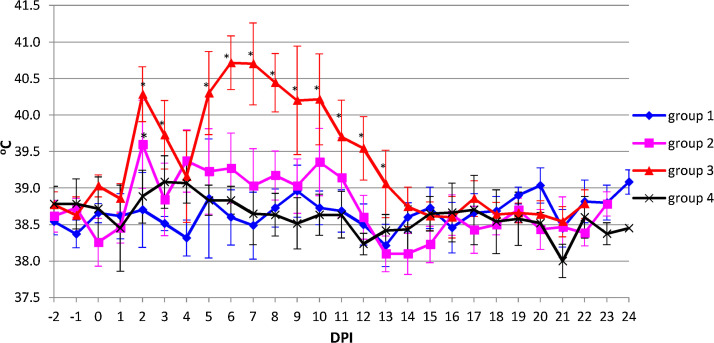
Studies from Eastern European countries proved that porcine reproductive and respiratory syndrome virus Type 1 (PRRSV-1) harbours high genetic diversity and that genetically divergent subtypes 2-4 circulate in this area. In the present study, we compared the pathogenicity of two different PRRSV-1 subtype 2 strains and a strain representing PRRSV-1 subtype 1. Four groups of 8-week-old specific pathogen free pigs were either infected with subtype 2 strain ILI6, subtype 2 strain or BOR59, subtype 1 strain 18794, or mock inoculated. The most pronounced clinical signs were observed in pigs infected with BOR59. Pigs from both subtype 2 strain infected groups exhibited significantly elevated mean body temperatures on DPI 2 compared to the other two groups, the difference remaining significant up to DPI 13 for the BOR59 group, only. The pigs in the latter group also displayed significantly highest levels of early viremia together with the most rapid APP response. Overall, the results indicated that BOR59 strain can be considered a highly pathogenic strain, similarly to subtype 3 strains Lena and SU1-bel, while the virulence of the other subtype 2 strain ILI6 was intermediate between BOR59 and subtype 1 strain.
来自东欧国家的研究证明,1型猪繁殖与呼吸综合征病毒(PRRSV-1)具有高度的遗传多样性,并且基因不同的2-4亚型在该地区流行。在本研究中,我们比较了两种不同的PRRSV-1 2型毒株和一种代表PRRSV-1 1型毒株的致病性。将四组8周龄的无特定病原体猪分别感染2型毒株ILI6、2型毒株BOR59、1型毒株18794,或进行 mock 接种。在感染BOR59的猪中观察到最明显的临床症状。与其他两组相比,两个感染2型毒株组的猪在感染后第2天平均体温显著升高,仅BOR59组在感染后第13天差异仍显著。后一组猪还表现出显著最高水平的早期病毒血症以及最快的急性相蛋白反应。总体而言,结果表明BOR59毒株可被认为是高致病性毒株,类似于3型毒株Lena和SU1-bel,而另一种2型毒株ILI6的毒力介于BOR59和1型毒株之间。