Schmidt Tom L, Barton Nicholas H, Rašić Gordana, Turley Andrew P, Montgomery Brian L, Iturbe-Ormaetxe Inaki, Cook Peter E, Ryan Peter A, Ritchie Scott A, Hoffmann Ary A, O'Neill Scott L, Turelli Michael
School of BioSciences, Bio21 Institute, University of Melbourne, Parkville, Victoria, Australia.
Institute of Science and Technology, Klosterneuburg, Austria.
PLoS Biol. 2017 May 30;15(5):e2001894. doi: 10.1371/journal.pbio.2001894. eCollection 2017 May.
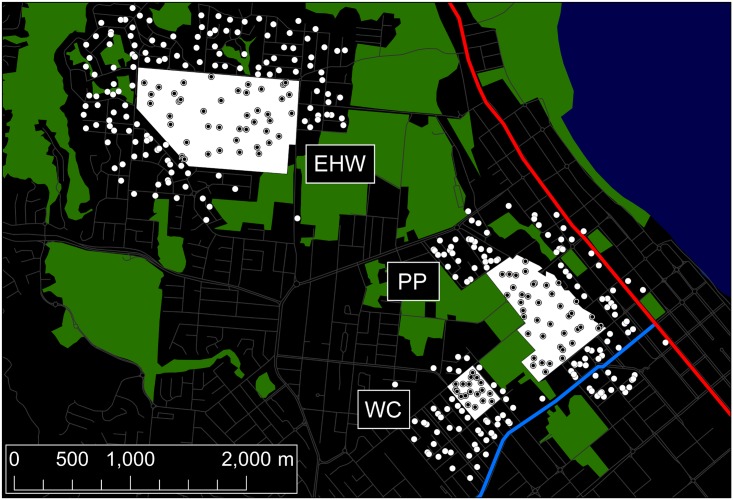
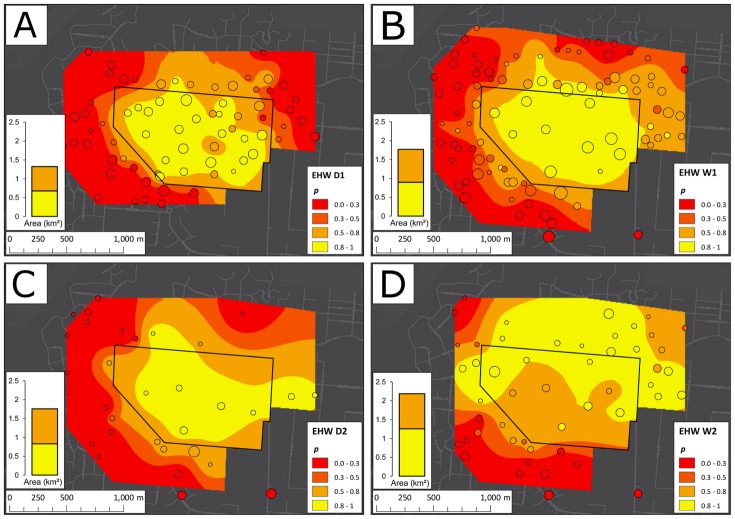
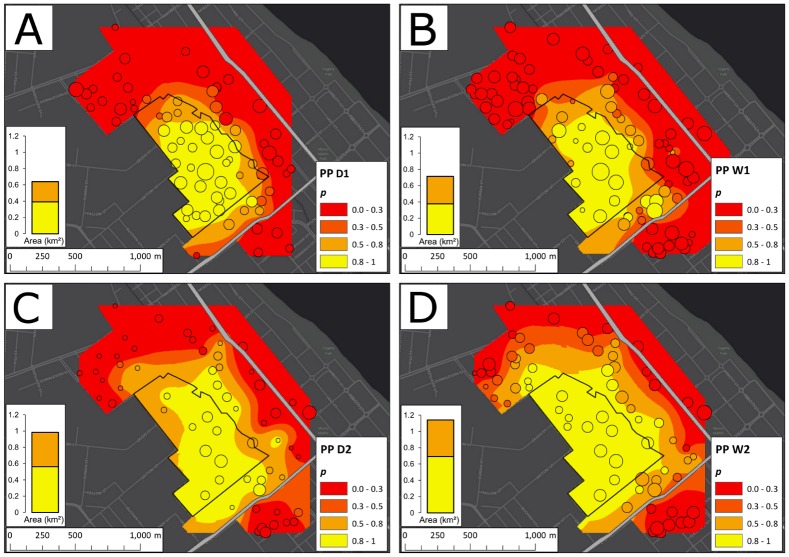
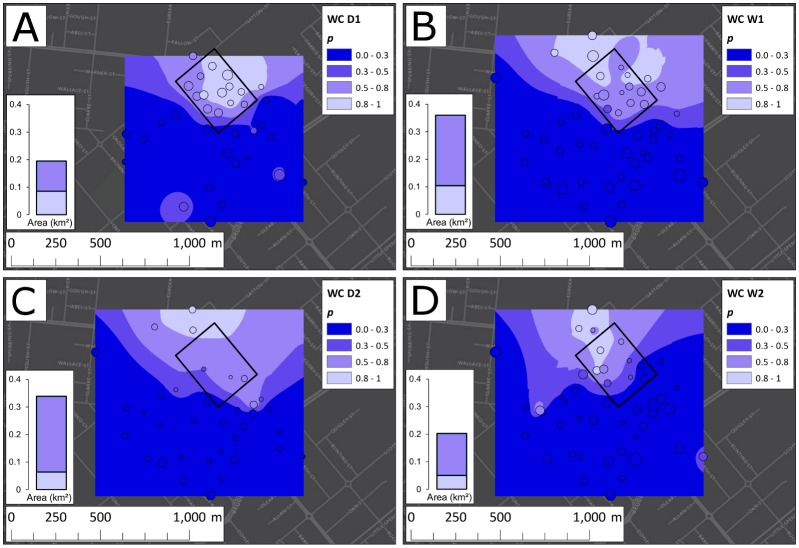
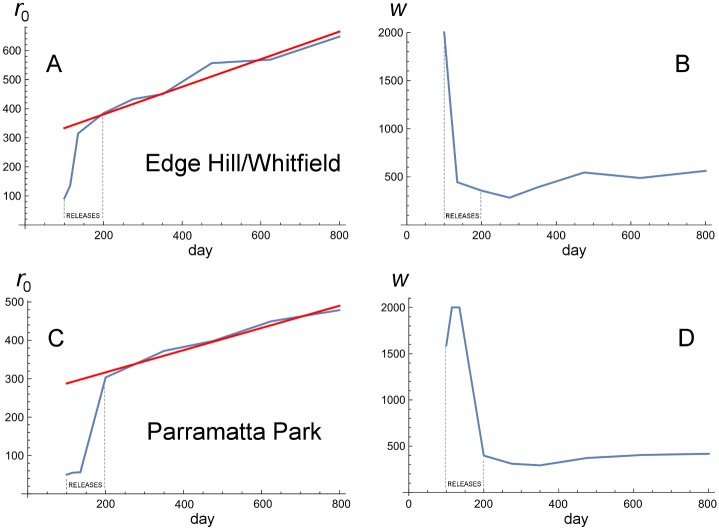
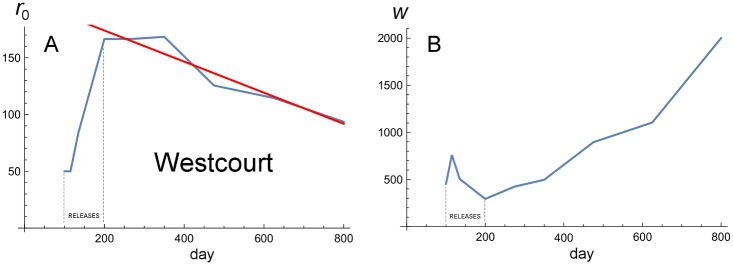
Dengue-suppressing Wolbachia strains are promising tools for arbovirus control, particularly as they have the potential to self-spread following local introductions. To test this, we followed the frequency of the transinfected Wolbachia strain wMel through Ae. aegypti in Cairns, Australia, following releases at 3 nonisolated locations within the city in early 2013. Spatial spread was analysed graphically using interpolation and by fitting a statistical model describing the position and width of the wave. For the larger 2 of the 3 releases (covering 0.97 km2 and 0.52 km2), we observed slow but steady spatial spread, at about 100-200 m per year, roughly consistent with theoretical predictions. In contrast, the smallest release (0.11 km2) produced erratic temporal and spatial dynamics, with little evidence of spread after 2 years. This is consistent with the prediction concerning fitness-decreasing Wolbachia transinfections that a minimum release area is needed to achieve stable local establishment and spread in continuous habitats. Our graphical and likelihood analyses produced broadly consistent estimates of wave speed and wave width. Spread at all sites was spatially heterogeneous, suggesting that environmental heterogeneity will affect large-scale Wolbachia transformations of urban mosquito populations. The persistence and spread of Wolbachia in release areas meeting minimum area requirements indicates the promise of successful large-scale population transformation.
抑制登革热的沃尔巴克氏体菌株是控制虫媒病毒的有前景的工具,特别是因为它们在局部引入后有可能自我传播。为了对此进行测试,我们追踪了2013年初在澳大利亚凯恩斯市3个非隔离地点释放的经转染的沃尔巴克氏体菌株wMel在埃及伊蚊中的频率。使用插值法并通过拟合描述波的位置和宽度的统计模型对空间传播进行了图形分析。对于3次释放中较大的2次(覆盖面积分别为0.97平方公里和0.52平方公里),我们观察到空间传播缓慢但稳定,每年约100 - 200米,大致与理论预测一致。相比之下,最小的释放区域(0.11平方公里)产生了不稳定的时间和空间动态,2年后几乎没有传播的迹象。这与关于降低适应性的沃尔巴克氏体转染的预测一致,即在连续栖息地中需要最小的释放面积才能实现稳定的本地定殖和传播。我们的图形分析和似然分析对波速和波宽得出了大致一致的估计。所有地点的传播在空间上都是异质的,这表明环境异质性将影响城市蚊虫种群的大规模沃尔巴克氏体转化。沃尔巴克氏体在满足最小面积要求的释放区域中的持续存在和传播表明了成功进行大规模种群转化的前景。