Puthenveetil Sujiet, He Haiyin, Loganzo Frank, Musto Sylvia, Teske Jesse, Green Michael, Tan Xingzhi, Hosselet Christine, Lucas Judy, Tumey L Nathan, Sapra Puja, Subramanyam Chakrapani, O'Donnell Christopher J, Graziani Edmund I
Worldwide Medicinal Chemistry, Pfizer Global R&D, Groton, Connecticut, United States of America.
Pfizer Oncology Research, Pearl River, NY, United States of America.
PLoS One. 2017 May 30;12(5):e0178452. doi: 10.1371/journal.pone.0178452. eCollection 2017.
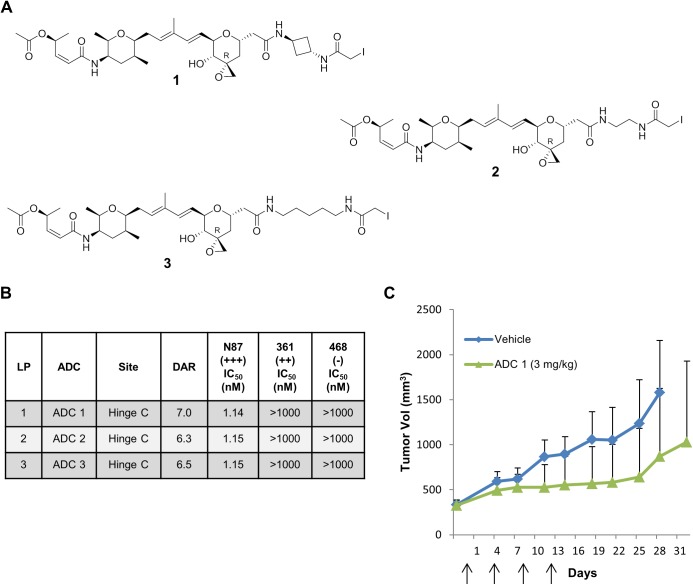
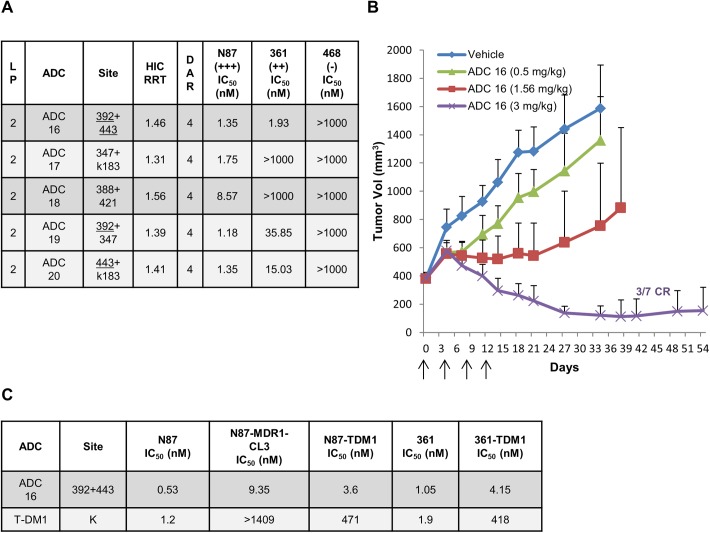
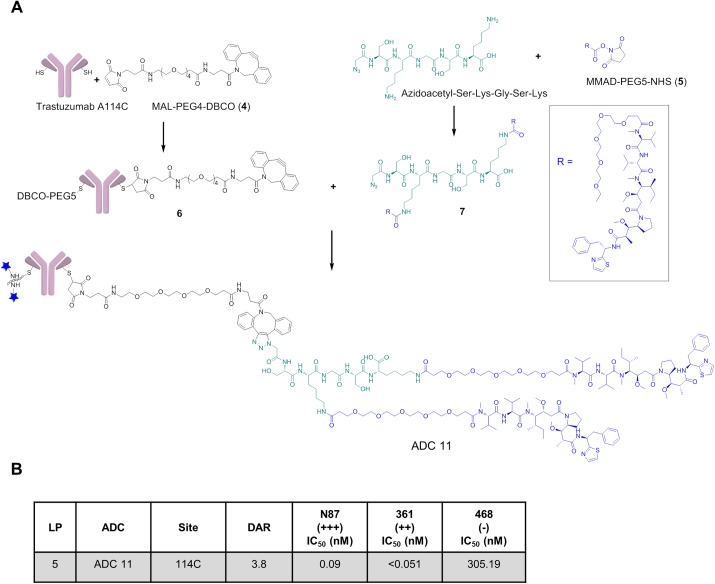
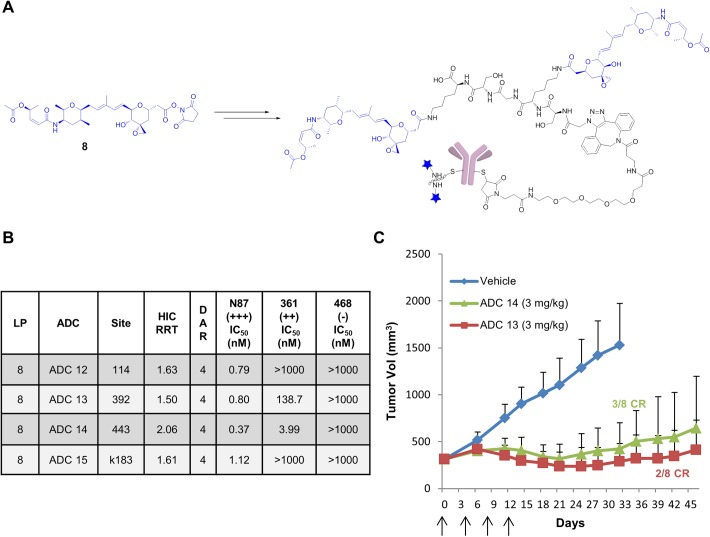
Antibody drug conjugates (ADCs) are no longer an unknown entity in the field of cancer therapy with the success of marketed ADCs like ADCETRIS and KADCYLA and numerous others advancing through clinical trials. The pursuit of novel cytotoxic payloads beyond the mictotubule inhibitors and DNA damaging agents has led us to the recent discovery of an mRNA splicing inhibitor, thailanstatin, as a potent ADC payload. In our previous work, we observed that the potency of this payload was uniquely tied to the method of conjugation, with lysine conjugates showing much superior potency as compared to cysteine conjugates. However, the ADC field is rapidly shifting towards site-specific ADCs due to their advantages in manufacturability, characterization and safety. In this work we report the identification of a highly efficacious site-specific thailanstatin ADC. The site of conjugation played a critical role on both the in vitro and in vivo potency of these ADCs. During the course of this study, we developed a novel methodology of loading a single site with multiple payloads using an in situ generated multi-drug carrying peptidic linker that allowed us to rapidly screen for optimal conjugation sites. Using this methodology, we were able to identify a double-cysteine mutant ADC delivering four-loaded thailanstatin that was very efficacious in a gastric cancer xenograft model at 3mg/kg and was also shown to be efficacious against T-DM1 resistant and MDR1 overexpressing tumor cell lines.
随着诸如ADCETRIS和KADCYLA等已上市抗体药物偶联物(ADC)的成功以及众多其他药物进入临床试验阶段,ADC在癌症治疗领域已不再是一个陌生的概念。对除微管抑制剂和DNA损伤剂之外的新型细胞毒性载荷的探索,使我们最近发现了一种mRNA剪接抑制剂——泰国他汀,它是一种有效的ADC载荷。在我们之前的工作中,我们观察到这种载荷的效力与偶联方法密切相关,赖氨酸偶联物的效力比半胱氨酸偶联物高得多。然而,由于其在可制造性、表征和安全性方面的优势,ADC领域正在迅速转向位点特异性ADC。在这项工作中,我们报告了一种高效位点特异性泰国他汀ADC的鉴定。偶联位点对这些ADC的体外和体内效力都起着关键作用。在这项研究过程中,我们开发了一种新颖的方法,即使用原位生成的多药携带肽接头在单个位点加载多个载荷,这使我们能够快速筛选出最佳偶联位点。使用这种方法,我们能够鉴定出一种双半胱氨酸突变体ADC,它能递送四聚体泰国他汀,在3mg/kg的剂量下对胃癌异种移植模型非常有效,并且还显示出对T-DM1耐药和MDR1过表达的肿瘤细胞系有效。