Wu Sarah S, Chen Lang, Battista Christian, Smith Watts Ashley K, Willcutt Erik G, Menon Vinod
Department of Psychology and Neuroscience, University of Colorado at Boulder, United States.
Department of Psychiatry and Behavioral Sciences, Symbolic Systems Program, Program in Neuroscience, Stanford University, United States; Department of Neurology and Neurological Sciences, School of Medicine, Stanford University, United States.
Cognition. 2017 Sep;166:118-129. doi: 10.1016/j.cognition.2017.05.016. Epub 2017 May 27.
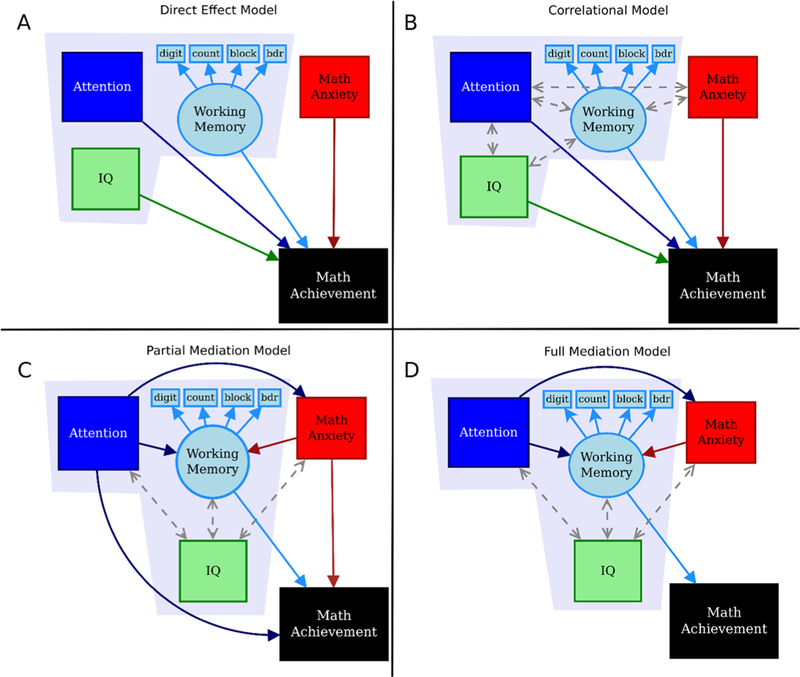
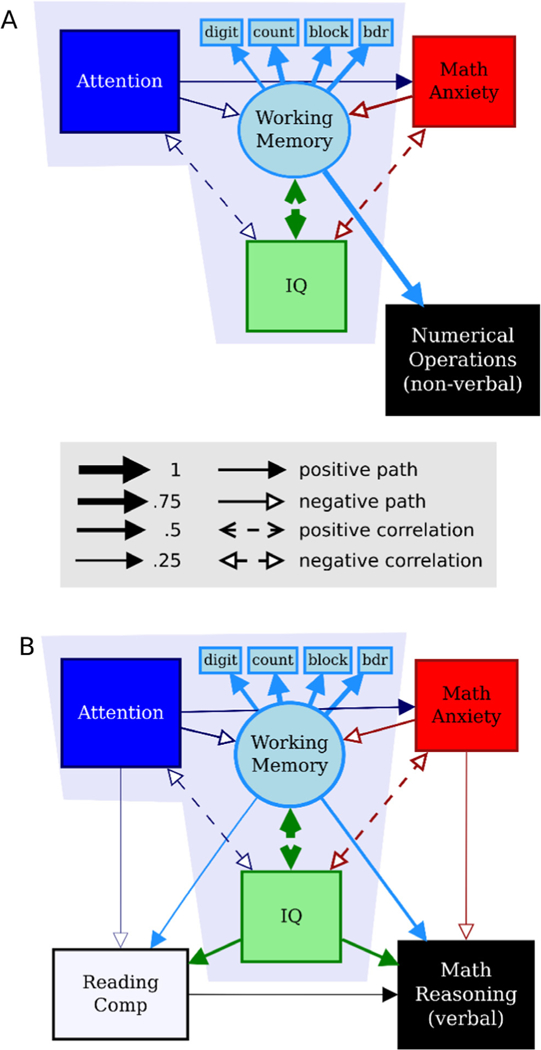
Individual differences in children's math performance have been associated with math anxiety, attention problems, working memory (WM), and reading skills, but the mechanisms by which these factors jointly contribute to children's math achievement are unknown. Here, we use structural equation modeling to characterize the relation between these factors and their influence on non-verbal Numerical Operations (NO) and verbal Math Reasoning (MR) in 330 children (M=8.34years). Our findings indicate that WM plays a central role in both non-verbal NO and verbal MR, whereas math anxiety and reading comprehension have unique and more pronounced influences on MR, compared to NO. Our study elucidates how affective and cognitive factors distinctly influence non-verbal and verbal mathematical problem solving.
儿童数学成绩的个体差异与数学焦虑、注意力问题、工作记忆(WM)和阅读技能有关,但这些因素共同影响儿童数学成绩的机制尚不清楚。在此,我们使用结构方程模型来描述这些因素之间的关系,以及它们对330名儿童(平均年龄8.34岁)的非言语数字运算(NO)和言语数学推理(MR)的影响。我们的研究结果表明,工作记忆在非言语数字运算和言语数学推理中都起着核心作用,而与数字运算相比,数学焦虑和阅读理解对数学推理有独特且更显著的影响。我们的研究阐明了情感和认知因素如何分别影响非言语和言语数学问题的解决。