Audigé Annette, Rochat Mary-Aude, Li Duo, Ivic Sandra, Fahrny Audrey, Muller Christina K S, Gers-Huber Gustavo, Myburgh Renier, Bredl Simon, Schlaepfer Erika, Scherrer Alexandra U, Kuster Stefan P, Speck Roberto F
Division of Infectious Diseases and Hospital Epidemiology, University Hospital of Zurich, University of Zurich, Raemistrasse 100, 8091, Zurich, Switzerland.
Institute of Medical Virology, University of Zurich, Zurich, Switzerland.
BMC Immunol. 2017 May 30;18(1):28. doi: 10.1186/s12865-017-0209-9.
Humanized mice (hu mice) are based on the transplantation of hematopoietic stem and progenitor cells into immunodeficient mice and have become important pre-clinical models for biomedical research. However, data about their hematopoiesis over time are scarce. We therefore characterized leukocyte reconstitution in NSG mice, which were sublethally irradiated and transplanted with human cord blood-derived CD34+ cells at newborn age, longitudinally in peripheral blood and, for more detailed analyses, cross-sectionally in peripheral blood, spleen and bone marrow at different time points.
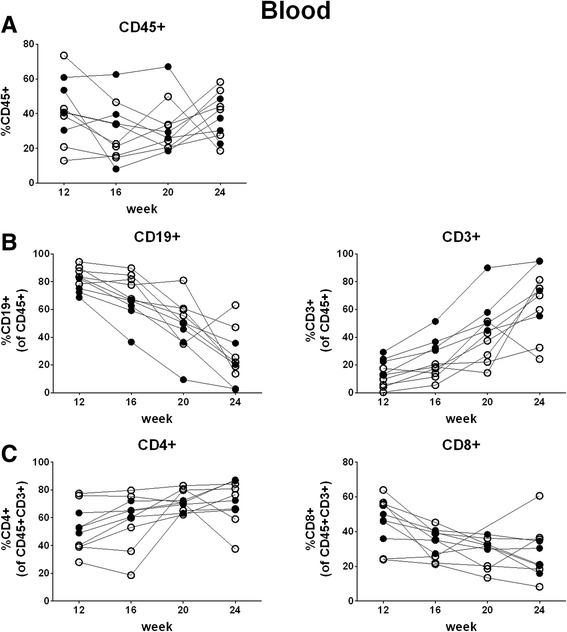
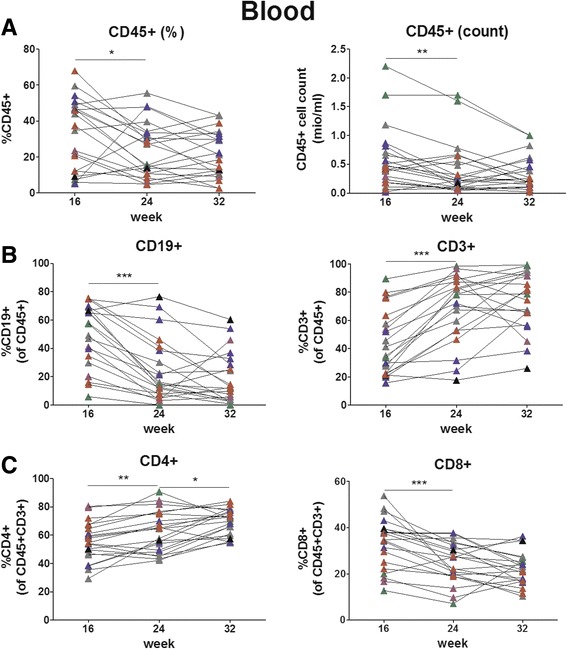
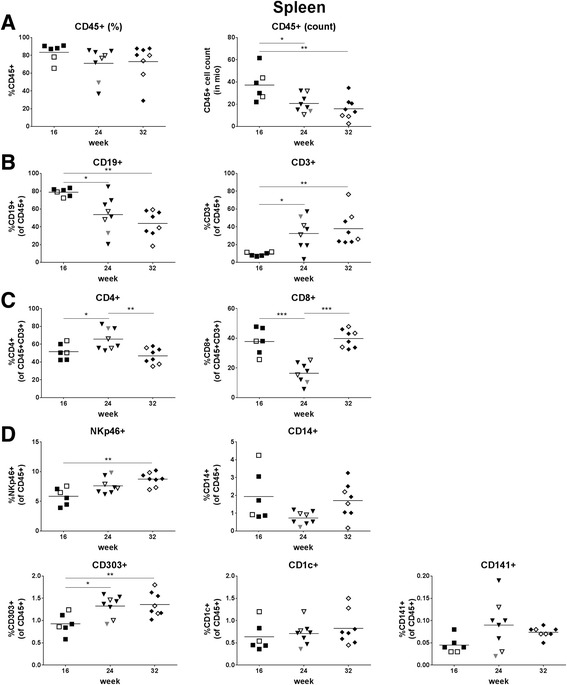
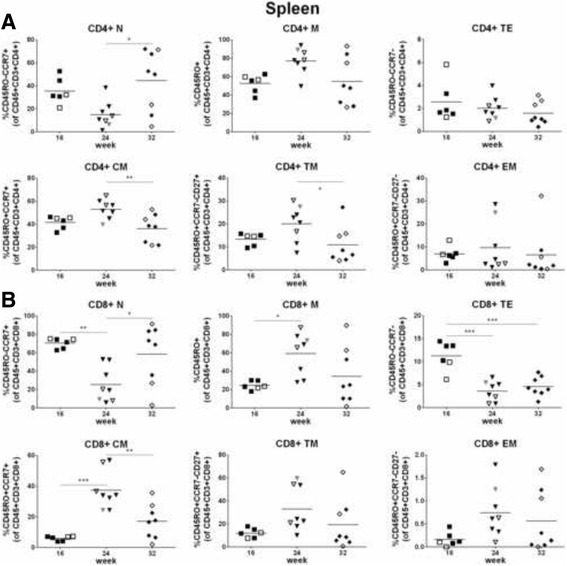
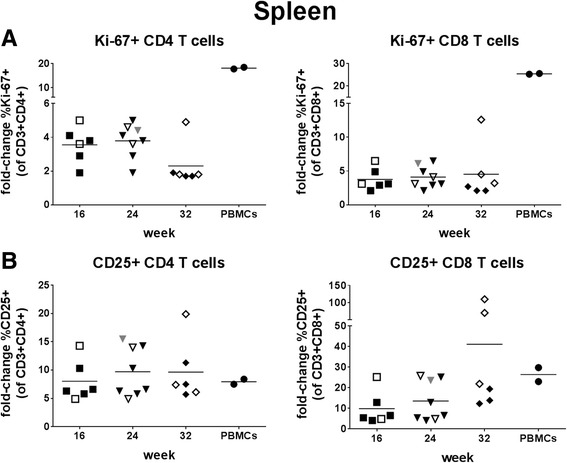
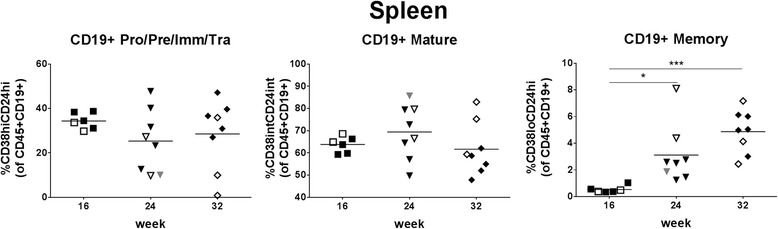
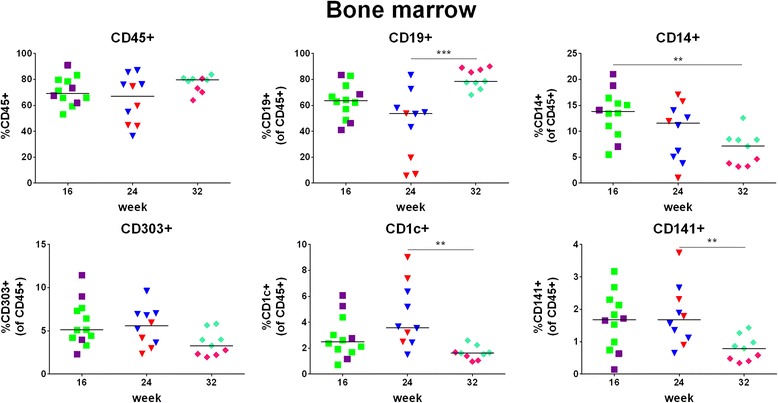
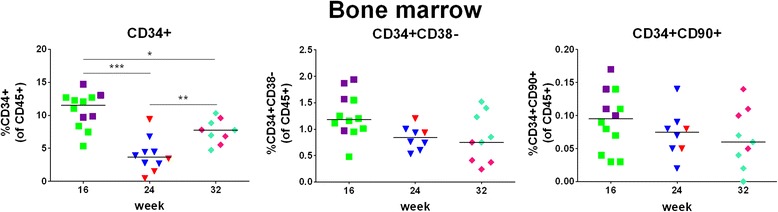
Human cell chimerism and absolute human cell count decreased between week 16 and 24 in the peripheral blood of hu mice, but were stable thereafter as assessed up to 32 weeks. Human cell chimerism in spleen and bone marrow was maintained over time. Notably, human cell chimerism in peripheral blood and spleen as well as bone marrow positively correlated with each other. Percentage of B cells decreased between week 16 and 24, whereas percentage of T cells increased; subsequently, they levelled off with T cells clearly predominating at week 32. Natural killer cells, monocytes and plasmacytoid dendritic cells (DCs) as well as CD1c + and CD141+ myeloid DCs were all present in hu mice. Proliferative responses of splenic T cells to stimulation were preserved over time. Importantly, the percentage of more primitive hematopoietic stem cells (HSCs) in bone marrow was maintained over time.
Overall, leukocyte reconstitution was maintained up to 32 weeks post-transplantation in our hu NSG model, possibly explained by the maintenance of HSCs in the bone marrow. Notably, we observed great variation in multi-lineage hematopoietic reconstitution in hu mice that needs to be taken into account for the experimental design with hu mice.
人源化小鼠(hu小鼠)基于将造血干细胞和祖细胞移植到免疫缺陷小鼠体内,已成为生物医学研究重要的临床前模型。然而,关于其造血功能随时间变化的数据却很匮乏。因此,我们对新生时经亚致死剂量照射并移植人脐带血来源的CD34 + 细胞的NSG小鼠的白细胞重建进行了特征分析,在外周血中进行纵向分析,为进行更详细的分析,在不同时间点对外周血、脾脏和骨髓进行横断面分析。
hu小鼠外周血中的人细胞嵌合率和人细胞绝对计数在第16周和第24周之间下降,但此后直至32周评估时保持稳定。脾脏和骨髓中的人细胞嵌合率随时间维持。值得注意的是,外周血、脾脏和骨髓中的人细胞嵌合率彼此呈正相关。B细胞百分比在第16周和第24周之间下降,而T细胞百分比增加;随后,它们趋于平稳,在第32周时T细胞明显占主导。自然杀伤细胞、单核细胞和浆细胞样树突状细胞(DCs)以及CD1c + 和CD141 + 髓样DCs在hu小鼠中均有存在。脾T细胞对刺激的增殖反应随时间得以保留。重要的是,骨髓中更原始的造血干细胞(HSCs)百分比随时间维持。
总体而言,在我们的hu NSG模型中,移植后长达32周白细胞重建得以维持,这可能是由于骨髓中造血干细胞的维持。值得注意的是,我们观察到hu小鼠多谱系造血重建存在很大差异,在设计涉及hu小鼠的实验时需要考虑这一点。