Shiba Koichiro, Kondo Naoki, Kondo Katsunori, Kawachi Ichiro
Departments of Health and Social Behavior/Health Education and Health Sociology, School of Public Health, The University of Tokyo, 7-3-1 Hongo, Bunkyo-ku, Tokyo, 113-0033, Japan.
Center for Preventive Medical Sciences, Chiba University, 1-8-1, Inohana, Chuo-ku, Chiba, 260-8670, Japan.
BMC Public Health. 2017 May 30;17(1):526. doi: 10.1186/s12889-017-4427-0.
Empirical evidence investigating heterogeneous impact of retirement on mental health depending on social backgrounds is lacking, especially among older adults.
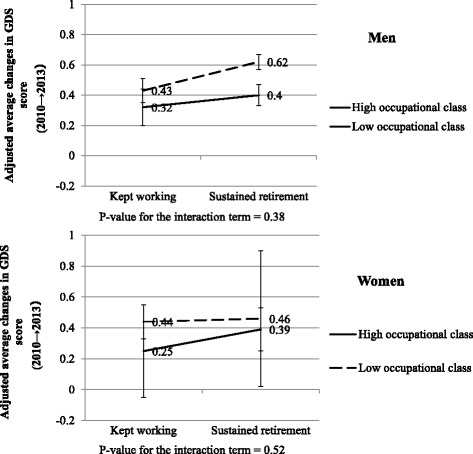
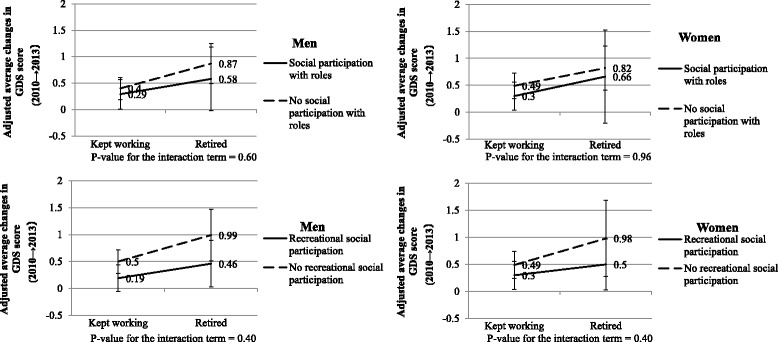
We examined the impact of changes in working status on changes in mental health using Japanese community-dwelling adults aged ≥65 years participating in the Japan Gerontological Evaluation Study between 2010 and 2013 (N = 62,438). Between-waves changes in working status ("Kept working", "Retired", "Started work", or "Continuously retired") were used to predict changes in depressive symptoms measured by the Geriatric Depression Scale. First-difference regression models were stratified by gender, controlling for changes in time-varying confounding actors including equivalised household income, marital status, instrumental activities of daily living, incidence of serious illnesses and family caregiving. We then examined the interactions between changes in working status and occupational class, changes in marital status, and post-retirement social participation.
Participants who transitioned to retirement reported significantly increased depressive symptoms (β = 0.33, 95% CI: 0.21-0.45 for men, and β = 0.29, 95% CI: 0.13-0.45 for women) compared to those who kept working. Men who were continuously retired reported increased depressive symptoms (β = 0.13, 95% CI: 0.05-0.20), whereas males who started work reported decreased depressive symptoms (β = -0.20, 95% CI: -0.38--0.02). Men from lower occupational class (compared to men from higher class) reported more increase in depressive symptoms when continuously retired (β = -0.16, 95% CI: -0.25--0.08). Those reporting recreational social participation after retirement appeared to be less influenced by transition to retirement.
Retirement may increase depressive symptoms among Japanese older adults, particularly men from lower occupational class backgrounds. Encouraging recreational social participation may mitigate the adverse effects of retirement on mental health of Japanese older men.
缺乏关于退休对心理健康的异质性影响(取决于社会背景)的实证证据,尤其是在老年人中。
我们使用2010年至2013年参与日本老年学评估研究的65岁及以上日本社区居住成年人(N = 62438),研究工作状态变化对心理健康变化的影响。工作状态的波间变化(“继续工作”、“退休”、“开始工作”或“持续退休”)用于预测由老年抑郁量表测量的抑郁症状变化。一阶差分回归模型按性别分层,控制随时间变化的混杂因素的变化,包括等效家庭收入、婚姻状况、日常生活活动能力、严重疾病发生率和家庭护理情况。然后,我们研究了工作状态变化与职业阶层、婚姻状况变化以及退休后社会参与之间的相互作用。
与继续工作的参与者相比,退休的参与者报告抑郁症状显著增加(男性β = 0.33,95%CI:0.21 - 0.45;女性β = 0.29,95%CI:0.13 - 0.45)。持续退休的男性报告抑郁症状增加(β = 0.13,95%CI:0.05 - 0.20),而开始工作的男性报告抑郁症状减少(β = -0.20,95%CI:-0.38 - -0.02)。来自较低职业阶层的男性(与来自较高阶层的男性相比)在持续退休时报告抑郁症状增加更多(β = -0.16,95%CI:-0.25 - -0.08)。那些退休后报告有娱乐性社会参与的人似乎受退休转变的影响较小。
退休可能会增加日本老年人的抑郁症状,尤其是来自较低职业阶层背景的男性。鼓励娱乐性社会参与可能会减轻退休对日本老年男性心理健康的不利影响。