Yong Roseline Kim Fong, Inoue Akiomi, Kawakami Norito
Department of Public Health, Graduate School of Medicine, Akita University, Akita, Japan.
Department of Mental Health, Graduate School of Medicine, The University of Tokyo, Tokyo, Japan.
BMC Psychiatry. 2017 May 30;17(1):201. doi: 10.1186/s12888-017-1364-5.
Prolonged Internet use is often associated with reduced social involvement and comorbid psychopathologies, including depression, anxiety, attention-deficit/hyperactivity disorder, and obsessive-compulsive disorder. Asian countries where Internet access is widely available have high reported levels of Internet addiction. As Internet use has changed drastically since concerns about Internet addiction were first raised, the results of recent studies may be inaccurate because the scales they employed to measure Internet addiction were formulated for different Internet usage from the present. It is thus necessary to develop more-up-to-date scales to assess problematic private use of the Internet.
The Compulsive Internet Use Scale (CIUS) was translated into Japanese. An online sample whose ages and sexes reflected that of the national population of Internet users was recruited to test the scale's reliability and validity. Correlations between the scale and Internet-related parameters (such as time spent online, motivation for going online, and applications used) and psychosocial factors (such as psychological distress symptoms and loneliness) were examined. Psychometric properties were examined by the split-half method using both exploratory and confirmatory factor analysis. Model fits were compared across gender.
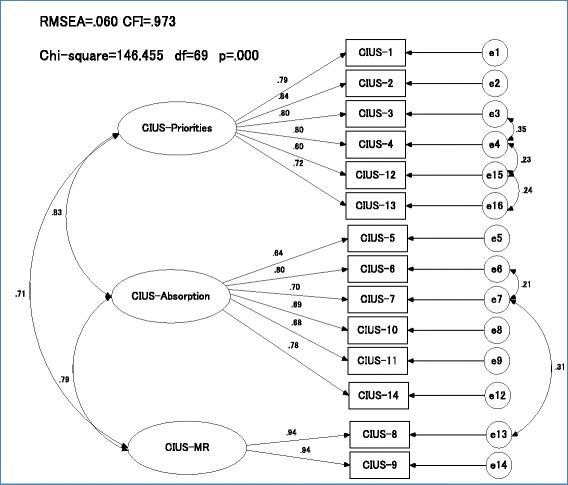
CIUS was found to have a high reliability and good concurrent, correlation and construct validity. Both exploratory and confirmatory factors revealed that the one-factor solution yielded a satisfactory result across gender. However, the three-factor structural model in which compulsiveness was gauged by "excessive absorption", "difficulty in setting priorities", and "mood regulation" gave the best fit of the model for the general population as well as across gender.
Compulsive Internet behavior in Japan can be assessed in terms of absorption, priorities, and mood. CIUS is a valid scale for screening compulsive Internet behavior in the general Japanese population regardless of age and gender.
长时间使用互联网通常与社交参与度降低以及共病心理病理学有关,包括抑郁症、焦虑症、注意力缺陷多动障碍和强迫症。在互联网接入广泛普及的亚洲国家,报告的网络成瘾水平较高。自从首次提出对网络成瘾的担忧以来,互联网使用情况发生了巨大变化,近期研究的结果可能不准确,因为它们用于衡量网络成瘾的量表是针对与当前不同的互联网使用情况制定的。因此,有必要开发更新的量表来评估有问题的个人互联网使用情况。
将强迫性互联网使用量表(CIUS)翻译成日语。招募了一个年龄和性别反映日本互联网用户全国人口情况的在线样本,以测试该量表的信度和效度。研究了该量表与互联网相关参数(如上网时间、上网动机和使用的应用程序)以及心理社会因素(如心理困扰症状和孤独感)之间的相关性。通过探索性和验证性因素分析的折半法检验心理测量学特性。比较了不同性别的模型拟合情况。
发现CIUS具有较高的信度和良好的同时效度、相关性和结构效度。探索性和验证性因素分析均表明,单因素解决方案在不同性别中均产生了令人满意的结果。然而,以“过度沉迷”、“难以设定优先级”和“情绪调节”来衡量强迫性的三因素结构模型对一般人群以及不同性别而言,模型拟合度最佳。
日本的强迫性互联网行为可以从沉迷程度、优先级和情绪方面进行评估。CIUS是一种有效的量表,可用于筛查日本普通人群中无论年龄和性别的强迫性互联网行为。