Grimes Carley A, Kelley Sarah-Jane, Stanley Sonya, Bolam Bruce, Webster Jacqui, Khokhar Durreajam, Nowson Caryl A
Deakin University, Geelong, Australia, Institute for Physical Activity and Nutrition Research, Locked Bag 20000, Waurn Ponds, Geelong, VIC, 3220, Australia.
The Victorian Health Promotion Foundation, VicHealth, 15-31 Pelham St, Carlton, VIC, 3053, Australia.
BMC Public Health. 2017 May 30;17(1):532. doi: 10.1186/s12889-017-4451-0.
Information on consumer's knowledge, attitudes and behaviours (KABs) related to salt can be used to inform awareness and education campaigns and serve as a baseline measure to monitor changes in KABs over time. The aim of this study was to determine KABs related to salt intake among Victorian adults.
Cross-sectional survey conducted in Victorian adults aged 18-65 years. Participants were recruited from shopping centres located in Melbourne and Geelong and via online methods (Facebook and Consumer Research Panel) to complete an online survey assessing KABs related to dietary salt. Descriptive statistics (mean (SD) or n (%)) were used to report survey findings.
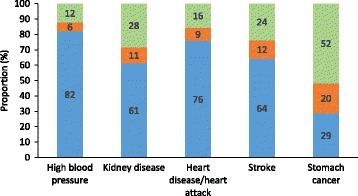
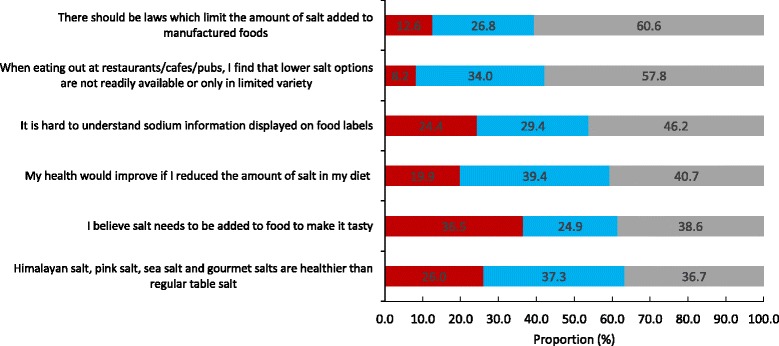
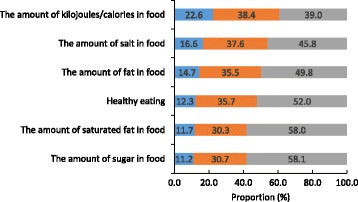
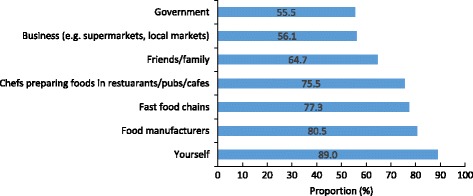
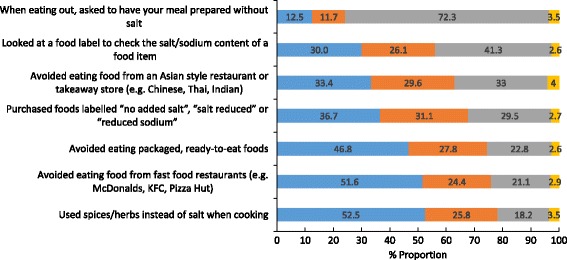
A total of 2398 participants provided a valid survey (mean age 43 years (SD 13), 57% female). The majority (80%) were born in Australia and 63% were the main household grocery shopper. The majority (89%) were aware of the health risks associated with a high salt intake. Eighty three percent believed that Australians eat too much salt. Three quarters (75%) correctly identified salt from processed foods as being the main source of salt in the diet. Less than a third (29%) of participants believed their own individual salt intake exceeded dietary recommendations and only 28% could correctly identify the maximum recommended daily intake for salt. Just under half (46%) of participants were concerned about the amount of salt in food. Almost two thirds (61%) of participants believed that there should be laws which limit the amount of salt added to manufactured foods and 58% agreed that it was difficult to find lower salt options when eating out.
The findings of this study serve as a baseline assessment of KABs related to salt intake in Victorian adults and can be used to assess changes in salt related KABs over time. Public concern about salt is low as many people remain unaware of their own salt intake. An increased awareness of the excessive amount of salt consumed and increased availability of lower salt foods are likely to reduce population salt intake.
有关消费者与盐相关的知识、态度和行为(KABs)的信息可用于为提高认识和开展教育活动提供参考,并作为监测KABs随时间变化的基线指标。本研究的目的是确定维多利亚州成年人与盐摄入量相关的KABs。
对18至65岁的维多利亚州成年人进行横断面调查。参与者通过位于墨尔本和吉朗的购物中心以及在线方式(脸书和消费者研究小组)招募,以完成一项评估与膳食盐相关的KABs的在线调查。描述性统计(均值(标准差)或n(%))用于报告调查结果。
共有2398名参与者提供了有效调查(平均年龄43岁(标准差13),57%为女性)。大多数(80%)出生在澳大利亚,63%是家庭主要食品杂货购买者。大多数(89%)意识到高盐摄入相关的健康风险。83%的人认为澳大利亚人盐摄入量过多。四分之三(75%)的人正确识别出加工食品中的盐是饮食中盐的主要来源。不到三分之一(29%)的参与者认为自己的个人盐摄入量超过了膳食建议量,只有28%的人能正确识别盐的每日最大推荐摄入量。略低于一半(46%)的参与者关注食物中的盐含量。近三分之二(61%)的参与者认为应该有法律限制加工食品中添加的盐量,58%的人同意外出就餐时很难找到低盐选择。
本研究结果作为对维多利亚州成年人与盐摄入量相关的KABs的基线评估,可用于评估盐相关KABs随时间的变化。公众对盐的关注度较低,因为许多人仍未意识到自己的盐摄入量。提高对过量盐摄入的认识以及增加低盐食品的供应可能会降低人群盐摄入量。