Department of Hematology and Cell Therapy, Hôpital Saint-Antoine, 184 Rue du Faubourg Saint Antoine, 75012, Paris, France.
Department of Medicine, Division of Hematology and Clinical Immunology, University of Perugia, Perugia, Italy.
J Hematol Oncol. 2017 May 30;10(1):113. doi: 10.1186/s13045-017-0480-5.
Allogenic hematopoietic stem cell transplantation (allo-SCT) is the most effective post-remission treatment for adults with high-risk acute lymphoblastic leukemia (ALL). The aim of the study was to analyze results of unmanipulated haploidentical allo-SCT (haplo-SCT) for adults with ALL and to identify prognostic factors.
We performed a retrospective analysis on 208 adults transplanted in EBMT centers from 2007 to 2014.
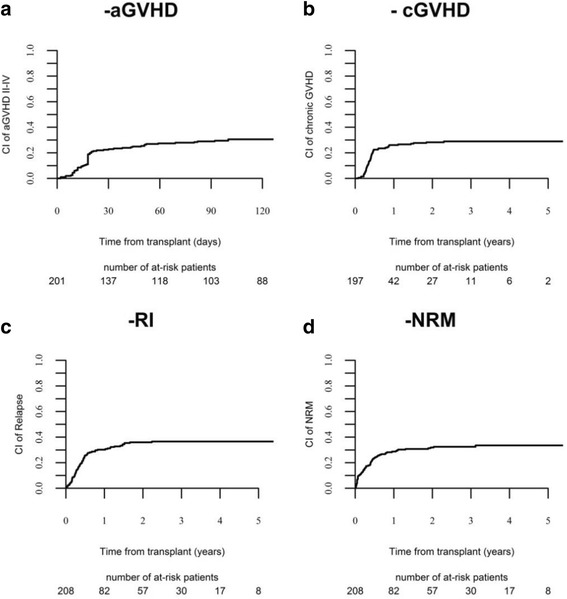
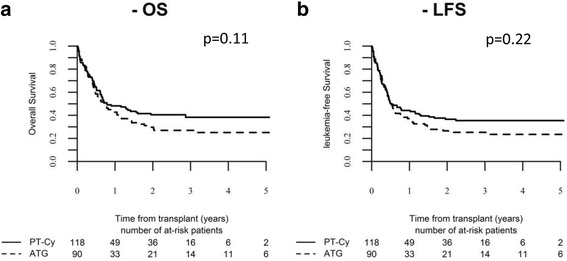
Median age at haplo-SCT was 32 years and median follow-up, 31 months. Forty-four percent of the patients were in first complete remission (CR1). Stem cell source was the bone marrow (BM) for 43% and peripheral blood (PB) for 57% of patients. Myeloablative conditioning (MAC) was used for 66% and reduced intensity regimen (RIC) for 34% of patients. GVHD prophylaxis was based on post-transplant cyclophosphamide (PT-Cy) for 118 (57%) or on anti-thymocyte-globulin (ATG) for 90 (43%) plus standard prophylaxis. One hundred eighty-four (92%) patients achieved engraftment. Cumulative incidence (CI) of grade II-IV acute-graft-versus-host-disease (GVHD) was 31%, grade III-IV 11%, and chronic GVHD 29%. Non-relapse mortality (NRM) and relapse-incidence (RI) were 32 and 37%, respectively. Overall survival (OS), leukemia-free survival (LFS), and GVHD-free, relapse-free-survival (GRFS) at 3 years were 33, 31, and 26%. For patients in CR1, OS, LFS, and GRFS were 52, 47, and 40%, respectively. Disease status was the main factor associated with transplant outcomes. Use of BM was independently associated with improvement in NRM, acute GVHD, GRFS, LFS, and OS.
Unmanipulated haplo-SCT may be considered a valid option for adult patients with high-risk ALL lacking HLA identical donor preferably in early disease status.
异基因造血干细胞移植(allo-SCT)是高危成人急性淋巴细胞白血病(ALL)缓解后最有效的治疗方法。本研究旨在分析未处理的单倍体相合 allo-SCT(haplo-SCT)治疗成人 ALL 的结果,并确定预后因素。
我们对 2007 年至 2014 年在 EBMT 中心接受移植的 208 例成人进行了回顾性分析。
haplo-SCT 时的中位年龄为 32 岁,中位随访时间为 31 个月。44%的患者处于首次完全缓解(CR1)。干细胞来源为骨髓(BM)的占 43%,外周血(PB)的占 57%。66%的患者采用清髓性预处理(MAC),34%的患者采用强度降低的预处理(RIC)。GVHD 预防方案基于移植后环磷酰胺(PT-Cy)的有 118 例(57%),基于抗胸腺细胞球蛋白(ATG)加标准预防的有 90 例(43%)。184 例(92%)患者获得了植入。Ⅱ-Ⅳ级急性移植物抗宿主病(GVHD)累积发生率(CI)为 31%,Ⅲ-Ⅳ级为 11%,慢性 GVHD 为 29%。非复发死亡率(NRM)和复发率(RI)分别为 32%和 37%。3 年时总生存率(OS)、无白血病生存率(LFS)和无 GVHD、无复发生存率(GRFS)分别为 33%、31%和 26%。CR1 患者的 OS、LFS 和 GRFS 分别为 52%、47%和 40%。疾病状态是与移植结果相关的主要因素。使用 BM 与 NRM、急性 GVHD、GRFS、LFS 和 OS 的改善独立相关。
对于缺乏 HLA 完全相合供体的高危 ALL 成人患者,未处理的单倍体相合 SCT 可能是一种可行的选择,尤其是在疾病早期。