Zingg Dana, Steinbach Sandro, Kuhlgatz Christian, Rediger Matthias, Schüpbach-Regula Gertraud, Aepli Matteo, Grøneng Gry M, Dürr Salome
Veterinary Public Health Institute, University of Bern, Bern, Switzerland.
Center of Economic Research, Swiss Federal Institute of Technology in Zurich, Zurich, Switzerland.
Front Vet Sci. 2017 May 16;4:70. doi: 10.3389/fvets.2017.00070. eCollection 2017.
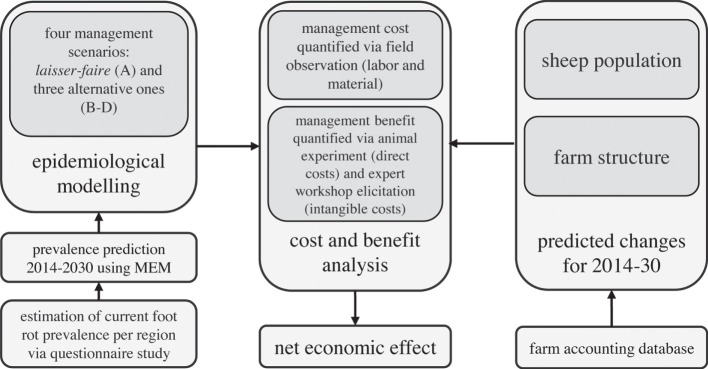
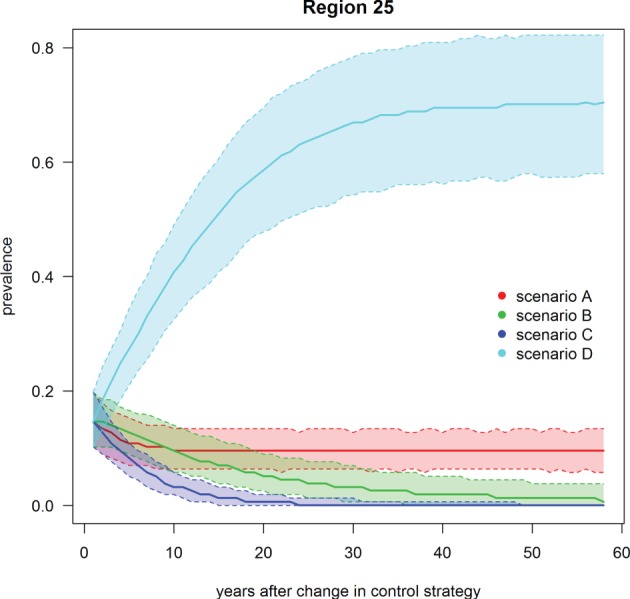
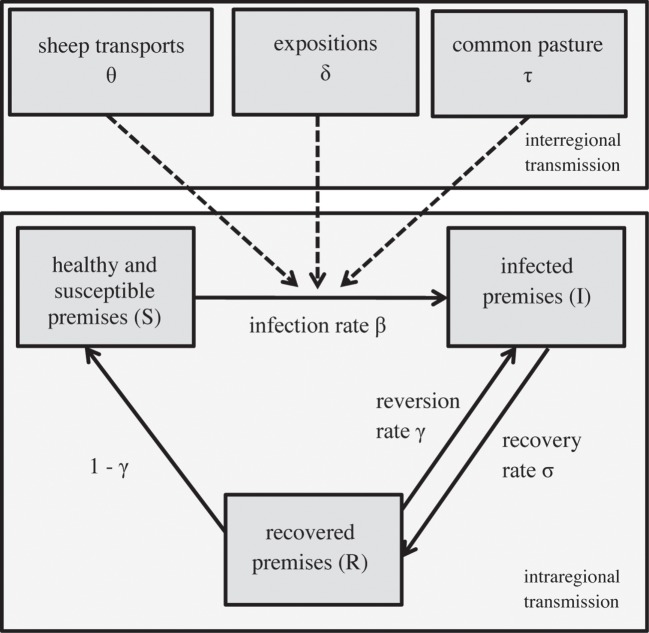
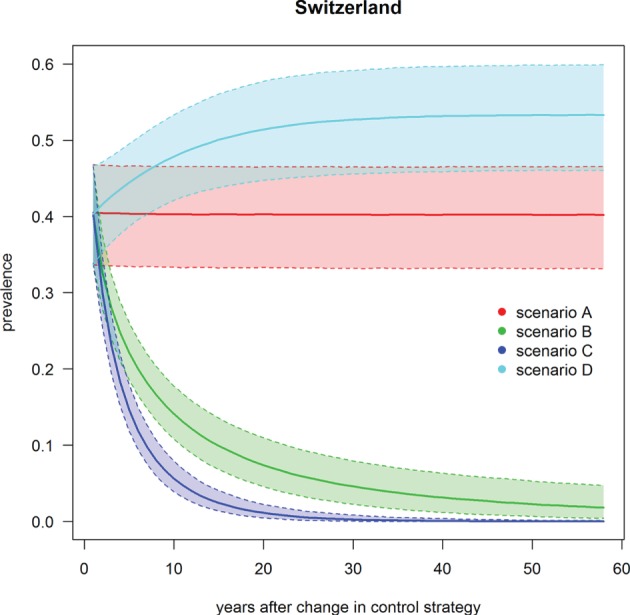
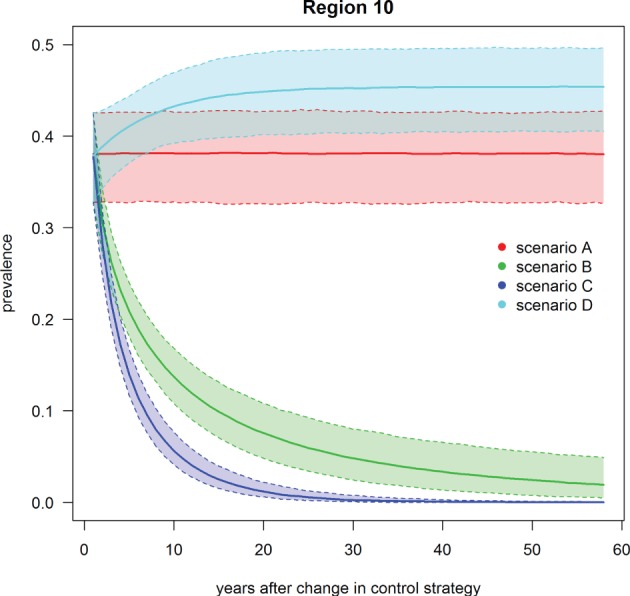
Footrot is a multifactorial infectious disease mostly affecting sheep, caused by the bacteria . It causes painful feet lesions resulting in animal welfare issues, weight loss, and reduced wool production, which leads to a considerable economic burden in animal production. In Switzerland, the disease is endemic and mandatory coordinated control programs exist only in some parts of the country. This study aimed to compare two nationwide control strategies and a no intervention scenario with the current situation, and to quantify their net economic effect. This was done by sequential application of a maximum entropy model (MEM), epidemiological simulation, and calculation of net economic effect using the net present value method. Building upon data from a questionnaire, the MEM revealed a nationwide footrot prevalence of 40.2%. Regional prevalence values were used as inputs for the epidemiological model. Under the application of the nationwide coordinated control program without (scenario B) and with (scenario C) improved diagnostics [polymerase chain reaction (PCR) test], the Swiss-wide prevalence decreased within 10 years to 14 and 5%, respectively. Contrary, an increase to 48% prevalence was observed when terminating the current control strategies (scenario D). Management costs included labor and material costs. Management benefits included reduction of fattening time and improved animal welfare, which is valued by Swiss consumers and therefore reduces societal costs. The net economic effect of the alternative scenarios B and C was positive, the one of scenario D was negative and over a period of 17 years quantified at CHF 422.3, 538.3, and -172.3 million (1 CHF = 1.040 US$), respectively. This implies that a systematic Swiss-wide management program under the application of the PCR diagnostic test is the most recommendable strategy for a cost-effective control of footrot in Switzerland.
腐蹄病是一种多因素传染病,主要影响绵羊,由细菌引起。它会导致足部疼痛性病变,引发动物福利问题、体重减轻和羊毛产量下降,给畜牧业生产带来相当大的经济负担。在瑞士,这种疾病呈地方性流行,只有该国部分地区存在强制性的协调控制计划。本研究旨在将两种全国性控制策略以及一种不干预方案与当前情况进行比较,并量化它们的净经济效应。这是通过依次应用最大熵模型(MEM)、流行病学模拟以及使用净现值法计算净经济效应来完成的。基于问卷调查数据,MEM显示全国腐蹄病患病率为40.2%。区域患病率值被用作流行病学模型的输入。在实施无改进诊断(方案B)和有改进诊断[聚合酶链反应(PCR)检测](方案C)的全国性协调控制计划的情况下,瑞士范围内的患病率在10年内分别降至14%和5%。相反,在终止当前控制策略时(方案D),观察到患病率上升至48%。管理成本包括劳动力和材料成本。管理效益包括育肥时间的减少和动物福利的改善,这受到瑞士消费者的重视,因此降低了社会成本。替代方案B和C的净经济效应为正,方案D的为负,在17年期间分别量化为4.223亿瑞士法郎、5.383亿瑞士法郎和 -1.723亿瑞士法郎(1瑞士法郎 = 1.040美元)。这意味着在瑞士应用PCR诊断检测的系统性全国管理计划是控制腐蹄病最具成本效益的推荐策略。