Feng Chencheng, He Jinyue, Zhang Yang, Lan Minghong, Yang Minghui, Liu Huan, Huang Bo, Pan Yong, Zhou Yue
Department of Orthopaedics, Xinqiao Hospital, The Third Military Medical University, Chongqing 400037, P.R. China.
Int J Mol Med. 2017 Jul;40(1):164-174. doi: 10.3892/ijmm.2017.3005. Epub 2017 May 29.
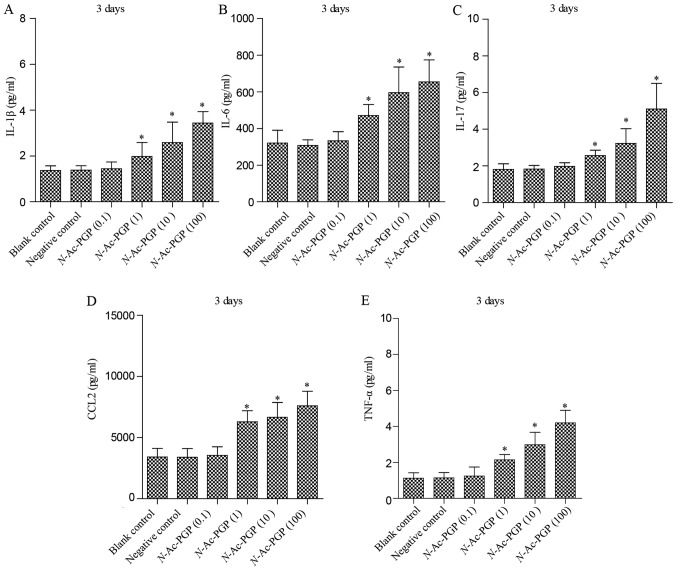
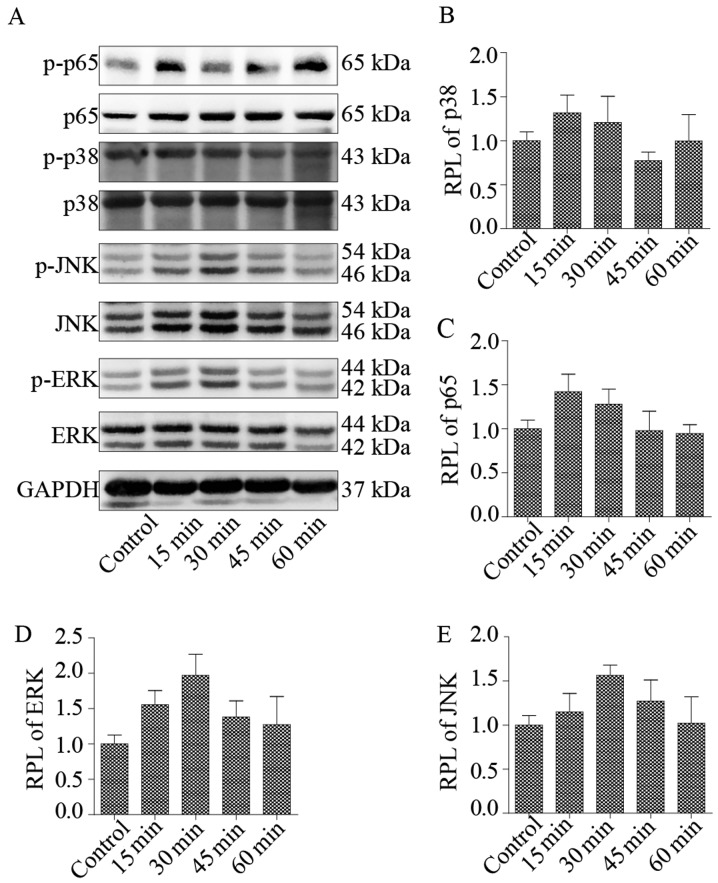
N-acetylated proline-glycine-proline (N-Ac-PGP) is a chemokine involved in inflammatory diseases and is found to accumulate in degenerative discs. N-Ac-PGP has been demonstrated to have a pro-inflammatory effect on human cartilage endplate stem cells. However, the effect of N-Ac-PGP on human intervertebral disc cells, especially nucleus pulposus (NP) cells, remains unknown. The purpose of this study was to investigate the effect of N-Ac-PGP on the expression of pro-inflammatory factors and extracellular matrix (ECM) proteases in NP cells and the molecular mechanism underlying this effect. Therefore, Milliplex assays were used to detect the levels of various inflammatory cytokines in conditioned culture medium of NP cells treated with N-Ac-PGP, including interleukin-1β (IL-1β), IL-6, IL-17, tumor necrosis factor-α (TNF-α) and C-C motif ligand 2 (CCL2). RT-qPCR was also used to determine the expression of pro-inflammatory cytokines and ECM proteases in the NP cells treated with N-Ac-PGP. Moreover, the role of nuclear factor-κB (NF-κB) and mitogen-activated protein kinase (MAPK) signaling pathways in mediating the effect of N-Ac-PGP on the phenotype of NP cells was investigated using specific signaling inhibitors. Milliplex assays showed that NP cells treated with N-Ac-PGP (10 and 100 µg/ml) secreted higher levels of IL-1β, IL-6, IL-17, TNF-α and CCL2 compared with the control. RT-qPCR assays showed that NP cells treated with N-Ac-PGP (100 µg/ml) had markedly upregulated expression of matrix metalloproteinase 3 (MMP3), MMP13, a disintegrin and metalloproteinase with thrombospondin motif 4 (ADAMTS4), ADAMTS5, IL-6, CCL-2, CCL-5 and C-X-C motif chemokine ligand 10 (CXCL10). Moreover, N-Ac-PGP was shown to activate the MAPK and NF-κB signaling pathways in NP cells. MAPK and NF-κB signaling inhibitors suppressed the upregulation of proteases and pro-inflammatory cytokines in NP cells treated with N-Ac-PGP. In conclusion, N-Ac-PGP induces the expression of pro-inflammatory cytokines and matrix catabolic enzymes in NP cells via the NF-κB and MAPK signaling pathways. N-Ac-PGP is a novel therapeutic target for intervertebral disc degeneration.
N-乙酰化脯氨酸-甘氨酸-脯氨酸(N-Ac-PGP)是一种参与炎症性疾病的趋化因子,在退变椎间盘内积聚。已证实N-Ac-PGP对人软骨终板干细胞具有促炎作用。然而,N-Ac-PGP对人椎间盘细胞,尤其是髓核(NP)细胞的作用尚不清楚。本研究旨在探讨N-Ac-PGP对NP细胞中促炎因子和细胞外基质(ECM)蛋白酶表达的影响及其分子机制。因此,采用多重检测法检测用N-Ac-PGP处理的NP细胞条件培养基中多种炎性细胞因子的水平,包括白细胞介素-1β(IL-1β)、IL-6、IL-17、肿瘤坏死因子-α(TNF-α)和C-C基序配体2(CCL2)。还采用逆转录定量聚合酶链反应(RT-qPCR)法测定用N-Ac-PGP处理的NP细胞中促炎细胞因子和ECM蛋白酶的表达。此外,使用特异性信号抑制剂研究核因子-κB(NF-κB)和丝裂原活化蛋白激酶(MAPK)信号通路在介导N-Ac-PGP对NP细胞表型影响中的作用。多重检测法显示,用N-Ac-PGP(10和100μg/ml)处理的NP细胞与对照组相比,分泌的IL-1β、IL-6、IL-17、TNF-α和CCL2水平更高。RT-qPCR检测显示,用N-Ac-PGP(100μg/ml)处理的NP细胞中基质金属蛋白酶3(MMP3)、MMP13、含血小板反应蛋白基序的解聚素和金属蛋白酶4(ADAMTS4)、ADAMTS5、IL-6、CCL-2、CCL-5和C-X-C基序趋化因子配体10(CXCL10)的表达明显上调。此外,N-Ac-PGP可激活NP细胞中的MAPK和NF-κB信号通路。MAPK和NF-κB信号抑制剂可抑制用N-Ac-PGP处理的NP细胞中蛋白酶和促炎细胞因子的上调。总之,N-Ac-PGP通过NF-κB和MAPK信号通路诱导NP细胞中促炎细胞因子和基质分解酶的表达。N-Ac-PGP是椎间盘退变的一个新的治疗靶点。